Quick answer: The best printable birthday games for kids are the ones a host can run without explaining twice: picture bingo, a treasure hunt, a word scramble, and a quiet colouring sheet for the gaps. This guide gives you eight games with rules, a running order for ages 4 to 10, and a printing checklist.
Start with the party, not the games
A game list is not a party plan. Before you print anything, answer three questions, because they decide which games work at all. How many children, and how old? Six four-year-olds and fourteen ten-year-olds are different parties. Younger children need picture games with no reading and no waiting for turns. Older children want competition, points, and something they can win. Mixed ages need at least one game that needs no reading at all, or the younger ones spend the party watching. How much space? A living room party needs sitting-down games: bingo, word games, colouring, guessing games. A garden party can take a treasure hunt and relay games. A party in a hall can take both, but the noise will tell you which ones the neighbours prefer. How long is the games slot? Most parties have 45 to 60 minutes of games between food and cake, broken by eating. Plan four games, not eight, for that slot — and keep the other four as spares. A spare game you never use is a success. A planned game you rush through because the cake is ready is a mess. Print one sheet per child for each game you actually plan to run, plus two spares. Print the answer keys only for yourself, on separate sheets, and keep them in a folder. The number one hosting mistake is printing the answer key on the back of the children's sheet. If you would rather start from a ready set than assemble games yourself, the printables page holds the Birthday Party Bundle, with its games, bingo cards and banner in one design.
Eight games, with rules you can read aloud
These eight cover the whole party: a loud one, a quiet one, a moving one, and a thinking one, for every age in the room.
A word on prizes: small, identical prizes for winners plus a sticker for everyone else beats one big prize and nine disappointed children. Party games should end with everyone holding something, even if it is only a sticker and a sweet.
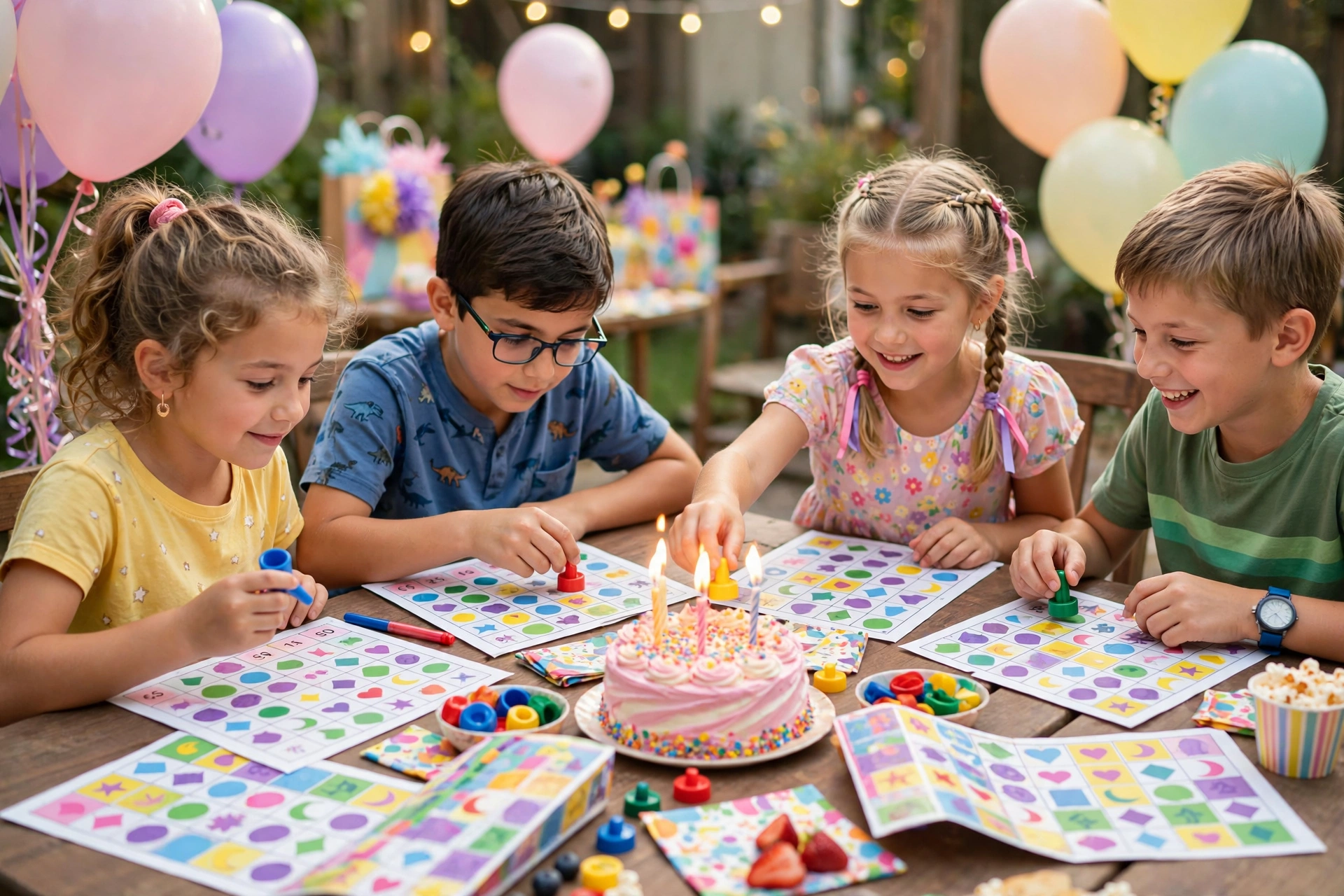
- Picture bingo: each child gets a bingo grid of birthday pictures — cake, balloon, present, candle, hat. The host calls pictures from a caller sheet, children cover matches with counters, coins or torn paper. First to a full row shouts "Bingo!" Works from age 3, because it needs no reading at all. Print one grid per child plus a caller sheet.
- Birthday treasure hunt: ten clues, each leading to the next hiding place, ending at the cake or the party bags. Write clues that match your house: "where the milk lives cold" for the fridge, "where shoes sleep" for the hallway cupboard. One hunt for the whole group, not one per child, or you will have ten children in ten rooms.
- Word scramble: ten birthday words with their letters mixed up — KCAE, LALONOB, TSRPEEN — with a word bank for younger children and no word bank for older ones. First to finish all ten wins. Best for ages 7 and up; for younger children, use picture matching instead of letters.
- Birthday scattergories: pick a letter, then name a cake flavour, a party game, a present and a song starting with that letter, in two minutes. Points for answers nobody else wrote. This is the game adults end up playing too, which is a good sign.
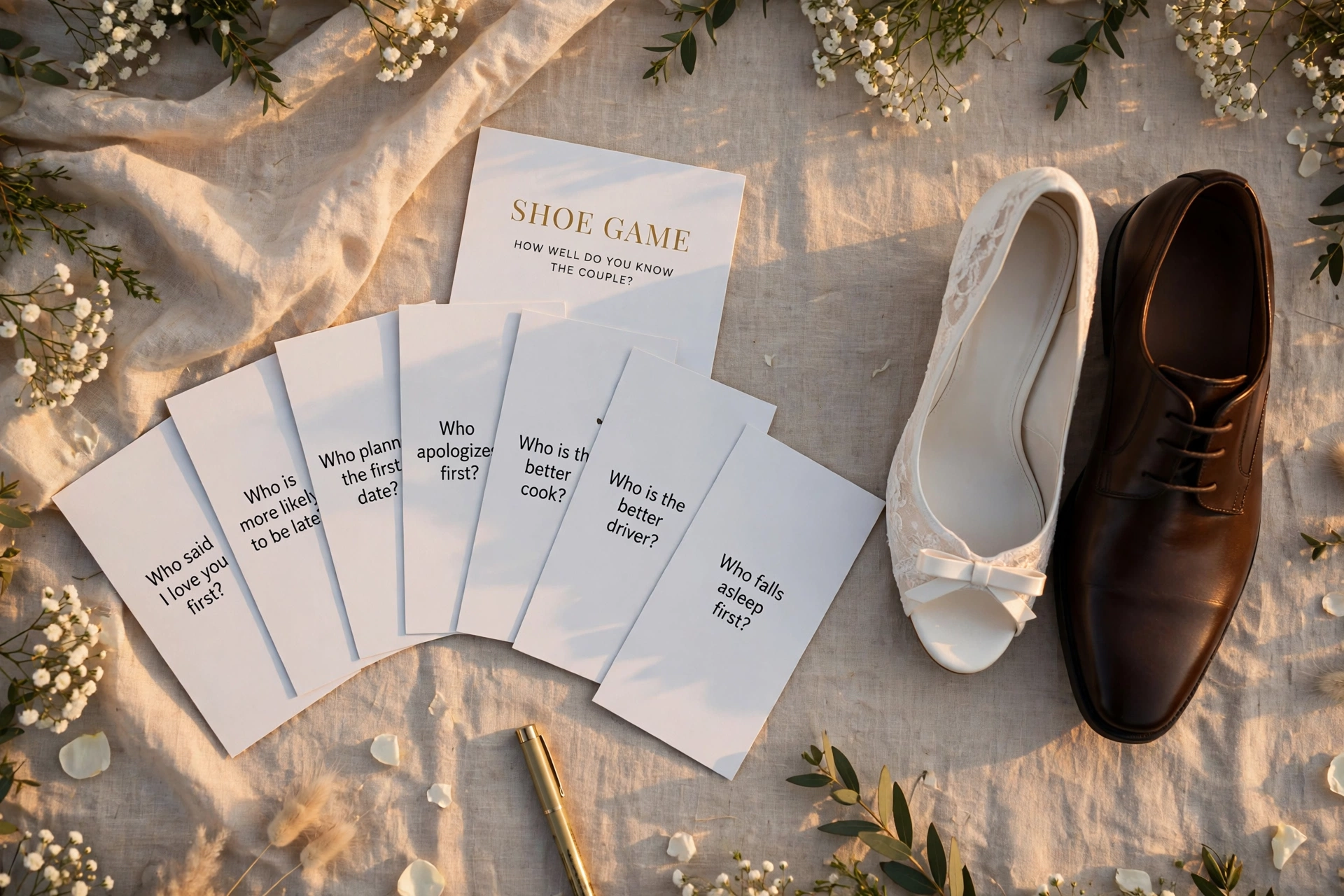
- How well do you know the birthday child? Ten questions only the birthday child can answer — favourite colour, first pet, dream job, most embarrassing moment (kept kind). The birthday child reads the answers. This game makes the birthday child the star, which is the point of the day.
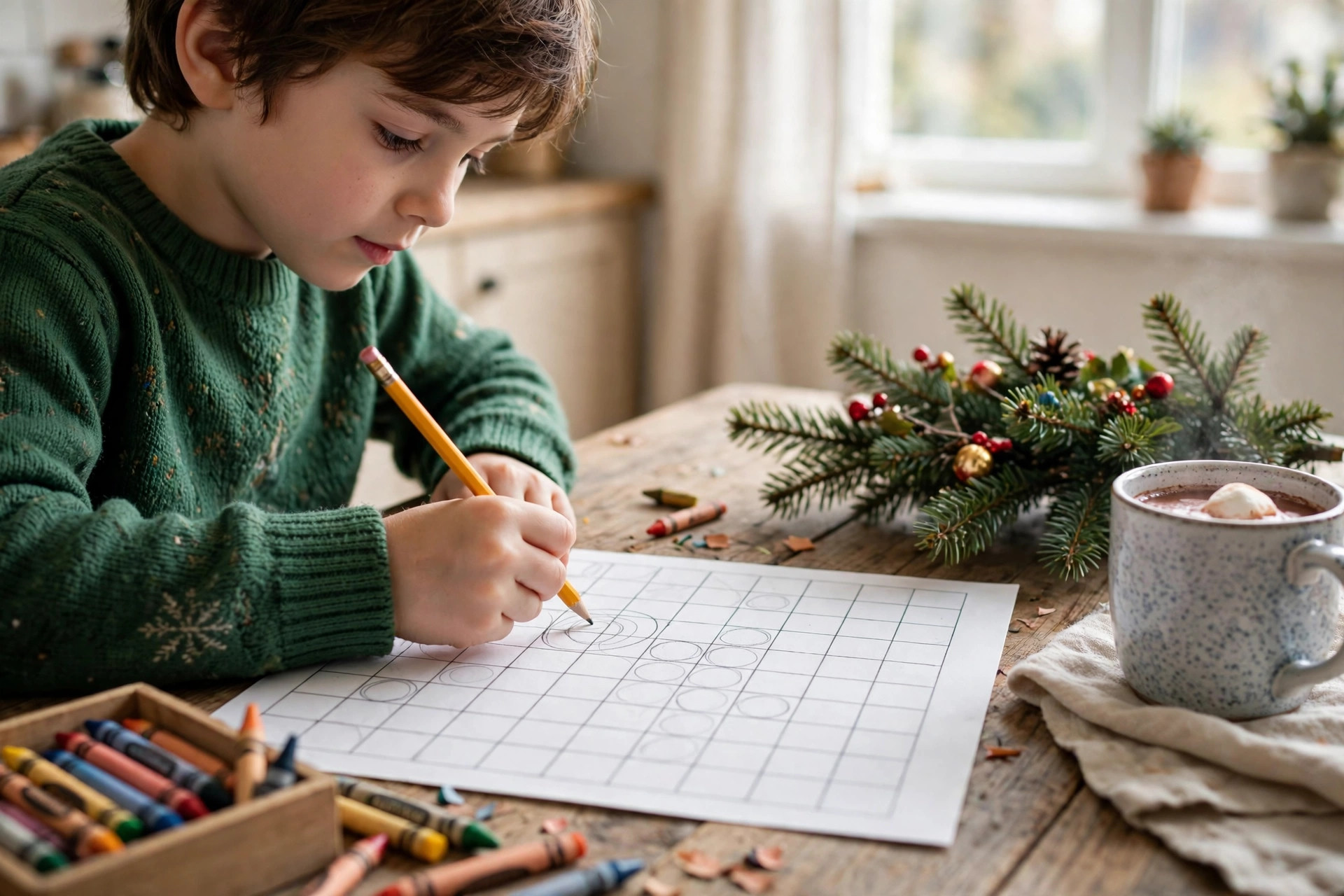
- Colour by number: a birthday picture divided into numbered sections, each number a colour. Quiet, absorbing, and perfect for the gap while food is being served or while a game is being set up. Print one per child and let them take it home.
- Memory tray: put ten party objects on a tray, show it for 30 seconds, cover it, and ask children to write or draw what they remember. Use real objects from the party table — a candle, a balloon, a party hat — so it feels like part of the day, not a test.
- Pass the parcel with a twist: wrap a small prize in layers, one per child, and put a tiny forfeit or question on each layer — "sing happy birthday in a silly voice", "name three cake flavours". The music stops, the layer comes off, the forfeit is done. The prize goes to whoever unwraps the last layer, so nobody knows who will win until the end.
A running order that actually works
Games fail in the wrong order more often than they fail for any other reason. Loud first, quiet last, food in the middle — that is the shape that holds. Start with the loud one: pass the parcel or the treasure hunt, while energy is high and children are still arriving. Energy spent early is energy that does not become chaos later. Move to the thinking games: bingo, then word scramble or scattergories, depending on age. Children are seated now, focused, and a seated game is a rest disguised as a game. Then food, then the quiet game: colour by number or memory tray while plates are cleared and the cake is prepared. This is the gap most hosts forget to plan, and it is where parties unravel — children with nothing to do, waiting, getting louder. End with the birthday-child game: "how well do you know me", right before the cake. It puts the birthday child at the centre at the exact moment everyone is already looking at them, and it leads naturally into singing and candles. If you want the same party logic for a Christmas gathering, our Free Printable Christmas Games guide runs eleven games the same way — trivia, bingo, word search and emoji pictionary, with the same rule: loud first, quiet last, food in the middle.
Printing checklist for the host
Print this section, or copy it onto your phone, and tick it off the night before. It is short, and it prevents the four hosting disasters: wrong counts, missing pens, answer keys handed out by mistake, and a game nobody can hear explained.
Print in black and white if you are watching ink — every game here works in greyscale, and children colouring a black-and-white sheet get a second activity free. Colour looks better for bingo grids, but it is a luxury, not a requirement.
- One sheet per child per planned game, plus two spares of each.
- Answer keys printed separately, in your folder only, never on the children's sheets.
- Pens or crayons counted: one per child per game, plus five spares. Crayons for under-6s, pens for over-7s.
- Counters for bingo: coins, buttons, dried pasta or torn paper, in a cup per table.
- Scissors and tape for the treasure hunt clues, cut and folded the night before, not during the party.
- A timer on your phone for scattergories and the memory tray — a visible countdown makes both games fairer and funnier.
- Party bags ready before the first game starts, so the end of the party is not a scramble.
Games by age, so nobody is left out
Ages 3 to 5: picture bingo, colour by number, pass the parcel, memory tray with real objects. No reading, no writing, no waiting more than a minute for a turn. Keep each game under ten minutes — attention at this age is a short, bright thing. Ages 6 to 8: add the treasure hunt, the word scramble with a word bank, and "how well do you know me" with picture answers. These children can read, but they read slowly, so give them time and do not make reading the point of the game. Ages 9 to 10: add scattergories, word scramble without a word bank, and a harder treasure hunt with riddles instead of plain clues. These children want to compete, so keep score visibly — a simple tally on a big sheet on the wall does it. Mixed ages: run picture bingo first (everyone can play), then split — younger children colour while older children play scattergories, then bring everyone back together for pass the parcel and the birthday-child game. Splitting for one game is not excluding anyone. Forcing a four-year-old to play scattergories is.
The same eight games, tuned for each age band
The eight games above do not need replacing as children grow — they need adjusting, and the adjustments are small. For ages 4 to 6, shorten everything. Bingo grids shrink to three by three, with big pictures and no words at all. The treasure hunt becomes five clues, all in one room or one garden corner, with an adult reading each clue aloud and the whole group hunting together so nobody is ever lost or last. Pass the parcel keeps its forfeits, but make them instant and silly — roar like a lion, hop to the door — because a four-year-old asked to sing solo may simply freeze.
For ages 7 to 9, children can handle a little jeopardy, and they love it. The word scramble loses the word bank halfway through: first five words with the bank, last five without, so everyone starts well and the confident readers get their stretch. Scattergories can run for two rounds with different letters, and the memory tray grows to twelve objects with only twenty seconds to look. The birthday-child quiz works best in this band of all — old enough to have opinions, young enough to announce them to a room without embarrassment.
For ages 10 to 12, raise the stakes in the scoring, not the prizes. Scattergories answers score double if nobody else in the room thought of them at all. The treasure hunt becomes a riddle trail with clues that need solving, not just finding — a short rhyme for the washing machine beats "look in the kitchen" every time. And let this age group run one game themselves: handing a confident eleven-year-old the bingo caller sheet frees the host to serve food, and being trusted with the job is, for many children, the best part of the party.
When rain moves the party indoors
Rain does not cancel a printable party — it just changes which sheets you reach for. Move the treasure hunt indoors by shrinking it: clues that lead from sofa to bookshelf to the cupboard under the stairs, with the final prize in the airing cupboard or behind the curtains. Small-space hunts work better with sealed envelopes than with hidden objects, because twelve children opening every drawer in your kitchen is a different kind of party.
Replace any running game with its seated cousin. A relay becomes a team challenge at the table: pass a balloon down the line using only elbows, seated, and time it. Bingo, the word scramble, scattergories and the memory tray were always indoor games — simply bring them forward in the order, and stretch the quiet slot with an extra colour-by-number sheet per child. If you know the forecast the night before, this is also the moment the ready set earns its space: the Birthday Party Bundle on the printables page means the indoor version of every game is already printed before the first cloud arrives.
One practical warning for indoor parties: noise rises faster in a small room than energy does. Alternate loud and seated games strictly — parcel, then bingo, then food, then quiz — and you will feel the difference by the second game. A party that ends with children pleasantly tired is a success; a party that ends with the host hoarse is just a louder one.
Games for shy children and very mixed ages
Every party has one child who would rather watch, and the kindest hosting skill is making watching a proper role instead of a failure. Shy children thrive in games with a job attached: bingo marker-checker, treasure hunt clue-holder, the person who reveals the memory tray. A job gives them a reason to be in the middle of the game without being the centre of attention, and many shy children join in fully by the third game once the pressure to perform has been taken off the first two.
Never build a game around solo performance for this group. Singing forfeits, charades in front of everyone and elimination games where a child sits out alone are the three to quietly drop — or soften. A forfeit done by the whole group together ("everyone sing it in a silly voice") keeps the laugh and removes the spotlight. Team versions of everything — two teams for scattergories, pairs for the word scramble, one shared hunt — protect both the shyest child and the youngest one in the same move.
Very mixed ages need the same trick viewed from the other side: give older children responsibility instead of advantage. A ten-year-old paired with a five-year-old for bingo, reading the caller sheet or keeping the score tally on the wall, is not being held back — most older children visibly grow an inch when a room of adults trusts them with a real role. The game stays fair because the challenge was never really the pictures; it was always being needed.
Keeping time by party stage, not by the clock
Hosts often ask how many minutes each game should get, and the honest answer is that parties run by stages, not by stopwatch — but stages do have natural lengths, and knowing them stops both rushing and drifting. The arrival stage, while children are still coming through the door, needs something children can join halfway through: colour by number on the table, or bingo that restarts in short rounds. Never start your best game before everyone has arrived; the late child who missed the treasure hunt remembers it longer than the game itself.
The high-energy stage comes next and lasts as long as the loudest game does — one parcel game or one full hunt, played properly, not stretched. When the noise starts rising instead of the fun, that is the signal the stage is over, whatever the time is. Move to the table stage: food first, then seated games while plates are cleared, because children who have just eaten will sit happily for a scramble or a quiz in a way that hungry children simply will not.
The last stage is the wind-down, and it is shorter than hosts expect: the birthday-child game, then cake, then party bags. Ten calm minutes here decide how children leave — unhurried, holding something, with the singing still in their ears. If a stage runs long, steal the time from the middle of the party, never from this ending.
Prizes without tears
The prize table causes more party tears than any lost game, and almost all of them are avoidable with one rule: prizes reward moments, not rankings. Instead of one prize for the overall winner, hand small prizes at the end of each game — first bingo row, fastest scramble, funniest scattergories answer (voted by clapping) — so the wins spread around the room by design. Over four games, most children will win something once, and the child who does not is rarely the one keeping score; it is usually an adult who notices.
Keep every prize the same size and roughly the same value: a small toy, a fancy pencil, a packet of stickers, a chocolate coin. The moment one prize is visibly better, it becomes the prize, and every other win turns into a consolation. Identical prizes in different colours are the host's friend, because choosing a colour feels like winning twice.
Finally, decouple prizes from goodbye. Party bags go to everyone, at the door, whatever happened in the games — say so at the start, out loud, so no child spends the party quietly calculating. A child who lost every game and still skips to the door with a bag and a balloon has had a good party. That, and not the score sheet, is what gets remembered at bedtime.
The ready-made version, when printing eight games is too much
This guide is complete on its own: the eight games, the running order and the checklist will carry a party. But if you are short on time, or you want every game in one matching design with answer keys already done, the printables page holds the Birthday Party Bundle for $3. It carries games with answer keys, bingo cards with a caller sheet, fold cards, gift tags and a banner in one set — the party kit version of this guide, ready to print the night before. Use the free games here for tonight's party, and the bundle when you want the whole set without assembling it yourself.
Your next step tonight
Pick four games from the list above for your party's age group, print one sheet per child plus two spares, and put the answer keys in a folder of their own. Then open our printables page and look at the Birthday Party Bundle — if the free games feel like enough, you are done; if you want the full matching set, it is there for $3.