Quick answer: A faith planner puts prayer, scripture, gratitude and everyday tasks on the same page, so faith is part of your day instead of an extra job. This page shows how to set one up, what goes on the daily page, which format fits you, and how to keep using it — plus a full sample week you can print.
Faith Planner: How to Set One Up, Use It Daily, and Print Your Own
A faith planner puts prayer, scripture, gratitude and everyday tasks on the same page, so faith is part of your day instead of an extra job. This page shows how to set one up, what goes on the daily page, which format fits you, and how to keep using it — plus a full sample week you can print.
Most planners fail in the same quiet way. You buy one in January, full of good plans, and by March it is sitting in a drawer with three weeks filled in and the rest blank. A faith planner has a better chance, because it is not built on willpower alone. It ties the planning to something you already care about.
You do not need a new habit, a new app, or a morning routine that takes an hour. You need one page, five minutes, and a pen. The sample week further down shows the whole thing filled in, so you can copy the shape of it on Monday morning.
If you want the full planner bundles, our printables page carries them — the Planners & Productivity Bundle is $4 for 28 A4 pages in an editable PDF, and the packs on the site run $2–$7. The sample week and the checklists on this page are free to print and use at home. Start with the free pages.
MerryHub is a printable-games and planner shop by ReplyPilot. Everything here is made to be printed, written on with a real pen, and used at a kitchen table — not stared at on a screen.
What is a faith planner?
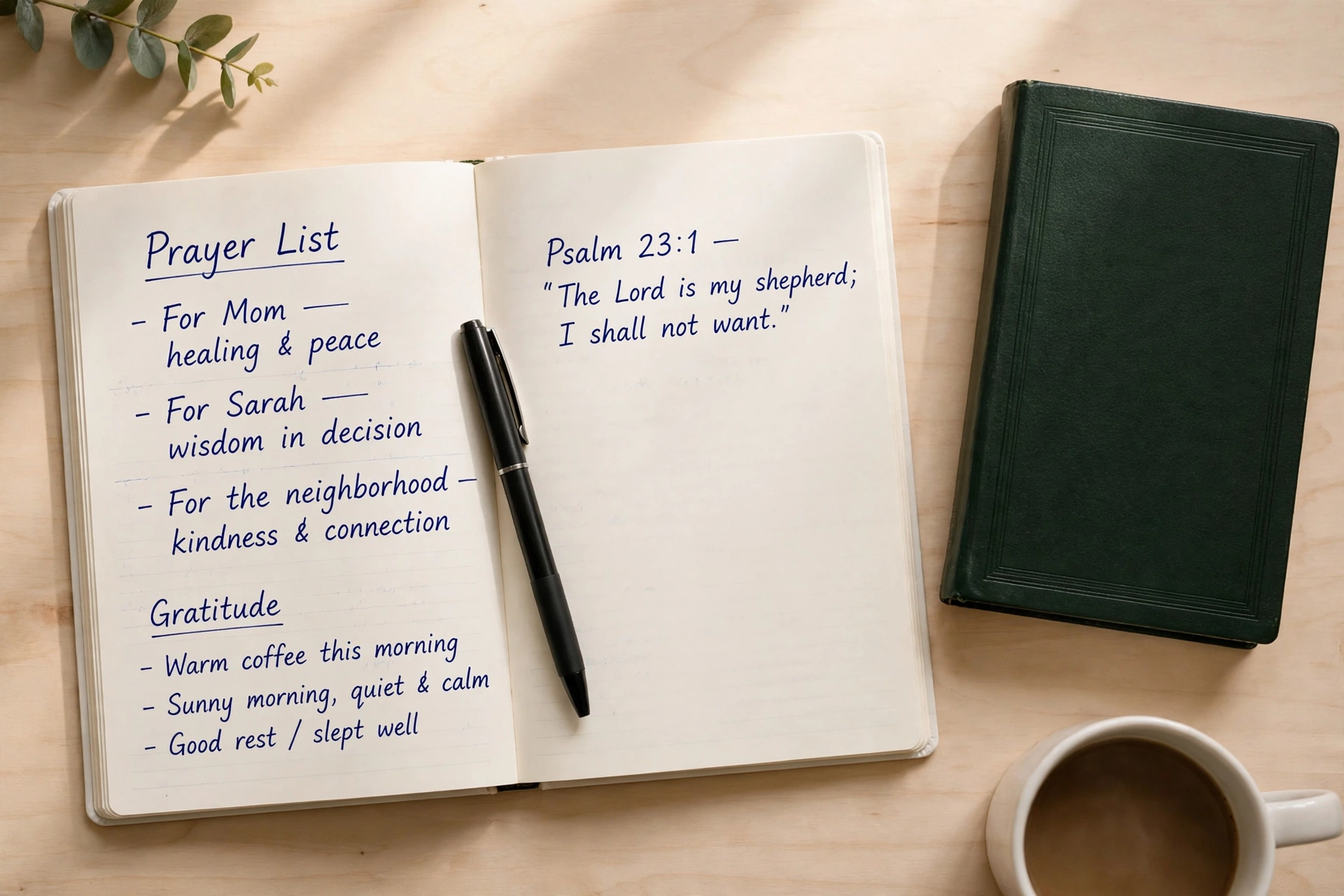
A faith planner is a planner that puts prayer, scripture, gratitude and ordinary tasks on the same page. Open it on any morning and you will see the same four things: who you are praying for, one short line from scripture, one thing you are thankful for, and the three tasks that matter today. It is not a diary, and it is not a Bible study book. It is a daily page that keeps your faith where you can see it, right next to the life you are actually living.
People come to it for different reasons. Some want prayer to stop being the thing they mean to do and never get to. Some want a record of what they prayed for, so they can look back in a month and see what changed.
The numbers back up the need. According to the Pew Research Center, 44% of U.S. adults pray at least once a day, down from 58% in 2007, and a further 23% pray weekly or a few times a month. That is from the Religious Landscape Study 2023–24, published 26 February 2025 and updated 9 July 2026, and we checked the page live on 12 November 2026. A planner will not fix that on its own, but it gives a daily habit a place to live.
A faith planner is also not the same thing as a devotional book. A devotional gives you something to read. A planner gives you something to write. The writing is the point. When you write a name on a prayer list, you remember that person all day in a way that reading a list of names never quite manages. The page is a tool, not a test. Nobody grades it, and a blank day is not a failure — it is just a blank day.
How do you set up a faith planner?
Setting one up takes an afternoon, and most of that afternoon is deciding what you want on the page — not buying supplies. Start with what you already have. A binder you are not using, a notebook with blank pages, or a stack of printed pages in a folder will all do. The binder is the most forgiving choice for a first try, because you can move pages around and take out the ones that do not work.
You need five kinds of page, in this order: a monthly overview, a weekly spread, a daily page, a prayer list, and a sermon-notes page. The monthly overview holds the big dates — birthdays, church events, appointments that matter. The daily page is the one you will use most, and the next section covers it in detail. The prayer list is a running list of names and requests, kept separately so it does not have to be rewritten every day.
Build the set in one sitting. First, print or draw one monthly overview for the current month and fill in the dates you already know. Second, print seven daily pages for the coming week — no more, because a stack of thirty blank pages feels like a chore and a stack of seven feels like a start. Third, write your prayer list on its own page, with a short line beside each name so you remember what you are praying for. Fourth, add one sermon-notes page for Sunday.
Supplies are simple. A pen you like writing with, a pencil for dates that might move, and a highlighter if you want to mark answered prayers. That is enough. Colored pens, stickers, and washi tape are fun, and plenty of people enjoy them, but they are decoration, not the system.
One question worth settling now is whether the planner lives on paper or on a screen. If you already take notes on an iPad, a digital planner can work well, and the GoodNotes Planner on our printables page is $5.99 for 1,000 hyperlinked pages. But if you are choosing between paper and a tablet and you are not sure, start on paper. Paper has no notifications, no battery, and no app to update.
What goes on a faith planner daily page?
A daily page has four parts, and each one earns its space by doing a different job.
The first part is the prayer list for today. Not the whole running list — just the two or three names you are carrying today. Write the name and one short line about the request. "Mom — knee appointment at 10" is enough. The running list lives on its own page; the daily page just pulls today's names from it. If a prayer is answered, mark it with the date — in a few months you will have a page of answered prayers.
The second part is one short scripture note. One verse, or even part of one verse, with one line in your own words about what it says to you today. Psalm 23:1 is a good example: "The Lord is my shepherd; I shall not want." The note beside it might be: "I do not have to carry today alone." That is all.
The third part is one line of gratitude. One real thing, written plainly. "The rain stopped before the school run" beats "I am grateful for everything" every time. The point is not to feel grateful on command. The point is to notice one good thing and write it down before the day rushes past it.
The fourth part is the tasks — three, not ten. Pick the three things that would make today feel done. A daily page with ten tasks is a guilt list, not a plan. If your tasks include work, a business planner printable can carry the work detail while the faith planner keeps the day's shape. And if the tasks include a wedding — a venue visit, a call to a caterer — a free printable wedding coordinator checklist holds the wedding detail so the daily page stays calm.
What does a real week look like?
A blank template tells you what the boxes are. A filled-in week tells you what the boxes are for. Here is one ordinary week, written out the way a real person would fill it in.
Monday. Prayer: Mom, and her knee appointment at 10 in the morning. Gratitude: the rain stopped before the school run, so nobody got soaked at the bus stop. Scripture: Psalm 23:1 — "The Lord is my shepherd; I shall not want." My note: "I do not have to carry today alone." Task: call the dentist and move Thursday's appointment to next week.
Tuesday. Prayer: Mr. Alvarez next door, recovering from surgery and bored stiff sitting at home. Gratitude: last night's soup stretched to two dinners, so tonight is easy. Scripture: Philippians 4:6 — "Do not be anxious about anything, but in every situation, by prayer and petition, present your requests to God." My note: "Say the worry out loud, then let it go." Task: reply to the school email about the field trip and send the permission slip back.
Wednesday. Prayer: the job interview tomorrow morning, and the nerves that come with it. Gratitude: a quiet lunch break, twenty minutes with nobody asking me for anything. Scripture: Proverbs 3:5 — "Trust in the Lord with all your heart and lean not on your own understanding." My note: "I have done the preparation. The rest is not mine to control." Task: lay out interview clothes tonight so the morning is calm, and print two copies of my resume.
Thursday. Prayer: the interview itself — for calm, honest answers, and for the right outcome, whatever that is. Gratitude: the bus came on time, which felt like a small gift on a big day. Scripture: Isaiah 41:10 — "Do not fear, for I am with you." My note: "Fear is loudest right before the thing starts." Task: send a short thank-you note after the interview, then take a proper walk before going home.
Friday. Prayer: a friend who is having a hard week and has gone quiet. I do not know what to say, so the prayer is just that she knows someone is thinking of her. Gratitude: Friday pizza night with the kids, and the youngest telling the same joke three times. Scripture: James 1:5 — "If any of you lacks wisdom, you should ask God." My note: "Ask before deciding. It costs nothing." Task: pay the water bill, finally, and put the receipt in the folder.
Saturday. Prayer: the week ahead, and rest — real rest, not just a day with no meetings. Gratitude: the garden tomatoes finally ripened, and there are enough for a salad tonight. Scripture: Exodus 20:8 — "Remember the Sabbath day by keeping it holy." My note: "Rest is part of the plan, not a break from it." Task: check the wedding venue shortlist with my sister, using our wedding planning checklist printable so nothing gets missed.
Sunday. Sermon notes: the title was "The Shepherd Who Provides," from Psalm 23. Three points: the shepherd knows the sheep by name; provision is daily; the table is set even when enemies are near. One question to carry into the week: what does it look like to trust daily provision when the bills come monthly? Weekly review, written after lunch. What worked: the morning pages before I touched my phone. What slipped: Thursday's prayer got skipped in the rush before the interview. One change for next week: move the prayer line to before breakfast, not after, so a busy morning cannot eat it.
Dated, undated or printable — which one should you pick?
There are four honest ways to own a faith planner, and the right one depends on how you live.
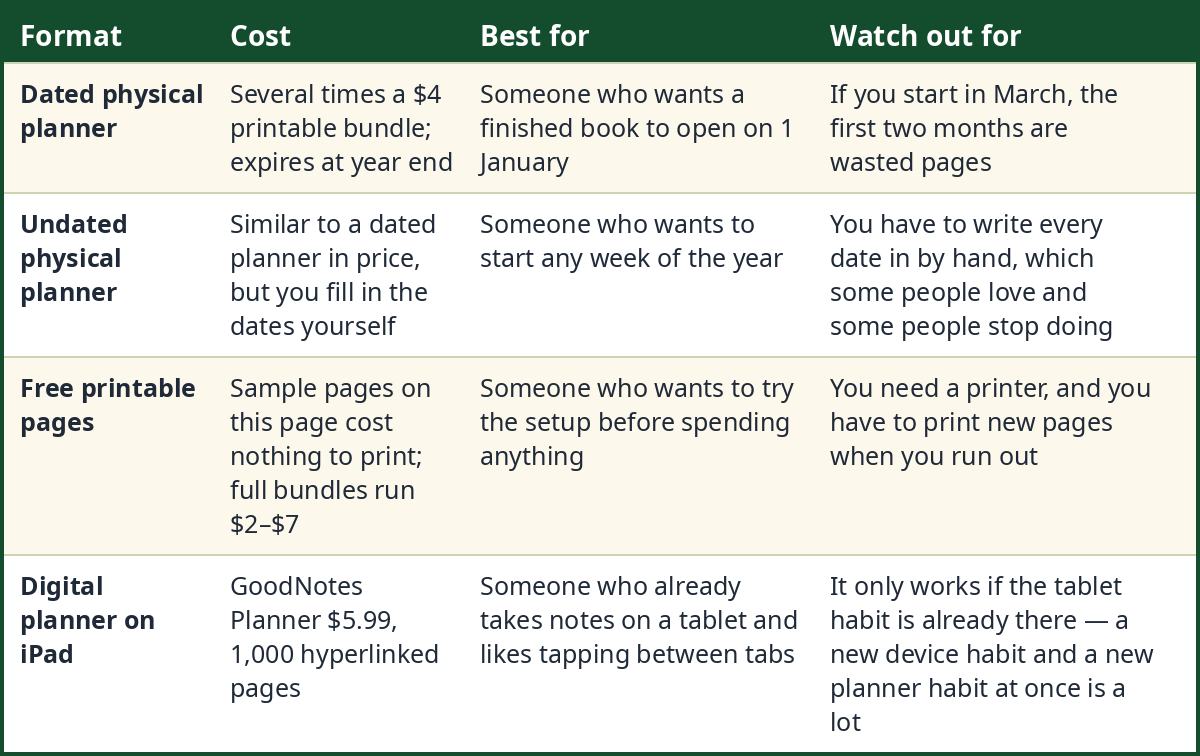 A dated physical planner is the classic choice. It arrives finished, with the dates printed, the months in order, and a ribbon to mark your place. It also costs several times a $4 printable bundle, and it expires at the end of the year whether you filled it or not.
An undated physical planner fixes the start date problem. You write the dates in yourself, so you can begin on any Tuesday in any month. That freedom has a small cost: writing in the dates is a weekly chore of its own, and if you stop doing it, the planner stalls.
Printable pages are the low-risk way in. The sample week on this page costs nothing to print, and you can try the daily page for a week before you spend anything. If the shape fits, the Planners & Productivity Bundle is $4 for 28 A4 pages in an editable PDF, and the packs on the site run $2–$7. The trade-off is the printer. You need one, and you need to remember to print the next week's pages before Sunday night.
A digital planner on an iPad is the best choice for someone who already lives on a tablet. The catch is the habit. If you do not already take notes on a tablet every day, you are building two habits at once — the tablet habit and the planner habit — and that is a heavy ask in the first week. If you want to see how the tabs work before you decide, our GoodNotes planner templates page walks through the setup, and it answers the question this section cannot: does a digital planner feel like writing, or does it feel like another app?
One honest note: most people who quit a faith planner do not quit because they picked the wrong format. They quit because the daily page asked for too much. The format is a container. The habit is the thing.
How do you keep using it after the first week?
The second week is where most planners die. Here is what keeps one alive.
First, shrink the page when life gets busy. On a hard day, write one prayer, one gratitude line, and one task. That is the whole page. A small page you actually fill in beats a full page you skip.
Second, tie the planner to something you already do. Put it next to the coffee maker, or on top of the Bible you read in the morning, or beside the bed. The planner needs a home and a time. "After breakfast" is a time. "When I get around to it" is not.
Third, read the scripture numbers as a nudge, not a scolding. The same Pew study that counted daily prayer also found that 29% of U.S. adults read scripture at least monthly, and 22% read scripture outside religious services at least once a week. That study is the Religious Landscape Study 2023–24, published 26 February 2025 and updated 9 July 2026, and we checked it live on 12 November 2026.
Fourth, review the week on Sunday, the way the sample week does. Five minutes, three questions: what worked, what slipped, one change for next week.
Fifth, when the house side of life starts crowding the prayer side out, give the house its own page. A free printable ADHD cleaning checklist or an ADHD cleaning planner can hold the chores so the faith page can hold the faith. The point is to stop writing the housework on the prayer page, where it pushes everything else off. If the cleaning list needs its own printable, our ADHD cleaning planner PDF is the fuller version of the same idea.
Sixth, expect a bad week and plan for it. Everyone misses days. A holiday, an illness, a week when the kids are off school — the planner will go quiet. That is normal. The rule for coming back is simple: do not try to fill in the missed days. Open a fresh page, write today's date, and start again. A fresh page is a welcome back.
What mistakes make people quit?
Most faith planners are abandoned for the same few reasons.
The first mistake is making the daily page too big. A page with eight boxes, a verse to copy out in full, a meal plan, a water tracker, and a habit grid is a second job. You will fill it in for three days and then avoid it.
The second mistake is copying someone else's planner instead of building your own. The photos online show color-coded pages, hand-lettered headings, and stickers in neat rows. Your page takes five minutes. If your handwriting is plain and your headings are not decorated, your planner is not broken.
The third mistake is treating a missed day as a failure. You miss Tuesday. Wednesday's page sits there, and the blank Tuesday next to it feels like proof you cannot keep this up. So you stop. The fix is a rule you decide now, before the first miss: a blank day is just a blank day. Turn the page. Write today's date. Carry on.
The fourth mistake is putting the planner where you cannot see it. In a drawer, on a high shelf, in a bag you only open at church — out of sight is out of mind, and out of mind is out of use within a week. It needs to live where your morning happens. On the kitchen table, next to the kettle, on the nightstand.
The fifth mistake is writing prayers you do not mean. Long, formal sentences copied from a book feel holy for a day and hollow by Friday. Write the prayer the way you would say it to a friend. "Please help Mom's knee heal" is a real prayer. The planner works when it sounds like you.
The sixth mistake is never looking back. A planner you only write in is half a planner. Once a week, read the last seven days. You will see prayers you forgot you prayed, gratitude lines that still make you smile, and a pattern in what keeps slipping. That weekly look-back is what turns a stack of pages into a record of your life.
What should you print first?
Print the smallest set that lets you start tomorrow. Seven daily pages, one prayer-list page, one sermon-notes page, and one monthly overview. That is ten pages, and it is enough for a full week. Do not print three months of pages on the first day.
Print at actual size, not "fit to page." Fit-to-page shrinks the writing lines, and small lines are hard to write on without your words crowding together. Use plain white paper and black ink.
Print one copy of the prayer list and keep it at the front of the binder, where you can reach it without flipping. Print the sermon-notes page on its own, so Sunday's notes do not get mixed in with the daily pages.
When the week is over and the shape feels right, that is the moment to look at a bundle. The Planners & Productivity Bundle is $4 for 28 A4 pages in an editable PDF, and it covers the daily, weekly, and monthly pages in one set. If you use a tablet, the GoodNotes Planner is $5.99 for 1,000 hyperlinked pages. If you want a planner that keeps the structure gentle and low-pressure, the ADHD-Friendly Planner is $4. And if the new year is coming, the 2027 New Year Planner is $3. The packs on the site run $2–$7, so the choice is about which pages you will actually use, not about the price.
Where should you go next?
You have the setup, the daily page, a full sample week, and the comparison of formats. The next step is the daily page itself, printed and filled in tomorrow morning. Our printable daily planner template page carries the daily page in a print-ready form, with the four parts laid out the way this article describes them — prayer, scripture, gratitude, and three tasks. Print seven copies, fill in the first one over breakfast, and see how the shape feels. If it fits, the week after that will take care of itself.