Quick answer: A wedding coordinator checklist is the hour-by-hour list the person running the wedding day follows, from morning setup to midnight teardown. It covers vendor arrivals, the ceremony cue sheet, the reception order, and who to call when something slips. Print it, clip it to a board, and the whole day runs from one page.
Free Printable Wedding Coordinator Checklist: The Day-Of Run Sheet That Keeps a Wedding on Time
A wedding coordinator checklist is the hour-by-hour list the person running the wedding day follows, from morning setup to midnight teardown. It covers vendor arrivals, the ceremony cue sheet, the reception order, and who to call when something slips. Print it, clip it to a board, and the whole day runs from one page.
That is what this page gives you: the checklist itself, written as a real run sheet for a 4 pm ceremony, plus the two pages that go with it — a vendor contact sheet and an emergency kit list. It is built to print. Take it to the venue, clip it to a clipboard, and tick each line as it happens. If you want the fuller wedding planning system behind it, with day-of timelines and an editable version, the Wedding Planner Bundle has 260 pages for $4, including the day-of pages this checklist is drawn from.
A wedding day is the most complicated event most people will ever run, and it is run once, with no rehearsal of the real thing. That is exactly why it needs a written list. A list will not stop things going wrong. It makes the day recoverable: when something slips — and something always slips — the list tells you what happens next.
What does a wedding coordinator actually do on the day?
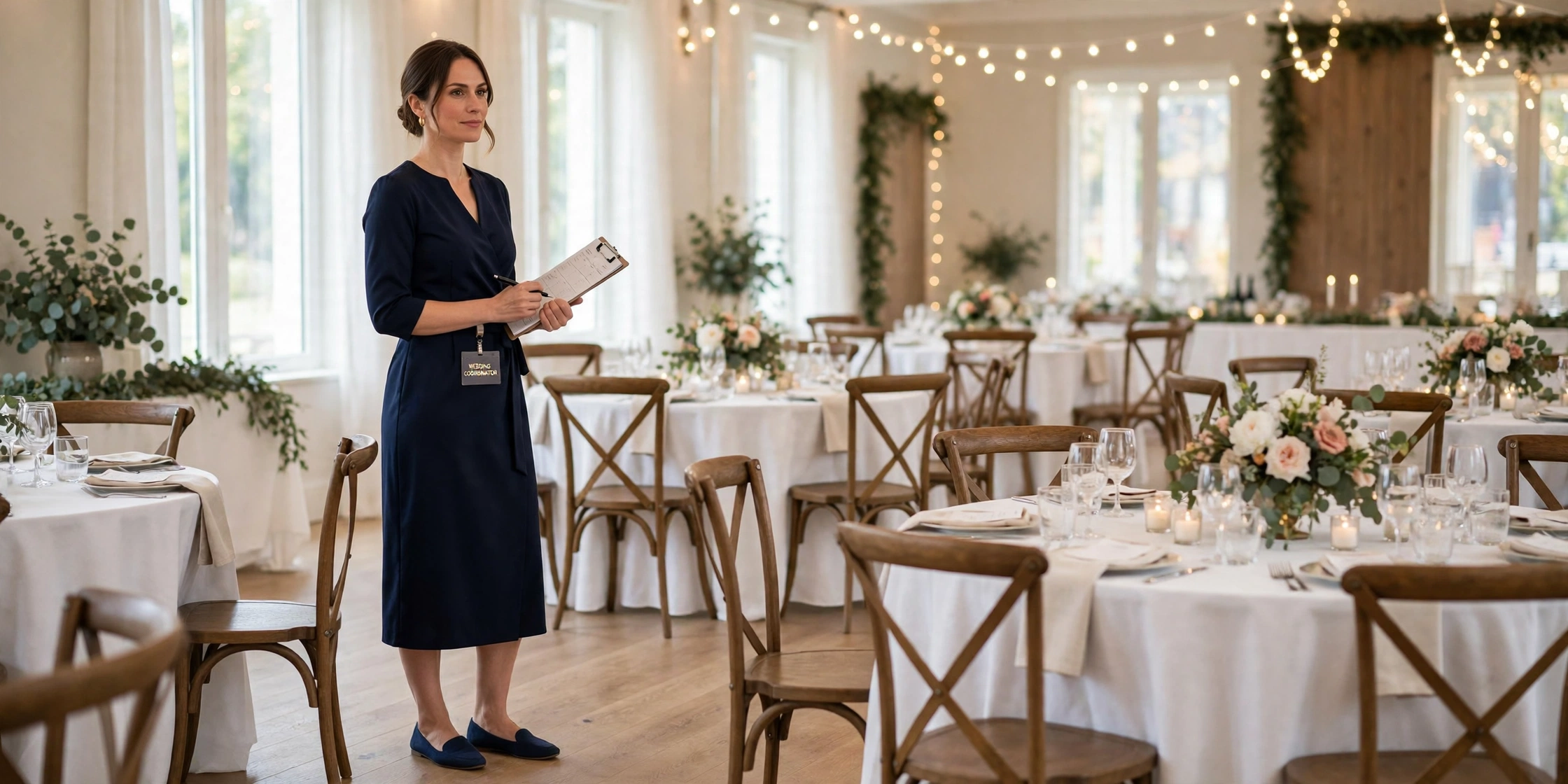
A coordinator is not a planner. A planner designs the wedding over months: venue, vendors, and the whole event. A coordinator runs the day itself. They usually step in during the final weeks and turn the couple's plans into a minute-by-minute schedule that someone has to hold.
On the day, the coordinator has four jobs. The first is timeline guard. The ceremony starts at 4 pm, not 4:15. Dinner is served at 6:30, not when the kitchen feels ready. The coordinator is the person who notices when the time is slipping and pulls it back.
The second job is vendor wrangler. The florist arrives at 10, the cake at 1, the band at 5. Each one needs to be met, pointed to the right room, and checked. A vendor who cannot find the loading door will waste half an hour, and half an hour is the whole buffer for the day.
The third job is problem buffer. Something always goes wrong at a wedding. A button pops. A speaker hums. A guest's child knocks over a centerpiece. The coordinator fixes the small things quietly, before the couple ever hears about them. If the couple hears about it, it has already gone too far.
The fourth job is family herder. The photographer needs the whole family together for one photo, and that means finding twelve people who have all wandered off in twelve directions. The coordinator knows the family photo list, knows who is in it, and gathers them in five minutes instead of twenty.
What a coordinator does not do matters too. They do not choose the flowers, the menu, or the seating plan. Those decisions belong to the couple, and they were made weeks ago. The coordinator's work starts where the decisions end: making sure the decisions actually happen, on time, in the right order.
MerryHub is a printable-games and planner shop by ReplyPilot, and this checklist is built the way our planners are built: one job per line, no decoration that gets in the way, and a layout that works on a clipboard in a noisy room.
The full day-of checklist: hour by hour for a 4 pm ceremony
This is the run sheet. It is written for a ceremony at 4 pm, dinner at 6:30, and dancing until 11:30, with teardown at midnight. If your ceremony is at a different time, shift every slot by the same amount and the plan still works. Each time has one job, and one thing to check before moving on.
8:00 am — Coordinator arrives. Walk the venue empty and count the tables and chairs against the seating plan.
9:00 am — Vendors begin arriving. Meet each one at the door, point them to their spot, and note the arrival time.
10:00 am — Decor and setup. Check the place cards against the seating plan, one table at a time. A wrong card found now takes ten seconds to fix; the same card at 6:15 pm takes ten minutes and a small scene.
11:00 am — Sound and light check. Play one song at full volume and walk to the back of the room. Test the microphone from the spot where the couple will stand.
12:00 pm — Lunch. The couple eats. Check the hair and makeup schedule too: if the bride is an hour behind, the photos will be an hour behind.
1:00 pm — Cake and final deliveries. Check the cake against the order, then walk the light with the photographer.
1:30 pm — First look and couple photos. Twenty minutes, then move on. Photos that run long are the most common reason a ceremony starts late.
2:30 pm — Guests begin arriving. Greet them, point them to the ceremony space, and check the chairs one last time.
3:00 pm — Wedding party lineup. Gather everyone in order, say where they walk and stand, and have them repeat it back.
3:30 pm — Final check. Music cue tested, rings with the best man, vows in pockets, photographer in place. Check your phone is on silent.
4:00 pm — Ceremony. Cue the music, send the wedding party down the aisle, then the couple. If it runs long, the photos run short, not the dinner. Dinner is fixed. Photos flex.
4:30 pm — Family photos. Run the photo list like a roll call: call the names, gather the group, photo, next group. Do not wait for stragglers.
5:30 pm — Cocktail hour. Check the bar, the music, and the seating while the couple is still with the photographer.
6:00 pm — Room flip. Move the chairs, reset the tables, and move the ceremony flowers to the reception. Thirty minutes is enough if everyone knows their job.
6:30 pm — Grand entrance and dinner. Cue the wedding party in, then the couple. The coordinator eats too, standing up if needed.
7:30 pm — Speeches. Three speeches, five minutes each. Hand the microphone to each speaker and stand close enough to take it back.
8:30 pm — First dance, then cake. Cut the cake during a natural break, not as a separate ceremony. Make sure the photographer is in place for both.
9:30 pm — Bouquet and garter, if the couple wants them. Five minutes, no more. Check the bar tab now, not at 11 pm.
10:30 pm — Last dance. Give the DJ a ten-minute warning, then a five-minute warning. A wedding that ends well is remembered well.
11:30 pm — Send-off. Check the couple's belongings are in the car: the card box, the guest book, the cake top tier.
12:00 am — Teardown. Final walk of the venue with the venue manager: every room, every bathroom, every corner. Lost items go into one labeled box.
That is sixteen hours, from 8 am to midnight. The most useful number in the whole plan is the buffer: fifteen minutes between each major part of the day. Six transitions times fifteen minutes is ninety minutes of buffer built into the day. That is why the plan holds when things slip. A plan with no buffer is not a plan. It is a wish.
One slot in this run sheet deserves its own page: the gap between dinner and dancing. Our fun shoe game questions page has 50 questions in five groups and a 15-minute host plan that fits exactly there.
Why does a checklist work at all?
It is a fair question, because a list of times looks too simple to matter. The answer comes from medicine, and it is one of the most tested findings in modern safety work.
In 2009, the World Health Organization published the results of a surgical safety checklist in the New England Journal of Medicine. Eight hospitals in eight countries used a 19-item checklist before, during and after surgery — simple steps like confirming the patient's name, checking the antibiotics, and counting the instruments. The results were large: deaths fell by 47%, and complications fell by 36%, across about 8,000 patients. The full study is published in PMC, the U.S. National Library of Medicine.
The lesson is not about surgery. It is about how human beings work under pressure. A wedding day is high pressure in the same way an operating room is: many people, many moving parts, one chance to get it right, and a tired brain at the end of a long day. A checklist does not make anyone smarter. It makes sure the simple things get done when the brain is busy with the hard things. The surgeon does not forget to count the instruments because they are careless. They forget because they are concentrating on the surgery. The coordinator forgets the rings for the same reason.
That is the whole case for this page. A printed list, ticked off one line at a time, costs one sheet of paper, and it protects the one day that cannot be repeated.
The vendor contact sheet: who to call, and when
A run sheet tells you what happens. A contact sheet tells you who to call when it does not happen. Print both. The contact sheet goes on the back of the run sheet, or on its own page in the same clipboard.
Every vendor gets one line: name, company, phone number, arrival time, and what they are bringing. Fill it in two weeks before the wedding, and confirm every line 48 hours before the day. The 48-hour check is the one that matters most: it catches the florist who wrote down the wrong venue, the DJ who thought the wedding was Saturday, and the cake baker who is waiting for a delivery that never came.
The lines you need, at minimum: venue manager, caterer, photographer, videographer, DJ or band, florist, cake baker, rental company, transport, and the couple's emergency contact — usually the maid of honor or the best man. Ten lines. Ten phone numbers. That is the whole sheet.
Two rules for the contact sheet. First, phone numbers, not email addresses. Email is for planning. Phone is for the day. A vendor who is late will not read an email. They will answer a phone. Second, the coordinator carries the sheet, and one other person has a copy. If the coordinator's phone dies or the clipboard is left in the wrong room, the backup copy is the one that saves the day. Give it to the maid of honor.
If you are still building the months-long plan that this day sits inside — the twelve months of booking, tasting, fitting and confirming — our wedding planning checklist printable is the 12-month plan this run sheet belongs to. The run sheet is the last page of that plan. This page is the day itself.
What goes in the emergency kit?
The emergency kit is a small bag that lives with the coordinator all day. It fixes the problems that happen at every wedding, and it costs less than twenty dollars to put together. Pack it the night before, and check it against this list before you leave the house.
For the clothes: safety pins in three sizes, a small sewing kit with white, black and ivory thread, a stain remover pen, clear nail polish for a run in a stocking, double-sided fashion tape for a neckline that will not stay put, and a spare pair of flat shoes in the bride's size for the dancing.
For the people: plasters in two sizes, painkillers, antihistamine tablets, mints, tissues, a small bottle of water, and a phone charger with a cable that fits the couple's phones. A bride with a headache and no painkillers is a problem that takes thirty seconds to fix if the kit is there, and thirty minutes if it is not.
For the venue: gaffer tape, scissors, a black marker, white chalk for a scuffed floor, spare batteries for the microphone, and a printed copy of the run sheet. The printed copy matters more than it sounds: phones die, and a paper run sheet does not.
For the paperwork: the vendor contact sheet, the seating plan, the family photo list, and the couple's marriage license or ceremony paperwork in an envelope. Keep the envelope in the kit bag, not in a car, and hand it to the couple at the end of the night. Paperwork is the one thing that cannot be fixed after the day is over.
Pack the kit in a bag you can carry in one hand. A big box gets left in the car. A small bag goes where the coordinator goes, and that is the point: the kit is only useful if it is in the room when the problem happens.
What if there is no hired coordinator?
Most weddings do not have a hired coordinator. A friend or a family member runs the day instead, and that can work well — if the right person is chosen, and if they have this checklist.
The right person is organized, calm under pressure, and not in the wedding party. That last part matters most. A bridesmaid cannot run the day and be in the photos at the same time. A best man cannot cue the music and give a speech at the same time. The person running the day needs to be free all day.
Give that person the checklist a week before the wedding, and walk through it with them once. Twenty minutes, over coffee, line by line: what happens at each time, who they call, where the kit bag is. Then hand them the clipboard on the morning of the wedding and let them run it. Do not hover. A coordinator who is second-guessed every ten minutes is a coordinator who stops deciding, and the day needs someone deciding.
There are two things a friend-coordinator needs that a hired one brings automatically. The first is authority: the vendors need to know this person speaks for the couple. Introduce them by name at the final vendor check, 48 hours out, so nobody is surprised on the day. The second is a backup: if the friend-coordinator gets sick or stuck, who takes the clipboard? Name that person in advance, even if they never touch it.
And be honest about the trade-off. A friend running the day is a friend who does not get to enjoy the wedding as a guest. They will spend the day working. If that is a price they are happy to pay, the arrangement works. If it feels like a burden, hire a professional for the day. Many coordinators offer a day-of-only service, and it is the cheapest professional help a wedding can buy.
One legal step to get right before the day
This is the part of the checklist that is not about the day at all, and it is the part that matters most if it is missed. The legal paperwork for the marriage has to be done before the ceremony, and the deadlines are real.
In England and Wales, the couple must give notice of their marriage at their local register office at least 29 days before the ceremony, and the ceremony must take place within 12 months of giving notice, as GOV.UK explains. That is the UK rule, and it is a legal requirement, not a suggestion. Book the register office appointment early, because the 29 days are a minimum and popular dates fill up.
In the United States, the rules are set by each county, not by the federal government, so there is no single national deadline. The practical step is the same in every state: check the county clerk's office where the marriage license will be issued, find out the waiting period and the expiry date of the license, and write both dates on the planning checklist. A license that expires before the ceremony is a problem no one can fix on the day.
Put the legal dates on the same page as the vendor confirmations, two weeks out. If the notice has been given and the license is in hand, tick the line and move on. Flowers can be bought late. A marriage license cannot.
What mistakes ruin a wedding day?
Most wedding days are not ruined by disasters. They are ruined by small mistakes that pile up. Here are the ones that happen most, and the fix for each.
No written timeline. A couple who keeps the plan in their heads will forget a part of it, and the part they forget will be the part that matters at 4 pm. Write it down. Print it. Clip it to a board.
No buffer. A day planned back to back, with no gaps, is a day that is late by noon. Fifteen minutes between each major part is the minimum. The run sheet above has ninety minutes of buffer built in, and that is why it holds.
The coordinator who is also a guest. A bridesmaid with a clipboard is a bridesmaid who is not in the photos. Pick a coordinator who is free all day, or hire one.
Confirming the vendors once and never again. One confirmation, months out, is not enough. Confirm at two weeks, and confirm again at 48 hours. The 48-hour check is the one that catches the mistakes.
Skipping lunch. The couple, the wedding party, and the coordinator all need to eat before 2 pm. A hungry bridal party is a slow bridal party, and a slow bridal party is a late ceremony.
The photo list with no one running it. The photographer can take the photos, but they cannot find twelve family members who have wandered off. The coordinator runs the list, calls the names, and keeps the session to thirty minutes.
No plan for rain. If any part of the day is outdoors, there must be a written rain plan, decided before the day, with a time at which the decision is made. "We will decide on the day" is not a plan. "At 1 pm, if it is raining, the ceremony moves inside, and the coordinator tells the guests" is a plan.
Nobody checks the venue at the end of the night. The couple leaves, the guests leave, and the card box, the guest book, and the grandmother's shawl are still in the venue. The final walk at midnight, room by room, is the cheapest insurance on this whole page. Do it, even when you are tired. Especially when you are tired.
A baby shower has the same kind of day-of pressure on a smaller scale, and the same kind of list fixes it: our printable baby shower games page carries games that run themselves once the list is written, which is the same principle as this checklist — decide it once, write it down, and let the day follow the page.
Where should you go next?
You have the run sheet: sixteen hours from an 8 am empty-venue walk to a midnight final check, a vendor contact sheet, an emergency kit list, and the mistakes that undo most wedding days. The next step is the plan this day sits inside. Start with our wedding planning checklist printable: the 12-month plan from first booking to final confirmation, and the page this run sheet belongs to. Build the months, and the day will follow.
For the shower itself, the he said she said bridal shower game runs the party in 25 to 30 minutes with 30 ready questions.