Quick answer: The he said she said bridal shower game asks guests to guess who said what: the bride or the groom. You collect the couple's answers in advance, print one question card per guest, read the questions out loud, and guests score a point for each match. This guide gives you 30 ready questions and a timed plan.
He Said She Said Bridal Shower Game: 30 Questions, a Free Printable Card and How to Run It
The he said she said bridal shower game asks guests to guess who said what: the bride or the groom. You collect the couple's answers in advance, print one question card per guest, read the questions out loud, and guests score a point for each match. This guide gives you 30 ready questions and a timed plan.
If you are hosting a bridal shower, you know the fear. Guests arrive, they eat, they chat in small groups, and then there is a gap. Nobody quite knows what happens next. A good game fills that gap, and this is the one most hosts reach for first, because it needs no props, no teams, and nobody has to stand up and perform. Everyone sits, everyone plays, and everyone learns something new about the couple. If you want the printable card this game runs on, our printables page has the full party games pack it comes from.
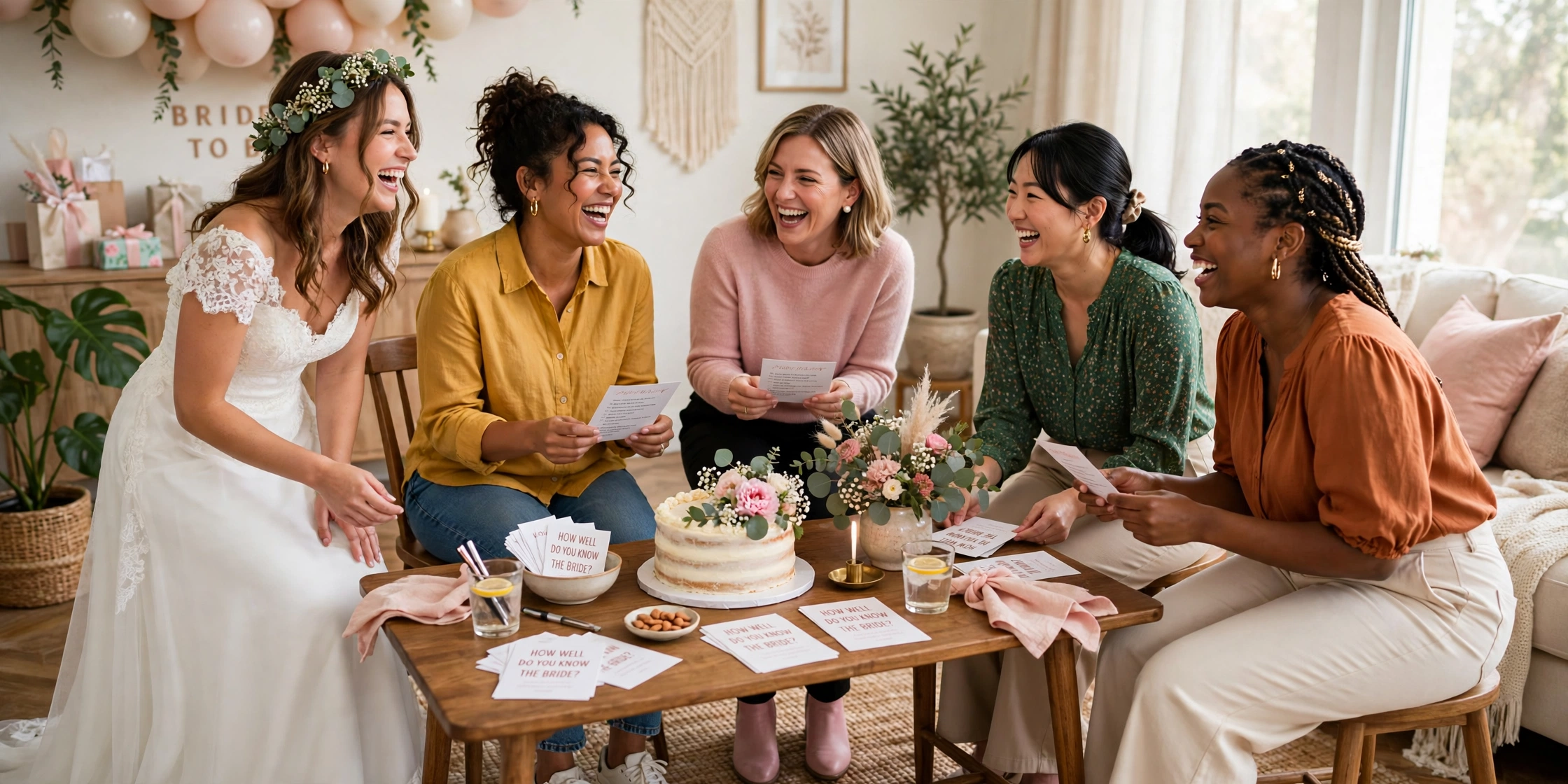
He said she said is a guessing game where each question has two possible answers, "he said" or "she said," and guests try to match the couple's real answers. The bride and the groom answer the same 30 questions separately before the shower. At the party, the host reads each question out loud, guests mark H or S, and the host reads the real answer after each one.
How does the he said she said game work?
You need three things: the couple's answers, one printed card per guest, and a host who reads out loud. Pens help. A timer helps. A prize helps. But the game itself is just questions and guesses, and that is why it works in a living room, a restaurant back room, or a garden.
Each guest gets a card with the 30 questions and two small boxes beside each one, marked H and S. The host reads question one out loud, gives guests about ten seconds to mark an answer, and then reads the couple's real answer before moving on. That rhythm matters: read, wait, reveal, let people react, move on.
Guests score one point for each match. A guest who guessed "she said" and the bride really did say it gets a point. There is no half point and no bonus for guessing fast. Knowing the couple matters, and that is the point of the game.
Showers are a big part of the wedding season, and guests do not just show up empty-handed. According to The Knot 2016 Wedding Guest Study, published by PR Newswire on 11 July 2017, among guests who attended a bridal shower, 8 in 10 bought a gift for the shower, spending an average of $75, and 95% of wedding guests also attend at least one other pre-wedding event. People have spent real money and real time to be there, so a game that gets the whole room laughing together is a fair return on that effort.
How do you get the couple's answers before the shower?
This is the step most hosts get wrong, and the whole game depends on it. If the couple's answers are guessed, rushed, or copied from each other, the game falls flat.
Send the same 30 questions to the bride and the groom separately, at least a week before the shower. Text, email, or a shared form all work, as long as each of them fills it in alone. Tell each of them: answer quickly, with the first thing that comes to mind, and do not check your answers with your partner.
When both lists come back, build the answer key. Go through the 30 questions one by one and write down who said what: H, S, or both, where they agreed. Mark the "both" questions clearly. If the couple agreed on a question, decide now that it is a free point for everyone, and write that on the key. Keep one printed copy for yourself and one spare in your bag, and never print the key on the back of the guest cards.
Ask the couple one more question, and it is not on the list of 30: is there any topic you would rather we left out? Some couples are happy to joke about money, or about who is messier. Others are not. If they flag a question, swap it for a spare. You only need 20 to run a good game.
For hosts planning the wider day, not just the game, our free printable wedding coordinator checklist covers who brings what and who sets up. And if the shower is part of a longer wedding countdown, the wedding planning checklist printable keeps the whole season in one place.
What are the 30 questions?
Here are the 30 questions, written fresh for this article in five groups of six. The order is deliberate: start warm, get funnier as the room loosens up, and save the habits and quirks for last. Read them out loud once, on your own, and cross out any question that does not fit this couple.
A note on how these were made: I wrote these 30 questions and the timed plan below for this article, built around the five parts of a couple's life guests actually know about. I did not copy them from another site. The honest limit: they have not been tested at a real shower by me, so if one lands oddly, drop it.
Romance — six questions to open the game:
1. Who said "I love you" first?
2. Who planned the first date?
3. Who was more nervous on the first date?
4. Who remembers the date of the first kiss?
5. Who picked the engagement ring?
6. Who cried first when the proposal happened?
Daily life — six questions guests can answer from what they have seen:
7. Who makes the bed in the morning?
8. Who does the dishes more often?
9. Who picks what to watch on TV?
10. Who is better at fixing things around the house?
11. Who folds the laundry?
12. Who checks that the front door is locked at night?
Funny — six questions that get the first real laugh:
13. Who is more likely to trip over nothing?
14. Who tells the same story at every party?
15. Who is worse at directions?
16. Who sings in the shower?
17. Who talks in their sleep?
18. Who takes longer to get ready to leave the house?
Food and travel — six questions about how they eat and where they go:
19. Who picks the restaurant when you eat out?
20. Who is the pickier eater?
21. Who does the grocery shopping?
22. Who packs the suitcase the night before a trip?
23. Who forgets the phone charger on holiday?
24. Who is more likely to try a strange dish on the menu?
Habits and quirks — six questions to close with, when the room is warm:
25. Who hogs the blanket at night?
26. Who leaves wet towels on the bathroom floor?
27. Who is grumpier in the morning?
28. Who loses their keys most often?
29. Who spends longer scrolling on their phone in bed?
30. Who is more likely to start a DIY job and not finish it?
Every question has a clear "he" or "she" answer, and none needs a long explanation. Every question is about the couple, not the guests. And every question is kind: nothing here is designed to embarrass anyone.
Print the questions on the card exactly as they appear here, one per line, with the two boxes beside each one. Use a font size of 12 points or larger, and leave a line at the top for the guest's name and one at the bottom for the total score.
How do you run the game at a 25-guest shower?
This is the timed plan I built for this article, written for a shower of about 25 guests. That number is not a guess: the average bridal shower has about 25 guests, with 20 to 30 the average range, according to Modern MOH, published 9 Jul 2021 and updated 11 Mar 2026. The timing below is a guide I worked out on paper, not a stopwatch reading from a real event.
Total time: 25 to 30 minutes, from the first card handed out to the prize being given.
Minutes 0 to 3: hand out the cards and pens. Walk table to table and give one card and one pen to each guest. Do not leave a stack of cards on a side table and hope people take one. Say the rules as you hand them out: mark H or S, one point per match, highest score wins.
Minutes 3 to 5: read the rules out loud, once. Stand where everyone can see you, hold up a card, and show guests where to mark. Say there is no shouting out, the answers come after each question, and the winner gets a prize. Then start.
Minutes 5 to 22: read the 30 questions. Read one question, wait about ten seconds, read the real answer, let the room react, then read the next question. That is roughly 30 to 35 seconds per question, or 15 to 18 minutes for all 30. Do not rush the reveal. If the room is large, read loudly and slowly, and keep the answer key in your hand.
Minutes 22 to 25: add up the scores. Ask guests to count their points and write the total at the bottom of the card. Then ask for scores from the top down: "Who scored over 25? Over 20? Over 15?" Hands go up, and you narrow it down without making the guest who scored 8 read their number out loud.
Minutes 25 to 28: tie-breaker and prize. Run the tie-breaker below, give the prize, and take a photo of the winner with the bride. Then let guests keep their cards if they like. The game is over, and the room moves on to gifts or cake with energy instead of a flat pause.
How does scoring work, and what happens in a tie?
Scoring is simple on purpose: one point for each correct guess, zero for a wrong guess, and the highest total wins. There is no bonus round and no penalty for a wrong answer. Simple scoring keeps the game fair.
Count the scores in the open. Ask guests to add their own points and write the total at the bottom. Then narrow the field by asking for score ranges. Check the top two or three cards yourself before you declare a winner. It takes thirty seconds, and it stops a guest who added wrong from claiming a win they did not earn.
Ties are common, so have a tie-breaker ready before the shower. Tie-breaker round one: the bride answers one new question in secret. Before the shower, ask her for one question only she can answer, such as how many pairs of shoes she owns. The closest guess wins.
Tie-breaker round two, if they are still tied: sudden death. Ask the bride a yes-or-no question the tied guests must guess, such as whether she would rather have a beach holiday or a city break. One question, one guess each, and the first guest to match her answer wins.
Tie-breaker round three, the last resort: the bride picks. Hand the tied cards to the bride and ask her to pick a winner. It works at a shower, because the day is about her, and nobody argues with the bride's choice.
The prize does not need to be big. A candle, a small box of chocolates, a gift card for a coffee shop, or a tiny potted plant all work. What matters is that there is a prize, given in front of everyone, with a small round of applause. Pick something thoughtful and wrap it.
And here is the part most hosts forget: the game ends, but the shower does not. The thank-you notes are the job that waits after everyone goes home. If you want a head start, our card maker turns the shower photos into thank-you cards the bride can send the same week. Cake, gifts, and then thank-you cards, in that order.
What variations work for co-ed, virtual and shoe-game showers?
Not every shower looks the same, and the game bends to fit. The questions stay the same. What changes is how the answers are collected and read out.
Co-ed showers, where the groom is in the room, are the easiest variation and the funniest. The groom sits beside the bride, and the host reads each question, then asks the couple to answer together, out loud, after the guests have marked their cards. The only rule: the couple must not discuss the answer before the guests mark theirs.
Virtual showers need a little more setup and the same questions. Send the card as a PDF a day before the call, or share a simple form with the 30 questions and two choices each. On the call, read the questions live, give guests fifteen seconds instead of ten, and have guests type H or S in the chat or hold up a card to their camera. The host keeps a list of scores. Plan for 30 to 35 minutes.
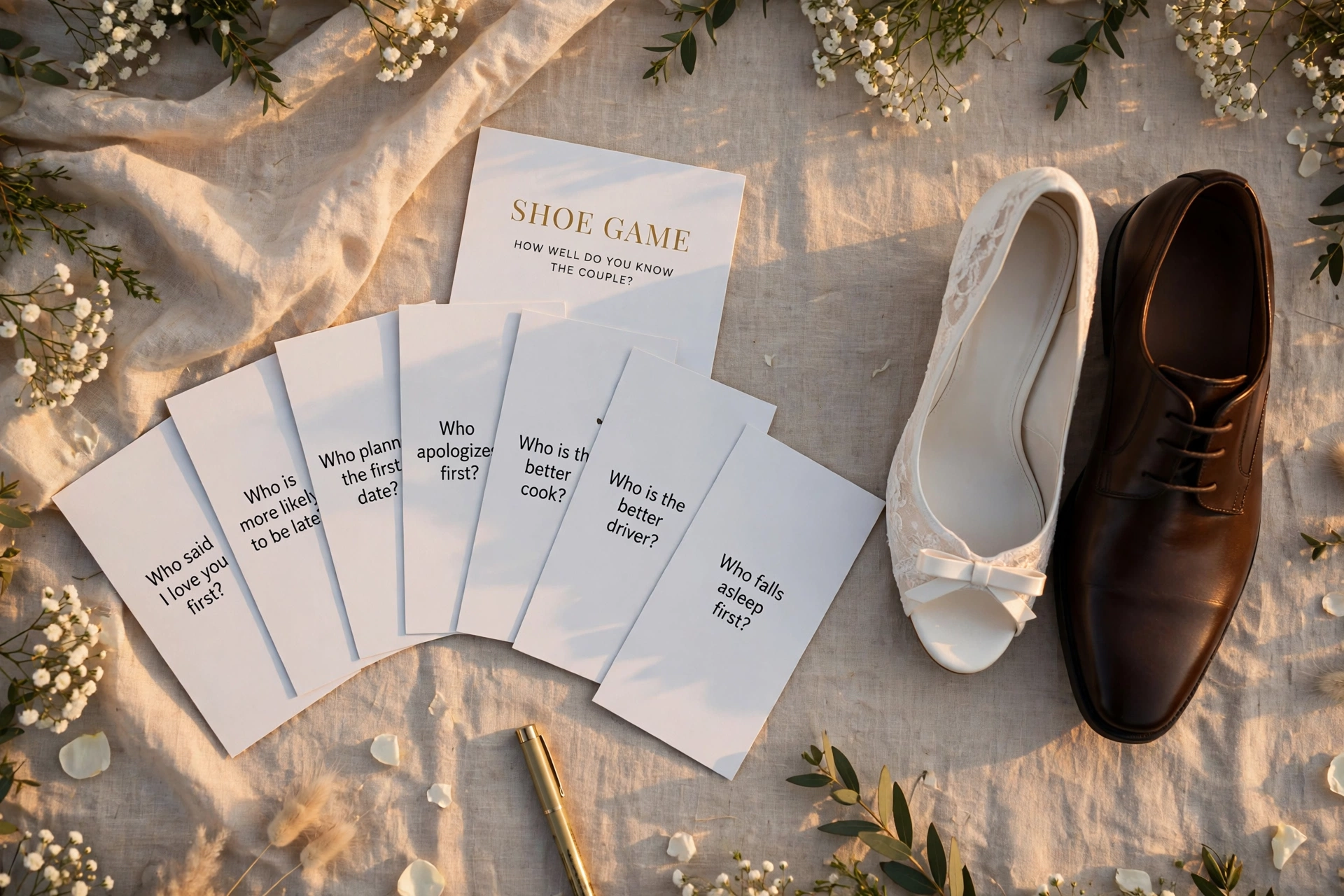
The shoe game is the cousin of he said she said, and some hosts run it instead. The bride and groom sit back to back, each holding one of their own shoes and one of their partner's shoes, and the host asks a question. They raise the shoe of the person the answer points to. It is visual and funny, but it is not the same game: he said she said lets all 25 guests play at once, while the shoe game is a show the guests watch. If the couple likes being the center of attention, run the card game first, then the shoe game with five questions.
Our fun shoe game questions page has the full 50 questions in five groups, with a 15-minute host plan for the reception version.
If you are planning a whole season of parties, the same card layout works for other games too. Our free printable birthday games for kids uses the same one-card-per-player idea for a younger crowd, and our free printable secret santa questionnaire uses the same question-and-answer shape for a Christmas party.
How do you print the cards so they look good?
A card that prints badly does not get played well. The fixes are small, and they are worth doing once.
Print at actual size, not "fit to page." Fit-to-page shrinks the text, and small text is hard to read when people hold a card in one hand and a glass in the other. Use a font size of 12 points or larger, and leave white space between the questions.
Use plain white card stock if you have it, or plain white paper if you do not. Card stock feels better in the hand and does not flop over. If you only have paper, print single-sided, because the back of a thin sheet shows pen marks through. Save color for the envelopes or the table decorations.
Set the printer to black and white. Color ink costs more without adding anything to a question card. Do not use draft mode: it makes the lines faint. Print one test card first, read it under the same light the party will use, and only then print the rest.
Print one card per guest, plus five spares: for the guest who spills coffee on theirs, the guest who arrives late, and the guest who wants to play twice. Print the answer key once, on its own page, and keep it with the host. Do not print the key on the back of the guest cards.
For a Christmas shower, the same printing rules apply to the festive games too. Our free printable christmas games page and our bingo game for christmas page both use the same one-card-per-player layout.
What mistakes spoil the game?
Most games fail in the same few ways, and all of them are easy to avoid.
The first mistake is collecting the couple's answers at the last minute. A groom who answers 30 questions in the car on the way to the shower gives rushed answers. Collect them a week early.
The second mistake is reading the questions too fast. A host who races through the list ends up with guests who missed three questions and stopped caring about the rest. Thirty seconds per question feels slow to the host and just right to the guests.
The third mistake is one card for the whole table. Six people sharing one card is not a game, it is a queue. Print one per guest. Paper is cheap. Waiting is not. Bring more pens than guests, because pens vanish at parties.
The fourth mistake is letting one guest shout out answers. Every room has one person who is sure they know the couple best and says the answer out loud before anyone has marked their card. Stop it kindly the first time: "Hold that thought, mark it first."
The fifth mistake is questions that embarrass the bride. A question about money, about an old relationship, or about a family argument has no place in a shower game. Read the list once through the bride's eyes before you print it.
The sixth mistake is no prize, or a prize nobody wants. A game with no prize ends flat, and a prize that feels like an afterthought sends the same message. A small, wrapped prize, given in front of everyone, closes the game properly.
The seventh mistake is running the game at the wrong time. Do not run it the moment guests arrive, or after the gifts, when everyone is tired. Run it in the middle, after food and before gifts.
Where should you go next?
You have the whole game now: 30 ready questions, a way to collect the couple's answers, a timed plan for 25 guests, scoring with tie-breakers, variations, printing settings, and the mistakes to avoid. Print the cards, collect the answers a week early, and run the game after food and before gifts.
If this shower has you planning the next party already, start with our printable baby shower games. It is a roundup of 12 games that use the same one-card-per-player idea, so the printing settings and the host's rhythm carry straight over. MerryHub is a printable-games and planner shop by ReplyPilot, and the baby shower roundup is the natural next page after this one.
Try it on MerryHub
- See the printable cards & games pack
- Printable Baby Shower Games
- Free Printable Wedding Coordinator Checklist