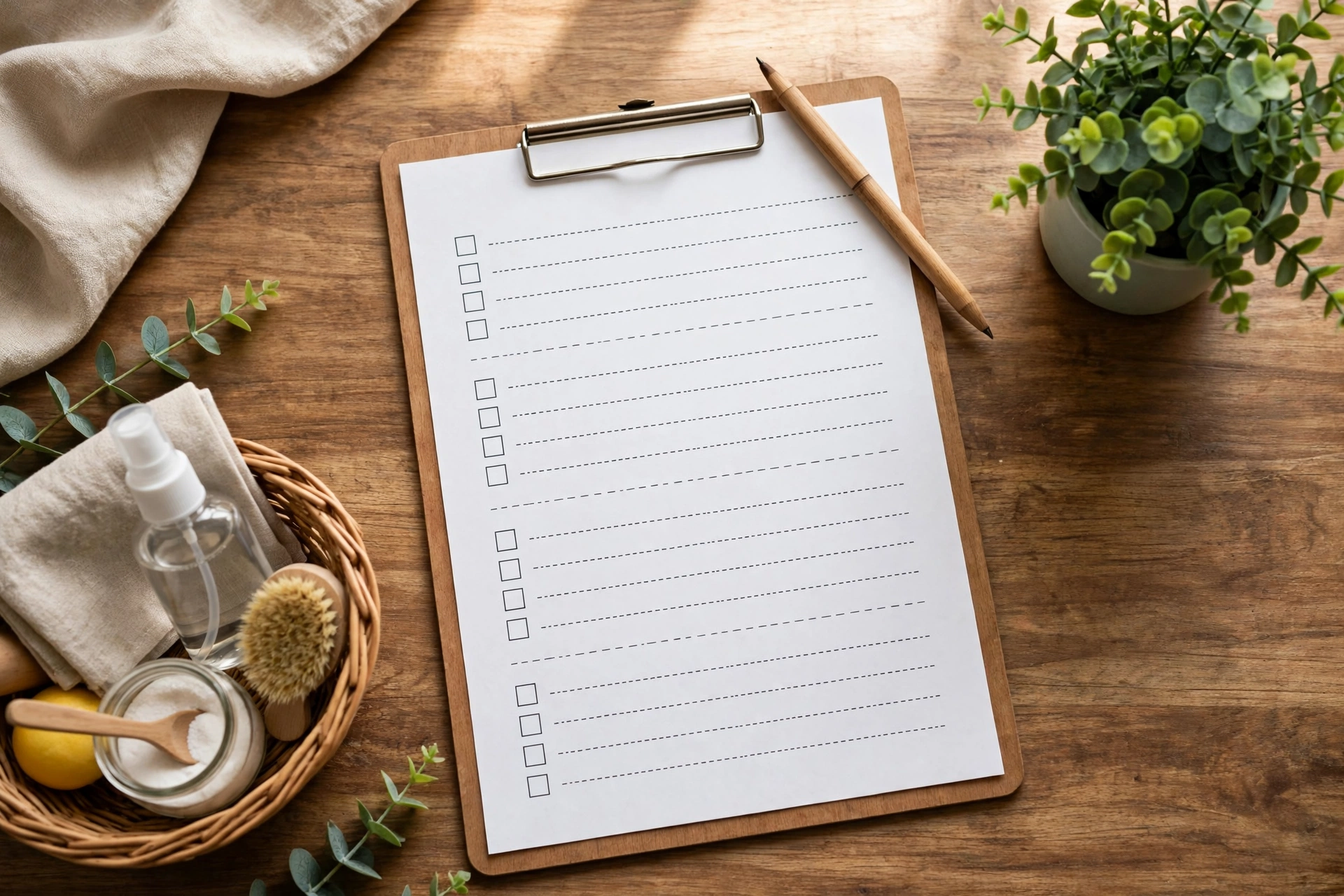
Quick answer: A free printable ADHD cleaning checklist is a short, tickable list of cleaning tasks broken down by room and by day, so you never have to decide what to do next. Print it, stick it on the fridge, and work through one small box at a time.
A checklist that does the deciding for you
MerryHub makes printable games, cards and planners for parties and family events that families download and print at home.
If your kitchen has been "almost clean" for three weeks, this page is for you. Not the version of you that deep-cleans the whole house on a Saturday. The real you. The one who walks into a messy room, feels the weight of it all at once, and walks straight back out again.
A checklist takes the deciding out of the job. You look at the paper, do the one thing it says, tick the box, and look again.
This page is the checklist itself: room-by-room tasks for the kitchen, bathroom, bedroom, living room, and entryway, plus daily, weekly, and monthly lists. Print it, or copy the parts you need. Our printable planners and checklists have more lists in the same style, and our printable daily planner template pairs well with it.
What is a free printable ADHD cleaning checklist?
A free printable ADHD cleaning checklist is a paper list of small, specific cleaning tasks, grouped by room and by how often they need doing, that you can print at home and tick off one box at a time.
The words matter. Free, because you should not have to pay to find out whether a list works for you. Printable, because paper works better than a phone for this job. A phone has notifications. Paper just sits there, quietly holding your place. ADHD, because a good list for an ADHD brain looks different from a normal cleaning list. And checklist, because the whole point is the ticking.
A normal list says "clean the kitchen." That is not a task. It is a project with fifteen hidden steps, and each one is a chance to get stuck. An ADHD-friendly list says "clear the counters," then "wipe the counters," then "load the dishwasher." Each line is one action you can finish in minutes. Tick it, feel the small win, and let that carry you to the next line.
Why does cleaning feel so hard with ADHD?
Because cleaning is almost perfectly designed to trip up an ADHD brain. It asks for the exact skills ADHD makes hardest: starting a boring task, holding a plan in your head, switching between small jobs, and finishing something with no deadline and no applause at the end.
Think about what "tidy the living room" asks you to do. Notice what is out of place. Decide where it belongs. Walk it there. Come back. Decide again. Meanwhile your brain spots the book you meant to read and the mug from yesterday, and each one opens a new thread. Twenty minutes later you are reorganizing a drawer, and the living room still looks the same. That is not failure. That is an ADHD brain following interest instead of a plan.
ADHD affects executive function, the brain's ability to prioritize and manage thoughts and actions. The CHADD guide to ADHD symptoms and treatment explains that people with ADHD can have difficulty with organization, following through with instructions, and sustaining attention on steady tasks. Cleaning is almost all steady effort with no clear finish line, so it hits exactly where the difficulty lives.
Some days the list will still feel too big. That is normal. Use the shorter version that day, further down this page. The low-energy list is not a consolation prize. It is part of the system.
How to use this checklist
Start small. That is not motivational talk. It is the method.
Pick one room. Not the worst room. The easiest one, or the one you spend the most time in. A small win in an easy room teaches your brain that this works, and that lesson is worth more than a heroic three-hour clean that leaves you exhausted and never repeated.
Before you start, set a timer for fifteen minutes. When it rings, you stop, even if you are mid-task. You can always do another fifteen later. Stopping on time keeps cleaning from becoming the thing you dread.
Work top to bottom: clear first, then wipe, then floor. Clearing first matters, because wiping a cluttered counter means moving everything twice. Do not jump ahead to the satisfying jobs. They are the reward for the boring ones.
Tick each box as you finish it. Out loud if it helps. "Counters, done." It sounds silly. It works. Your brain needs the feedback.
If a task takes longer than ten minutes, it is not one task. Break it. "Clean out the fridge" becomes "throw away the old food," "wipe one shelf," and "wipe the next shelf." There is no prize for keeping a task big.
The daily 15-minute list
This list keeps your home from sliding backwards. Fifteen minutes, once a day, at the same time if you can. After dinner works for many people. Pick the time you are already standing up and moving.
Do these in order. Skip nothing, but do not add anything either. The discipline is in the stopping.
That is eight tasks. On a good day they take fifteen minutes, on a slow day twenty. The point is not speed. It is that tomorrow starts from "mostly tidy" instead of "where do I even begin."
- Make the bed, or at least pull the covers straight
- Put dirty dishes in the dishwasher or sink
- Wipe the kitchen counters and the stove top
- Take out the trash if the bag is full
- Do one load of laundry, or fold one dry load
- Put shoes, bags, and coats where they belong
- Do a quick pick-up in the living room: five minutes, one bag or basket
- Wipe the bathroom sink and mirror
Kitchen checklist
The kitchen is where mess grows fastest, because it is used three times a day. It is also where a checklist pays off quickest. A clean kitchen changes how the whole house feels.
Work top to bottom, and clear before you clean.
Ten tasks. The first three are the hardest, because deciding what to keep is real decision work. Use a rule: if you cannot remember when you opened it, throw it away. If it has no lid and no label, throw it away.
- Clear everything off the counters into one pile
- Put clean dishes away and load dirty ones into the dishwasher
- Throw away old food from the fridge and the counters
- Wipe the counters and the stove top
- Clean the sink and wipe the faucet
- Wipe the outside of the fridge and the microwave
- Sweep the floor
- Mop the floor, or spot-clean the sticky patches
- Empty the trash and put in a fresh bag
- Wipe the cabinet fronts where hands leave marks
Bathroom checklist
Bathrooms are small, which is good news. One can go from awful to fine in about ten minutes, and the change is obvious. Start here on days when you need proof that cleaning works.
Eight tasks. Dry jobs first, wet jobs last, floor last of all. Mop first and drop a hairbrush, and you have to mop again. That small defeat can end a cleaning session early.
- Pick up towels, clothes, and bottles from the floor
- Put products back in their places
- Wipe the mirror
- Clean the sink and the faucet
- Wipe the toilet seat and the outside of the toilet
- Scrub the toilet bowl
- Shake out the bath mat or hang it to dry
- Sweep and mop the floor, or wipe it with a damp cloth
Bedroom checklist
A bedroom is the room you wake up in, and waking up to mess sets the tone for the day. A made bed and a clear floor are worth more than a perfect bedroom. They are the two things your eyes land on first.
Eight tasks. Every home has a chair for clothes that are not quite dirty and not quite clean. Give it a rule: anything there more than two days is either dirty and goes in the basket, or clean and goes in the drawer. The chair is not a wardrobe.
- Make the bed and straighten the pillows
- Put dirty clothes in the laundry basket
- Hang up or fold the clean clothes on the chair
- Clear the bedside table down to one or two things
- Put books, chargers, and cups where they belong
- Dust the dresser and the bedside table
- Empty the trash can
- Vacuum or sweep the floor
Living room checklist
The living room is the room other people see, which adds pressure that does not help. Forget impressing anyone. Clean it so sitting down feels nice. That is the only standard that matters.
Eight tasks. The last one is the secret weapon. Every living room collects objects from other rooms. Put them all in one basket, carry it around the house, and put each thing away. One trip. Done.
- Pick up cups, plates, and rubbish
- Put books, remotes, and chargers in their places
- Fold blankets and straighten the cushions
- Clear the coffee table and wipe it
- Dust the shelves and the television stand
- Shake out or vacuum the cushions
- Vacuum or sweep the floor
- Take out anything that belongs in another room
Entryway checklist
The entryway is small, but it sets the tone. It is the first thing you see coming home and the last thing you see leaving. A clear entryway makes the whole house feel more under control.
Six tasks. The fastest list on the page, and a good place to start when the whole house feels too big. Six ticks in five minutes. Real wins build momentum.
- Hang up coats and put shoes on the rack or in their place
- Put bags, keys, and mail where they belong
- Clear the console table or shelf
- Throw away junk mail and old flyers
- Wipe the door handles and the light switch
- Sweep the floor and shake out the doormat
The weekly list
Daily lists stop the slide. Weekly lists do the deeper work. Pick one day a week. Saturday morning is common. Sunday evening works too. The day matters less than the habit.
Ten tasks. Do not try to do all ten in one heroic session. Split them: five in the morning, five after lunch, or three a day across the week. The list is weekly, not "must be finished by noon on Saturday."
- Change the bed sheets and pillowcases
- Vacuum all the floors properly, including under the bed and sofa
- Mop the kitchen and bathroom floors
- Clean the bathroom properly: shower, tiles, and toilet
- Wipe mirrors and windows in the main rooms
- Dust shelves, windowsills, and picture frames
- Take out the trash and recycling from every room
- Clean out one shelf or drawer in the fridge
- Do a full laundry round: wash, dry, fold, put away
- Water the plants and wipe their leaves if dusty
The monthly list
Monthly tasks are the ones everyone forgets until they become a problem: the filter, the oven, the windows. Once a month keeps them small. Waiting a year turns them into a weekend project nobody wants.
The last task is the most important one on this list. Homes fill up slowly, one object at a time, and clutter makes every other list harder. One cupboard a month is twelve cupboards a year. That is a different house by next winter, built from one small decision a month.
- Deep-clean the oven and the microwave inside
- Clean the fridge fully, shelf by shelf
- Wash the windows inside
- Clean the washing machine filter and run a cleaning cycle
- Vacuum the sofa and under the cushions
- Dust the tops of cupboards and door frames
- Clean the shower head and the bathroom drains
- Sort one cupboard, drawer, or closet and remove what you no longer use
What is the 20-10 method?
The 20-10 method is simple: clean for 20 minutes, then rest for 10 minutes, and repeat. That is the whole method. Twenty on, ten off. It works because it gives your brain two things it craves: a clear end point and a promised break.
Here is a worked example. Saturday morning, kitchen needs attention. Set a timer for 20 minutes and start at the top of the kitchen list: clear the counters, load the dishwasher, throw away old food, wipe the counters. When the timer rings you have probably done five or six tasks. Stop. Rest ten minutes. Then choose: another round, or stop for the day.
Two rounds is 40 minutes of cleaning with a real break in the middle. Most people are surprised how much that covers. Work in pieces with rest built in, and a kitchen that felt impossible is suddenly done.
Three rules make it work. First, the rest is real rest. Do not use the ten minutes to start another chore. Second, stop when the timer rings, even if you are mid-task. Third, two rounds is a great day. Three is a big day.
The ADDA guide to ADHD facts lists difficulty with organization, prioritizing, and following through on daily routines among the common signs of ADHD in adults. The 20-10 method answers that directly: it replaces prioritizing with a timer and "follow through" with a list that tells you the next step. You do not need more willpower. You need a smaller next step and a clock that says when to stop.
The low-energy version
Some days are low days. Bad sleep. A hard week. Your brain feels like it is running on one bar of battery. On those days, the goal is the smallest useful thing, done without guilt.
Here is the low-energy list. Six tasks. Nothing else.
That is it. No vacuuming. No mopping. No fridge. Six small actions that stop the house getting worse. On a low-energy day, control is worth more than cleanliness.
A low-energy day is not a failed day. You did the list. The list is finished. The rest can wait until tomorrow.
- Make the bed, or just pull the covers up
- Put all the dirty dishes in the sink and fill it with hot water
- Take out the trash if it smells
- Put one bag of rubbish or clutter by the front door
- Wipe the bathroom sink quickly with a damp cloth
- Put your shoes and keys in their places
How to build your own checklist
This page gives you a full list, but your home is not my home. You might not have a bath mat. You might have a cat, a baby, or a housemate who leaves mugs everywhere. A checklist only works if it matches your actual house, so here is how to make it yours in about twenty minutes.
Walk through your home with a notebook, room by room, and write down everything you can see that needs doing. Do not organize yet. Just list. The kitchen alone will probably give you fifteen lines. That is normal.
Now sort each room's list into three piles: every day, once a week, once a month. Dishes are daily. Vacuuming is weekly. The oven is monthly. If you are not sure, ask yourself what happens if you skip it for a week. If nothing bad happens, it is weekly or monthly. If it smells, it is daily.
Next, break any line longer than ten minutes into smaller lines. "Clean the bathroom" becomes four lines. If a line still feels scary, it is still too big.
Finally, cut the list. Cross out anything that is not really your job or that you do once a year. A checklist with forty lines gets used. One with a hundred lines gets folded up and forgotten.
If you want the bigger picture, how the daily, weekly, and monthly pieces fit into one routine, our ADHD cleaning planner guide walks through the full system. This page is the checklist. That page is the plan that holds it together.
Printing tips
A checklist only helps if you can read it and tick it. A few small choices make a big difference.
Print on plain paper, not glossy. Glossy paper smears when you tick it, and a smeared list is a list you stop using. Use a font size you can read from arm's length. Fourteen point is a good size for a list that lives on a fridge.
Keep a pen attached to the list. A list without a pen is a poster. A list with a pen is a tool. And print two copies: one for the fridge, one for your bag or bedroom door. The best checklist is useless if it is in the kitchen and you are in the bedroom wondering what to do next.
The ready-made next step
You know the system now: small tasks, one room at a time, a timer, and a list that tells you the next step. You can build all of that yourself from this page, and the checklist above is free to print and use.
If you would rather skip the building, our ADHD-Friendly Planner ($4) is the natural next step. It is an undated printable planner for adults with daily, weekly, and reset pages, so your cleaning checklist sits next to the rest of your day. You can find it on Whop. No pressure. The free list above is a complete system on its own. The planner just saves you drawing it all up yourself.
About 880 searches a month in the US use the phrase "free printable ADHD cleaning checklist" (Semrush, November 2026). That is a lot of people looking for the same thing you are: a list that makes starting easier. You are not the only one who finds cleaning hard.
This page lists 72 tasks across its daily, weekly, monthly, low-energy, and room-by-room lists, so you can pick the lines that fit your home and ignore the rest. You do not need all 72. You need the ten or fifteen that match your rooms and your life.
Your next step
You have the full list now. The best next thing is small: print this page, pick one room, and set a timer for fifteen minutes. That is the whole job for today.
When you want the printable download version, with the daily, weekly, and monthly pages ready to print, go to our ADHD cleaning planner PDF. Same system, print-ready, so you can keep it on the fridge and start tomorrow.
And if you want cleaning tasks next to the rest of your day, the ADHD-Friendly Planner ($4) on Whop has undated daily, weekly, and reset pages for adults. Start with the free list. Add the planner when it saves you time. Either way, you have already started, and starting was always the hard part.
Try it on MerryHub
- Printable planners and checklists
- Printable daily planner template
- ADHD cleaning planner guide
- ADHD cleaning planner PDF