Quick answer: A printable daily planner template is a page that holds your day: your top three priorities, your time blocks, your tasks and a short review. Used well, it takes about ten minutes a day and stops the day from running you. This guide teaches the routine, each section, and how to keep going past week one.
What a daily planner page is for
A daily planner page has one job: to turn a busy day into a short list of things that will actually get done. It is not a diary, and it is not a place to record everything that happened. It is a tool you look at in the morning to decide the day, and look at again in the evening to close it. Everything on the page should help with one of those two moments.
Most people do not need a more complicated system. They need a page that answers three questions before the day starts: what matters most today, when will I do it, and what else must not be forgotten. If a planner page answers those three questions, it is doing its job, no matter how plain it looks. If it does not answer them, then even a beautiful page is just decoration.
A printable page has one advantage over a phone app: it stays in one place, it shows the whole day at a glance, and it does not buzz, suggest, or distract. You write on it with a pen, which slows you down just enough to think. Many people find that writing the day by hand helps them remember it better than typing it into a screen. Psychologists who compared the two found that taking notes by hand led to better understanding than typing them. You can still keep appointments on your phone. The planner page is for the day itself: the priorities, the order, and the promise to yourself about what will get done.
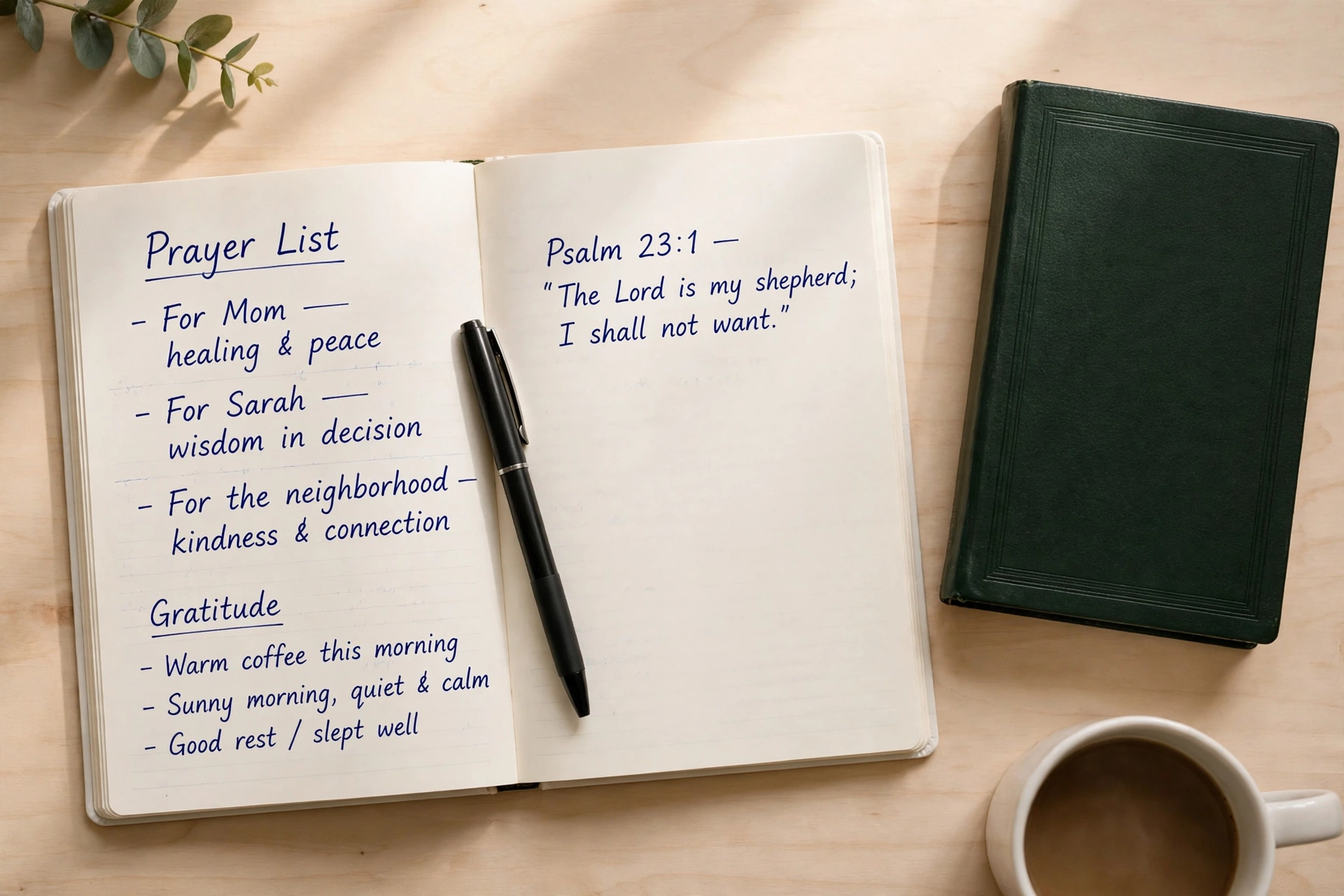
If your daily page also needs room for prayer and scripture, a faith planner keeps those on the same page as your tasks.
The 10-minute daily routine
A planner only works if using it takes less time than the chaos it replaces. The routine below takes about ten minutes in total, split across the day, and it is the whole method. Do not add steps to it. The simplicity is the point.
Start with five minutes in the morning, before the day pulls you in. Sit with the blank page and a pen, and do three things in order. First, pick your top three priorities, the three things that would make today feel successful even if nothing else got done. Second, block the day, giving each priority a rough time, and leaving gaps between blocks. Third, list the small tasks that must also happen, like calls, errands and messages, without letting them push the top three off the page.
Then use the page during the day as a reference, not a chore. Glance at it when you finish something, cross it off, and move to the next block. Do not rewrite the page mid-day, and do not reorganise it when plans change. Cross things out, write a new time beside a moved block, and carry on. A planner page that looks a little messy by evening is a page that was actually used.
End with five minutes in the evening, when the day is done. This is the review, and it is the step most people skip, which is why most planner habits die. Look at what got done, and write one line about it. Move anything unfinished to tomorrow's page, honestly, not hopefully. If a task has been moved three days in a row, it is either not important, in which case you should drop it, or it is too big, in which case you should break it into a smaller first step. Then close the page. The day is finished, and tomorrow starts blank.
What goes in each section of a daily page
A good daily page has five sections, and each one has a clear job. If you build your own page, include all five. If a section is missing, its job does not disappear; it just crowds into the other sections and makes them messy.
- Date and top three priorities: the date at the top, and directly under it, three lines for the three things that matter most today. These are not the three easiest things, or the three loudest things. They are the three things you would choose if you could only do three. Writing them first, before anything else, is what stops the day from being eaten by small jobs.
- Schedule and time blocks: a column of hours, or a set of blank blocks you can label, for the shape of the day. This is where appointments go, and where each top priority gets a time. Time blocking is simply deciding when a thing happens, instead of only deciding that it should happen. A priority without a time is a wish. A priority with a time is a plan.
- Tasks: a short list of the smaller jobs that must happen today, separate from the top three. Keep this list short, ideally no more than five or six items. If the list grows longer, it stops being a daily list and becomes a wish list, and wish lists do not get finished. Anything that does not fit goes on a separate master list, to be picked from on another day.
- Notes: a small open space for anything the other sections cannot hold. A phone number, an idea that arrived mid-day, a reminder to buy something, a thought worth keeping. Notes are the safety valve of the page. Without them, stray thoughts end up scribbled across the schedule and the priorities, and the page becomes hard to read.
- Review: two or three lines at the bottom for the evening check. What got done, what moved to tomorrow, and one line about how the day went. The review is not a grade. It is a record, so that over weeks you can see patterns: which days work well, which times suit deep work, and which tasks keep being postponed.
Daily, weekly and monthly planning: when each wins
Daily planning answers the question of what today holds. Weekly planning answers a different question: what does this week hold, and which days should carry which jobs. Monthly planning answers a third: what is coming, what are the big dates, and what must be prepared in advance. Each one wins at its own scale, and each one fails when asked to do another's job.
Daily planning wins when life is busy and changeable. It is the right tool for a day full of appointments, deadlines and small jobs, because it forces a fresh choice every morning about what matters. It fails when used alone, because a day page cannot show you that Friday is already overloaded, or that a big project needs three days of steady work, not one heroic afternoon.
Weekly planning wins when you need to spread work across days. On a Sunday evening or a Monday morning, a weekly view lets you place the big jobs on the days with room, keep one day lighter for catching up, and see clashes before they happen. It fails when it tries to hold hourly detail, because a week page with every hour filled becomes unreadable by Tuesday, when plans have already changed.
Monthly planning wins for the big picture. Birthdays, holidays, deadlines, trips and school terms all live at monthly scale. A monthly view is where you spot that December will be busy, that a project deadline lands in the same week as a family visit, or that you need to start preparing something two weeks early. It fails as a daily tool, because a month page cannot hold the detail of a single Tuesday.
The practical answer is to use all three, but lightly. A monthly page for dates and deadlines, a weekly page for spreading the work, and a daily page for running each day. That is the system behind most good planner bundles, and it is why a single daily page, used alone, often disappoints. The daily page is the engine, but it needs the weekly and monthly views to steer it.
A one-page layout you can copy
Here is a layout for one daily page, described in full so you can draw it on a blank sheet, copy it into a notebook, or set it up in any document. No special supplies are needed, only a pen, a ruler if you like straight lines, and a page.
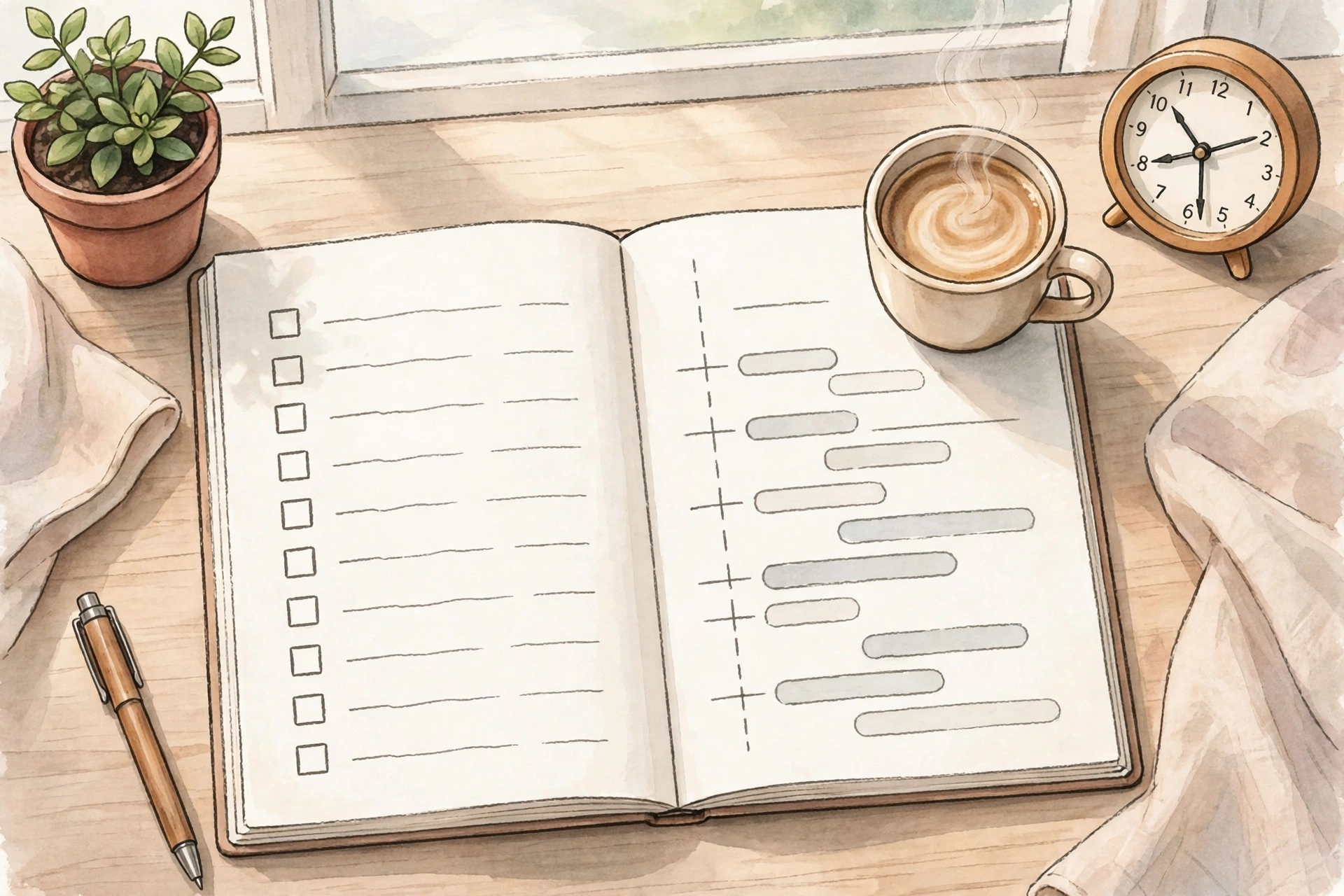
Draw a line near the top for the date, and write the day and date there each morning. Under it, draw a box with three numbered lines, and label it Top Three. These are your three priorities, written before anything else. Leave the lines long enough for a short sentence each, not just a single word, because a vague priority like "work" does not tell you what to actually do.
Down the left side of the page, draw a column for the schedule, with one row for each hour of your working day, or one row for each block of the day if you prefer, such as morning, midday and afternoon. Write appointments in this column, and write the time for each top priority beside it. Down the right side, draw a smaller box labelled Tasks, with six short lines, each starting with a small empty square to tick off.
Under the schedule and tasks, leave a box labelled Notes, about a quarter of the page, for anything that does not fit elsewhere. At the very bottom, draw a final box labelled Review, with three short prompts written inside it: Done today, Moved to tomorrow, and One line about the day. Fill the review in the evening, in a few words, not an essay.
Use this layout for a full week before changing it. A layout that feels awkward on day one often feels natural by day four, once your hand learns where things go. Only change a section if, after a week, you still never use it, or you keep needing a space that is not there. Small, patient changes beat redesigning the page every morning.
Common mistakes that break a planner habit
Most planner habits do not fail because the planner is bad. They fail because of a few predictable mistakes, and knowing them in advance is half the cure.
- Overfilling the day: writing twelve tasks on a page built for five, then feeling defeated by evening. A day has limited hours, and a planner that pretends otherwise teaches you to ignore it. Pick three priorities and a handful of small tasks, and let the rest wait. An honest short list beats an impressive long one that never gets finished.
- No buffer: packing every hour with work, so that one late meeting or one long phone call wrecks the whole day. Leave gaps between blocks, especially around appointments and school runs. A gap is not wasted time. It is the space where life happens, and a plan with no gaps is a plan that breaks on contact with real life.
- Copying someone else's schedule: taking a routine from a video or a book and forcing your day into it, even though your job, your family and your energy are different. Someone else's 5 a.m. routine is not your routine unless your life matches theirs. Build the day around your real hours, your real energy peaks, and your real commitments, and the plan will hold.
- Planning without reviewing: writing a beautiful morning plan and never looking at it again until the next morning. Without the evening review, unfinished tasks pile up invisibly, and the same jobs get rewritten day after day. The review is what turns planning from a morning ritual into a system that actually learns.
- Treating a missed day as failure: skipping one day, deciding the habit is broken, and abandoning the planner entirely. Every planner user misses days. Holidays, illness and busy weeks interrupt everyone. The habit is not broken by a missed day. It is broken by the decision not to return. A blank day is just a blank day. Pick up the next page and start again.
How to stick with it past week one
Week one is easy, because the page is new and the motivation is fresh. Week two is where habits are decided, and the trick is to make returning to the page easier than skipping it.
Keep the page where you will see it in the morning. On the kitchen table, beside your keys, or open on your desk, not buried in a drawer or a bag. A planner you have to hunt for is a planner you will skip. Keep the pen with it, attached if you can, so there is no small friction between waking up and writing the top three.
Tie the morning five minutes to something you already do every day, like making coffee, waiting for the kettle, or sitting down after breakfast. Habits stick when they attach to an existing routine, not when they float free, waiting for willpower. The same goes for the evening review: attach it to something you already do, like charging your phone or locking up for the night.
Lower the bar on hard days. On a day when you are ill, travelling or overwhelmed, the whole routine can shrink to one line: a single top priority, written on any scrap of paper. That still counts. Habits survive because they bend, not because they never break. A one-line day keeps the thread alive until a normal day returns.
Finally, look back after a month, not after a day. Read through four weeks of review lines, and notice what they tell you. Which days felt good, and what did they have in common. Which tasks kept moving, and what smaller first step would unstick them. That monthly look-back is the reward for the daily habit, because it shows you your own life, clearly, in your own handwriting. That is what a planner is really for.
The planner system behind this page
This guide teaches the method, and the method works on any blank page, drawn by hand. If you want the full system ready to print, rather than drawing it yourself each time, the Planners and Productivity Bundle on the printables page holds it: undated daily, weekly, habit and goal pages, 28 A4 pages in total, editable in the PDF, so you can type into the pages or print them blank. Undated matters, because it means a missed week does not waste the bundle. You simply start on the next page, whenever you return, without throwing dated pages away.
That bundle is the system behind this guide: daily pages for running each day, weekly pages for spreading the work, habit pages for tracking the routines you want to keep, and goal pages for the bigger aims those routines serve. Start with the daily page in this guide, use it for a week, and if the habit holds, the bundle gives you the weekly and monthly views to grow into. Planning December day by day works the same way, and the Advent activity cards guide shows how one small planned activity a day can carry a whole month, which is exactly the rhythm a daily planner teaches.