Quick answer: Advent activity cards are small cards, one for each day from 1 to 24 December, each with a simple Christmas activity for children that day. Print them, cut them out, and place one in each pocket, envelope or jar of a reusable advent calendar. Each morning a child opens one card and discovers the day's activity.
Why activity cards beat chocolate calendars
Chocolate calendars are easy, but they are over in ten seconds and forgotten by lunch. Activity calendars give children something to look forward to all day, not just at breakfast. A card that says "build a snowman from socks" or "read a Christmas story by torchlight" turns an ordinary December evening into a small event.
They also solve the hardest part of December parenting: the daily question of what to do after school. Instead of inventing an activity every evening while dinner cooks, you decide once, in November, and the cards decide for you all month. Parents who have used them say the same thing: December feels calmer, because the plan is already made.
Activity cards are also reusable in a way chocolate is not. The same set of pockets, jars or envelopes works year after year. You only change the cards, or even reuse the same cards and let children enjoy their favourites again. For families watching spending, that matters: one afternoon of preparation replaces 24 days of buying treats and thinking up plans.
How advent activity cards work
The idea is simple, and that is why it works for ages three to ten. You need three things: a container with 24 spaces, one card per space, and a daily moment to open one. Most families open the card at breakfast or after school, so the activity can happen that evening.
Number the spaces 1 to 24. Mix the cards so busy days get easy activities and weekends get the bigger ones. That one tip — easy cards on weekdays, big cards on weekends — is the difference between a calendar that works and one that leaves you baking biscuits at 9 pm on a Tuesday.
If you want the days themselves planned week by week as well, our Christmas Countdown Activities for Kids guide lays out a full 24-day plan, and the ready-made sets are gathered in one place in our printables collection.
- Pockets: a fabric wall hanging with 24 pockets, bought once and used for years. Cards slide in and out easily.
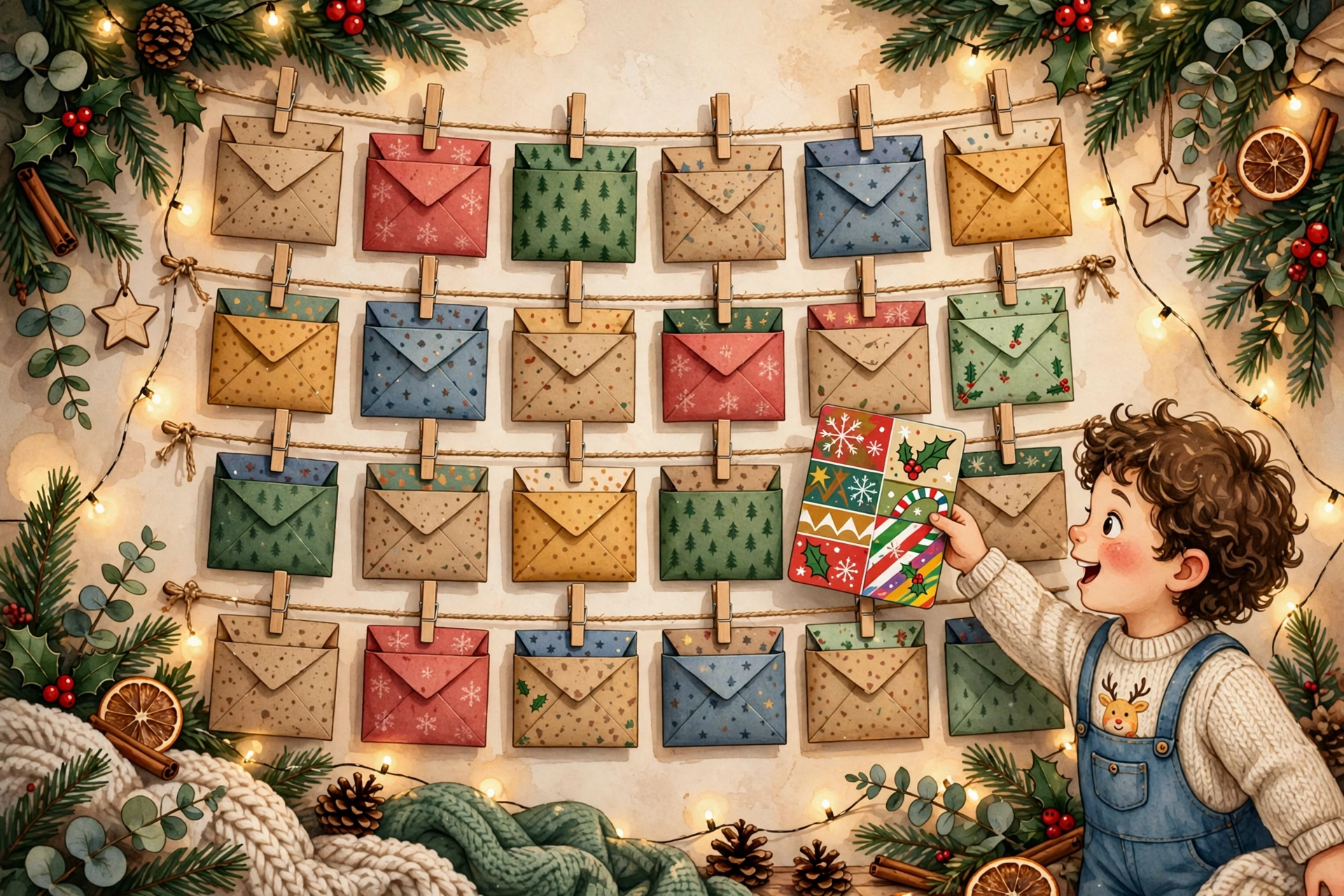
- Envelopes: 24 small envelopes pegged to a string, a ribbon, or a branch. Cheap, pretty, and easy to make with children.
- Jars or boxes: 24 small jars, tins or matchboxes on a shelf. Children love lifting lids and peeking inside.
- Paper bags: 24 small paper bags folded over and numbered. The simplest option, and children can decorate them themselves.
25 activity ideas you can use right away
You do not need to buy a set to start. The ideas below cover the full month, with a mix of craft, cooking, kindness, outdoor and quiet activities. Pick 24, swap any that do not suit your family, and write each one on a card.
Keep the wording on each card short and exciting: "Tonight we bake biscuits!" works better than a paragraph of instructions. Children should feel a small thrill when they read it, not like they have been given homework.
- Day ideas for the full countdown: bake simple biscuits together; make paper snowflakes for the windows; write a letter to Santa; read a Christmas story by torchlight; build a blanket fort and watch a Christmas film; make a bird feeder with peanut butter and seeds; sing three carols together, loudly; deliver a card to a neighbour; make salt-dough ornaments; have hot chocolate with marshmallows; draw a Christmas picture for grandparents; do a Christmas puzzle together; make reindeer food with oats; wrap a gift for someone else; go for a walk to see the lights; make a paper chain; build a gingerbread house from a kit; have a Christmas picnic on the floor; make handprint reindeer art; play a board game by candlelight; donate a toy to a collection box; make popcorn garlands; decorate the tree together; write thank-you notes; on Christmas Eve, read one final story and leave out milk and cookies.
Activities by age: what actually works
A card that delights a four-year-old can bore a nine-year-old, so match the mix to your children. For ages three to five, keep every activity short, hands-on and a little messy: sticking, painting, sprinkling, building. Avoid anything with long instructions or waiting times. Colouring, simple crafts and outdoor walks are the winners here.
For ages six to eight, add small challenges and a sense of helping: writing the cards, measuring ingredients, wrapping a real gift, making something for someone else. These children love being trusted with a proper job, and an activity card that says "you are in charge of tonight's biscuits" feels like a promotion.
For ages nine and up, give them ownership. Let them choose or even write some of the cards, plan the weekend activities, or teach a younger sibling a craft. Older children who help make the calendar rarely complain that it is "for little kids", because it is partly theirs.
If your children span several ages, write cards with a job for everyone: one child stirs, one decorates, one reads the card aloud. Shared activities beat parallel ones, and they are what children remember in January.
Making your own cards in one afternoon
You can make a full set in about an hour, and children can help. This is the part many families enjoy almost as much as December itself, because making the calendar becomes the first Christmas activity of the year.
If handwriting 24 cards sounds like too much, MerryHub's printable pack includes a set of 25 ready advent activity cards, so you can print, cut and fill your calendar in minutes instead of an afternoon. Either way, the calendar itself is what children remember, not how the cards were made.
- Print or write the cards. Use thick paper or card so they survive 24 mornings of small hands. Each card needs only the day number and one activity.
- Add a picture if you like. A small drawing, a sticker or a stamp makes cards easier for young children who cannot read yet.
- Mix easy and big days on purpose. Put crafts and baking on weekends, and quiet activities — a story, a song, a puzzle — on school nights.
- Include two or three kindness cards. A card that says "give a compliment to everyone at dinner" or "choose a toy to donate" teaches more than any craft, and children often pick these as their favourites.
- Keep three blank spare cards. Something will go wrong — a sick day, a late evening, a forgotten ingredient. A spare card that says "free choice: pick any activity from this month" saves the day without breaking the magic.
When the card does not quite fit the child in front of you
The easiest fix is not a new calendar. It is a swap written on the back of the card before December starts. As you fill the pockets, ask of each activity: what would this look like for the youngest child here, and for the oldest? If you can answer both in a few words, the card stays. If not, write the easier or harder version underneath, in pencil, while you still have time to think.
For a toddler, the swap is usually about joining in safely rather than finishing anything. A card that says "decorate biscuits" becomes "press one sprinkle star onto a biscuit, then eat your work". A walk to see the lights becomes a ride in the pushchair under a warm blanket, spotting one thing: the house with the blue door. Keep their part to two or three minutes, and let them carry the card back to its pocket and post it in themselves.
For a teenager who has decided advent is for little children, do not argue, and do not ask them to perform enthusiasm. Offer a role with a little status instead. They can be the keeper who brings the card to breakfast without reading it first, the person who chooses the music while a craft happens, or the judge who scores paper snowflakes for drama rather than neatness. A card aimed at them might say "choose tonight's Christmas song and defend your choice", or "plan one stop on Saturday's walk".
Pocket-sized backup cards for low-energy days
Some December days start tired. A parent has a headache, a baby has been up in the night, or everyone comes home damp from the rain and the planned craft feels like a mountain. For days like that, keep a separate little bundle: five or six backup cards in a different-coloured envelope, tucked at the front of the calendar box. Reaching for them is not cheating. It is the plan working exactly as it should.
Notice what these backups share. None of them needs a table cleared, a bag emptied or a shop visited. Most can happen on a sofa, in a kitchen doorway, or already in pyjamas. Save at least two cosy cards for the final week, when tiredness is almost guaranteed.
- Count the baubles. Sit where you are, point at the tree together, and count slowly — or find every bauble of one colour.
- Christmas statues. One person calls out "snowman", "reindeer" or "tree"; everyone freezes in that shape for three breaths, then melts.
- A story in six sentences. Take turns adding one sentence about a robin who missed the last bus north, and let the youngest person say the final line.
- Warm drink tasting. Two mugs, eyes closed for anyone who wants to, and everyone guesses which one hides the extra spoon of cocoa.
- Card on the pillow. Tonight's whole activity is choosing tomorrow's pyjamas and leaving the next card where it will be found first.
- Lights from the window. No coats and no walk: stand at the darkest window for two minutes and name the furthest light you can see.
Handwritten, printed, or a cheerful mixture of both
Handwritten cards carry a charm printed ones cannot copy. A parent's handwriting, a wobbly star in the corner and a joke in brackets — "yes, you may eat one while you decorate" — become part of what a child keeps. If you love making them, sit down with a mug, a thick pen and the radio on, and write the whole month in one sitting rather than across three dutiful evenings.
Printed cards win on time, legibility and sameness. Every card is the same size, fits the same pocket, and can be read by a grandparent, a babysitter or a half-awake six-year-old without help. They are also kinder when your December is already full, or when your handwriting turns a short instruction into a puzzle.
Many families settle happily in the middle: print the main set, then personalise a handful. Add a sticker to the card that falls on a family birthday, write a name on the card for the day grandparents visit, and keep two blank cards for ideas that only occur to you once the month has begun. The mixture gives you the speed of printing with the fingerprints of home still on it.
Planning the whole month on one page, before you fill a single pocket
Before any card goes into a pocket, lay the month out on one sheet of paper — a notebook page is plenty, as long as you will actually keep it. Draw four rough week boxes and mark the fixed points first: school plays and parties, late work nights, travel days, visitors, and the evenings when you know everyone will be home early. You are not choosing activities yet. You are looking at the shape of your December.
Now place the bigger cards. Baking, building and visiting belong beside free afternoons and willing adults; quiet cards belong beside late nights and early starts. If one week already holds three fixed events, give that week the simplest cards — December awards no extra points for difficulty. This one-page view is also where a treat evening fits naturally: one of the big weekend cards can simply be a games night chosen from our Free Printable Christmas Games, instead of three separate activities squeezed into one tired Friday.
As you place each card, sprinkle in kindness where it costs nothing extra. Two or three of these small acts, spread across the month, change the feel of the whole countdown:
- Hide a tiny drawing inside a family member's coat pocket, to be found on a cold morning tomorrow.
- Call or video-call someone who lives alone and ask them one question about Christmas when they were small — then really listen.
- Choose one good item from the cupboard together and put it by the front door for the next food collection point you pass.
- Pick up litter on your own street for five minutes, gloves on, and count what you collect like treasure hunters.
- Thank the person who cooked by washing one pan properly, without being asked, before anyone leaves the kitchen.
- Leave a short thank-you note where your post is delivered, for the person who walks it to your door in the rain.
Busy nights, sick days and swaps: the honest guide
No family does all 24 activities perfectly. Someone gets ill, work runs late, or a card says "bake" on a night when everyone is exhausted. That does not mean the calendar has failed. It means you need a swap rule, agreed in advance.
The simplest swap rule is this: any card can be swapped with any later card, once, no questions asked. A Tuesday baking card moves to Saturday, and Saturday's story card moves to Tuesday. Children accept swaps happily when the rule is clear from the start, because nothing is cancelled — it is only moved.
For truly impossible days, keep the "free choice" spare cards from the making stage. A child choosing their own activity from the month's list is still opening a card, still counting down, and still happy. The calendar survives, and so does your evening.
One more honest tip: start the calendar on 1 December, not earlier, even if children beg. The countdown only works because it counts down. Starting early makes the last week drag, and the whole point of advent is the waiting.
Advent cards and the rest of your Christmas countdown
Activity cards sit naturally alongside the other countdown traditions on this site. The Christmas countdown page helps children watch the days tick down, and the countdown activities guide has more ideas for families who want screen-free ways to fill December evenings. Together, they turn waiting for Christmas from the hardest part of the month into the best part.
If your family also has an elf, the two traditions pair beautifully: the elf can "deliver" each morning's card, or leave a note hinting at the day's activity. One tradition feeds the other, and neither needs extra planning once the cards are made.
Want all 25 cards ready to print? The Advent Activity Cards pack ($2) — or the Elf + Advent Bundle ($4) with the full elf kit — is on our Printables page.
Your next step from here is the Advent Activity Cards pack: twenty-five ready cards for 1 to 25 December that you can print, cut and slip straight into the pockets, jars or envelopes you have just planned.
Try it on MerryHub
- See the printable cards & games pack
- Check the Christmas countdown
- Christmas Countdown Activities for Kids
- Free Printable Christmas Games