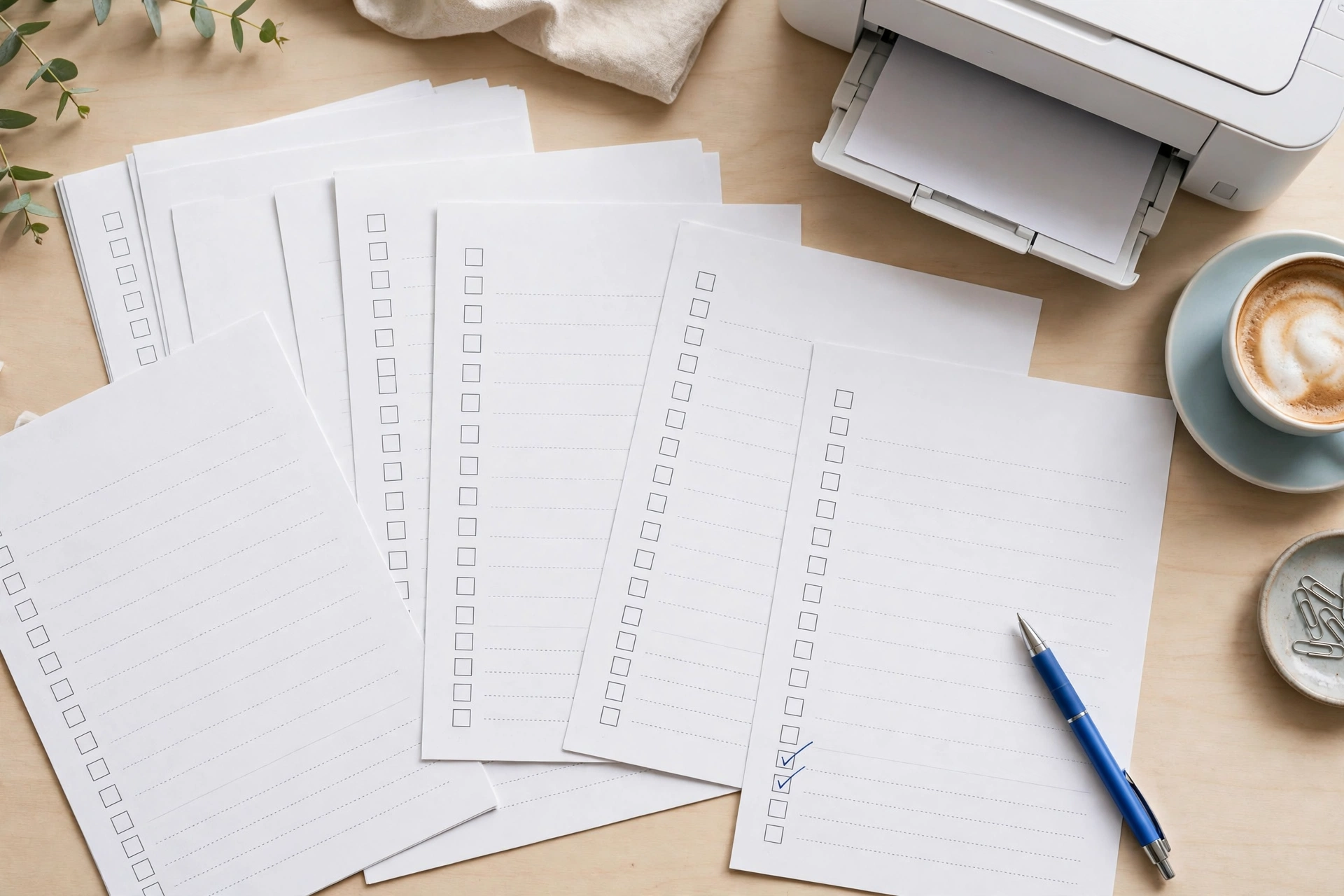
Quick answer: An ADHD cleaning planner PDF is a printable set of simple cleaning pages you download, print at home, and check off by hand. This guide walks through each page, shows how to print and bind it, and gives you copy-ready checklists to use today.
What is an ADHD cleaning planner PDF?
An ADHD cleaning planner PDF is a printable set of simple cleaning pages you download, print at home, and check off by hand. It is not an app. It does not buzz, update, or hide behind a login screen. It sits on your fridge or kitchen counter, right where you can see it.
Cleaning with ADHD is rarely a problem of not knowing what to do. The hard part is starting, holding the plan in mind while we work, and coming back to it after we get pulled away. A paper page holds the plan for you. You look down, find the next box, and do that one thing.
MerryHub makes printable games, cards and planners for parties and family events that families download and print at home.
Start with the wider collection on our printables page. The printable daily planner template pairs well with this one. A good set contains five pages: a daily reset page, a weekly grid, room-by-room pages, an energy-level page, and a monthly deep-clean page. One useful fact: "adhd cleaning planner pdf" is searched about 1,600 times a month in the United States, according to Semrush data from 5 November 2026.
Why does a paper PDF work when apps and notebooks do not?
You download a cleaning app with real hope. It looks great for a day. Then the notifications start to feel like nagging. You swipe one away, then another, and by the end of the week you have stopped opening the app at all. The app is still there. The plan inside it might as well not exist.
A blank notebook has the opposite problem. It starts empty, then asks you to invent the whole system before you can clean a single sink. By the time you have decided what goes on the page, the energy you had for cleaning has gone into planning.
A good PDF skips both traps. The boxes are there. The order is there. Your only job is to pick up a pen and check a box. For a brain that struggles to start, removing ten small decisions before the first task is the whole game. Paper also stays visible, and it forgives interruptions. Your pen is still lying on the line you were about to check when you come back from the doorbell. On a hard day, three checked boxes can be the proof that you did something, even when the house still looks messy.
What should you look for before you download anything?
Not every PDF with "ADHD" in the title is built for an ADHD brain. Some are just a normal cleaning list with a new label on top. Check a PDF against this short list before you print a whole pack.
First, look at the size of the tasks. "Clean the kitchen" is not one task. It is a trap. "Clear the counter, load the dishwasher, wipe the sink" is three tasks you can actually finish. Second, count the lines on a page. Most people do better with five to eight tasks per page, with space to write. White space is breathing room for your eyes.
Third, check for a place to write the date and your energy level. A planner that treats every day the same will fail on your tired days. Fourth, look for a "done enough" line. A ten-minute tidy is a real win. Fifth, print one page first and test it. Are the lines dark enough? Can you read it from arm's length? Does the ink smudge? Finally, ask who the planner is really for. This guide is written for adults, in adult homes, with adult mess.
The daily reset page: the one page that does the most work
If you print only one page from this whole guide, print the daily reset page. It is the workhorse. A daily reset is not a deep clean. It is a short pass, ten to twenty minutes, that puts the house back to "okay." Okay means you can find the keys and sit down in the evening without wading through clutter.
A good daily reset page has three short groups: morning, evening, and before bed. Keep each group to three or four tasks.
Morning, about five minutes:
Evening, about ten minutes:
Before bed, two minutes: lock the doors, turn off the lights downstairs, and write tomorrow's one big job on the page. One big job. Not five. One. Write it the night before, so the morning does not start with a decision. The page should also have a small box for start and finish times. Seeing "started 7:05, finished 7:18" day after day slowly rewrites the story that cleaning always takes forever. Leave a line that says "good enough today" too.
- Make the bed, or just pull the covers straight
- Put last night's dishes in the dishwasher or sink
- Wipe the bathroom sink while the kettle boils
- Take out anything that needs to go out the door today
- Clear the kitchen counters
- Run the dishwasher or wash the pans
- Put shoes, bags, and coats where they belong
- Set out tomorrow's clothes or work bag
How does the weekly grid hold the week together?
The daily reset keeps things from getting worse. The weekly grid is what makes things slowly get better. It gives each bigger job a day of its own, so no single day carries the whole house. A good weekly grid has seven columns, one per day, and only one or two tasks in each column. It also has a notes row at the bottom, where you write what actually happened. "Skipped Tuesday, did it Thursday." That is not failure. That is the grid doing its job.
Here is a sample week you can copy. Move days around until the week fits your real life.
There is no day that says "clean the whole house." A week of small, finished jobs beats one giant cleaning day that never happens because it feels too big to start. Write the dates at the top: "Week of 9 November." If you live with other people, write a name next to each day and rotate the names each week.
- Monday: kitchen — clear the fridge of old food, wipe the shelves
- Tuesday: bathroom — clean the toilet and sink, change the hand towel
- Wednesday: floors — vacuum the main rooms, mop the kitchen floor
- Thursday: laundry — wash, dry, and put away one load; change the bedding
- Friday: living room — clear surfaces, fluff cushions, take out the trash
- Saturday: one longer job, or catch up on the job you skipped
- Sunday: rest, or a ten-minute reset only
Room-by-room pages: for the day one room needs real attention
Some days, one room is the problem. The kitchen has reached the point where you cannot cook in it. The bathroom has reached the point where guests would notice. On those days, a general list does not help. You need a page for that room, and only that room.
Each room page should follow the same order: top to bottom, then out the door. Start high, so dust falls onto surfaces you have not cleaned yet. Finish at the door, so you walk out of a finished room.
Take the kitchen as an example:
The bathroom is shorter: clear the surfaces, clean the toilet, then the sink, then the shower or bath, change the towels, empty the bin, and mop the floor. The bedroom page is the kindest one: pick up clothes, clear the bedside table, change the bedding if it is laundry day, clear one surface, just one, and vacuum the floor. Start with the two rooms that bother you most. Use them for a month. Then add a third room if you need it.
- Clear the counters into one pile, then sort it
- Load the dishwasher and start it
- Wipe the hob and the counters
- Clean the sink and shine the taps
- Empty the bin and put in a fresh bag
- Sweep or mop the floor
The energy-level page: a plan for low, medium, and high days
Here is the page most cleaning planners forget. Your energy is not the same every day. A plan that only works on a good day will fail on a tired day, and then you will stop trusting it. The energy-level page has three columns: low, medium, and high. You check your energy first, then you look at the matching column. You do not try to do a high-energy job on a low-energy day.
A low-energy day is real. Maybe you slept badly. Maybe work drained you. On a low day, the list should be tiny and kind. Five minutes is a win. Ten minutes is a great day.
A medium-energy day is the normal day. You can do the daily reset and one extra job. A high-energy day is the rare day when you wake up and actually want to clean. On a high day, take on the bigger job: the fridge, the oven, the cupboard you have been avoiding. The high column holds one big job and a note that says "stop while it still feels good." The energy page should also have a line for what helped. "Slept eight hours." "Put music on first." Match the job to the day you actually have, not the day you wish you had.
- Put five things away, just five
- Load the dishwasher or rinse one pan
- Take out one bag of trash
- Wipe one surface, the one you can see from the sofa
The monthly deep-clean page: the jobs that only need doing once in a while
Some jobs do not belong on a daily or weekly page. They belong on a monthly page, where they can wait quietly until their turn comes. A monthly deep-clean page is a short list, usually ten to twelve jobs, with a box to write the month at the top. You work through it across the month, a job or two at a time, not all in one day.
Here is a monthly list you can copy and change to fit your home:
There is nothing clever on that list. Deep cleaning is the same small jobs, done a little less often, with a page that remembers them for you. The monthly page also needs a "not this month" box. Some months are hard. A job can wait.
- Clean the inside of the fridge and throw out old food
- Wipe the inside of the kitchen cupboards
- Clean the oven or the microwave
- Wash the windows in the main rooms
- Dust the shelves and the tops of door frames
- Vacuum under the sofa and the beds
- Clean the washing machine drawer and the filter
- Sort one drawer or one cupboard
- Check the bathroom grout and the shower head
- Wash the shower curtain or the bath mat
- Clean light switches and door handles
- Go through one shelf of old papers and recycle what you do not need
Copy-ready checklist pages: use these today
This is the part of the guide you can use without downloading anything at all. The checklists below are written to be copied by hand onto a blank page, or printed from this article, and used today. They are short on purpose. A checklist you can finish is better than a perfect list you never start.
Morning reset, five minutes:
Evening reset, ten minutes:
Five-minute rescue, for the days when someone is coming over. Set a timer for five minutes. Stop when it rings. That is the rule.
Low-energy list, kept somewhere easy to find. On a low day, you will not want to search for it.
Change a word. Swap a job. Cross out the one that does not fit your home and write in one that does.
- Straighten the bed covers
- Put dishes in the dishwasher
- Wipe the bathroom sink
- Take the trash bag to the door
- Clear the kitchen counters
- Start the dishwasher
- Put shoes and bags away
- Lay out tomorrow's clothes
- Collect all the rubbish in one bag
- Collect all the cups and plates in the sink
- Clear one surface you can see from the door
- Fluff the cushions and fold one blanket
- Open a window for fresh air
- Put away five things
- Rinse one pan or load the dishwasher
- Take out one bag of trash
- Wipe one surface
How do you print it, bind it, and fill it in?
A planner that is hard to read will not get used, no matter how good the list is. Plain printer paper works fine. If you can, use slightly heavier paper, the kind sold as 100 gsm or more, for the pages you will handle every day. If you only have normal paper, use that. Do not wait for perfect paper.
Most home printers in the United States use Letter size, 8.5 by 11 inches. Print at 100 percent, not "fit to page," so the boxes stay the size they were drawn. Print single-sided to start with. It means you can write on the back, stick a page on the fridge with a magnet, or carry one page to the room you are cleaning. Color is optional. Print seven copies of the daily reset page, one for each day of the week, and two copies of the weekly grid.
For filing, the clipboard is the easiest start. Clip the daily reset page to a clipboard and hang it on a hook in the kitchen. A folder with plastic sleeves works too: weekly grid in front, room pages behind it, monthly page at the back. Whatever you choose, keep the pen with the planner.
On a low-energy day, start with the energy page, not the daily reset page. Ask how much you have today. Low is a real answer. If the answer is low, use the low column only. Five things put away. One pan rinsed. One bag of trash out. That is enough. Check the boxes. Then stop. Shrink the job in your head before you start it. "Clear the counter by the kettle" is small enough to start. Set a timer for five minutes. Work until it rings, then stop, even if the job is half done. At the bottom of the page, write one kind sentence to yourself. "I did three things today and that counts."
A simple first week with your planner
You do not need a big launch. You just need one week, one page at a time. Day one is for printing and choosing. Print the daily reset page, the weekly grid, and the energy page. Pick the two room pages for the rooms that bother you most. That is day one. No cleaning required. Setting up counts.
Day two is for the first reset. Morning reset, five minutes. Evening reset, ten minutes. Write down tomorrow's one big job before bed. Day three is for the first weekly job. Do the room for that day, using the room page. If the room feels too big, do half of it and write "half done" on the page.
Day four is for noticing. What worked? What felt too long? Cross out a task that does not fit your home and write in one that does. Day five is for the energy check. Use the matching column. Day six is for catching up, or for resting. A missed job is not a debt. Day seven is for looking back. Spend two minutes with the week's pages. Count the checked boxes. Most people are surprised. They expected to see failure. They see a week of small, steady work instead. Print next week's pages now, while the habit is warm.
If you want a ready-made set instead of building your own from these pages, the ADHD-Friendly Planner for adults, $4 on Whop is the next step from this guide: undated printable daily, weekly, and reset pages for adults. It is the same idea as the free pages above, in one complete pack you can print again and again.
What do most free PDFs miss?
Most free cleaning planner PDFs give you a list. They do not give you a way to use the list on a bad day, or a way to print it well, or a way to keep going when the first week gets messy. That gap is where this guide fits. The top results for this search include a small site with just six free printable pages, no prices, and a newsletter signup as the only next step. Searchers are not finding a complete, adult, step-by-step answer yet. This guide is the rest.
The first gap is energy. Most PDFs treat every day the same, with no smaller plan for a tired day. That is why so many get printed once and then forgotten. The second gap is printing itself. Most PDFs never tell you what paper to use, what size to print, or how to file the pages.
It helps to understand why the planning part is hard in the first place. ADHD affects executive function, which covers planning, organizing, prioritizing, and holding steps in mind. The Attention Deficit Disorder Association explains ADHD facts for adults, including how executive function challenges make everyday organizing harder even when a person is capable and motivated. A paper planner holds the steps outside your head. The CHADD overview of ADHD symptoms and treatment makes the same point: ADHD affects attention, organization, and follow-through across home, school, and work.
So here is the question that follows naturally: once you have the pages, what does the full routine look like, day by day, when you put them together? That routine is exactly what the full guide covers, linked in the closing section below.
Most planners fail because of a few quiet mistakes. Making the list too long. Printing the whole pack at once. Treating a skipped day as a broken system. Copying someone else's routine exactly. Hiding the planner away. Worst of all, using the planner to keep score against yourself. Let it record what you did do, even if that was only three small things.
Your next step: read the full cleaning guide
You now have the pages, the print settings, and the checklists. The next step is to see how those pages fit into a full cleaning routine, with the order of jobs and the timing that keeps the habit going. Read the ADHD cleaning planner guide next. It takes the PDF pages from this article and shows you the routine that sits behind them, so you can use the pages with a clear plan instead of guessing. If you want the ready-made pack to go with it, the ADHD-Friendly Planner for adults, $4 on Whop gives you undated printable daily, weekly, and reset pages for adults in one place. Print the daily reset page tonight. Put it where you will see it in the morning. Do the five-minute version first. That is the whole start. Everything else in this guide can wait until tomorrow.