Quick answer: Free printable Thanksgiving word puzzles give you ready word searches, crosswords and scrambles for Thanksgiving night, sorted by level so kids, parents and grandparents can all play at one table. This page gives easy puzzles for kids, medium puzzles for family, and hard puzzles for adults, with answer keys, timing and printing tips.
Free printable Thanksgiving word puzzles, ready for 26 November
Free printable Thanksgiving word puzzles give you ready word searches, crosswords and scrambles for Thanksgiving night, sorted by level so kids, parents and grandparents can all play at one table. This page gives easy puzzles for kids, medium puzzles for family, and hard puzzles for adults, with answer keys, timing and printing tips.
Thanksgiving in the United States falls on Thursday, 26 November 2026, and these puzzles are built for that night. MerryHub is a printable-games and planner shop by ReplyPilot. If you want the wider set of family games behind these puzzles, start with the Complete Christmas Bundle, which is where our printable game packs live.
Nothing here needs a special printer, a paid app, or a craft box full of supplies. A home printer, plain paper, and a few pencils are enough.
What is a free printable Thanksgiving word puzzle?
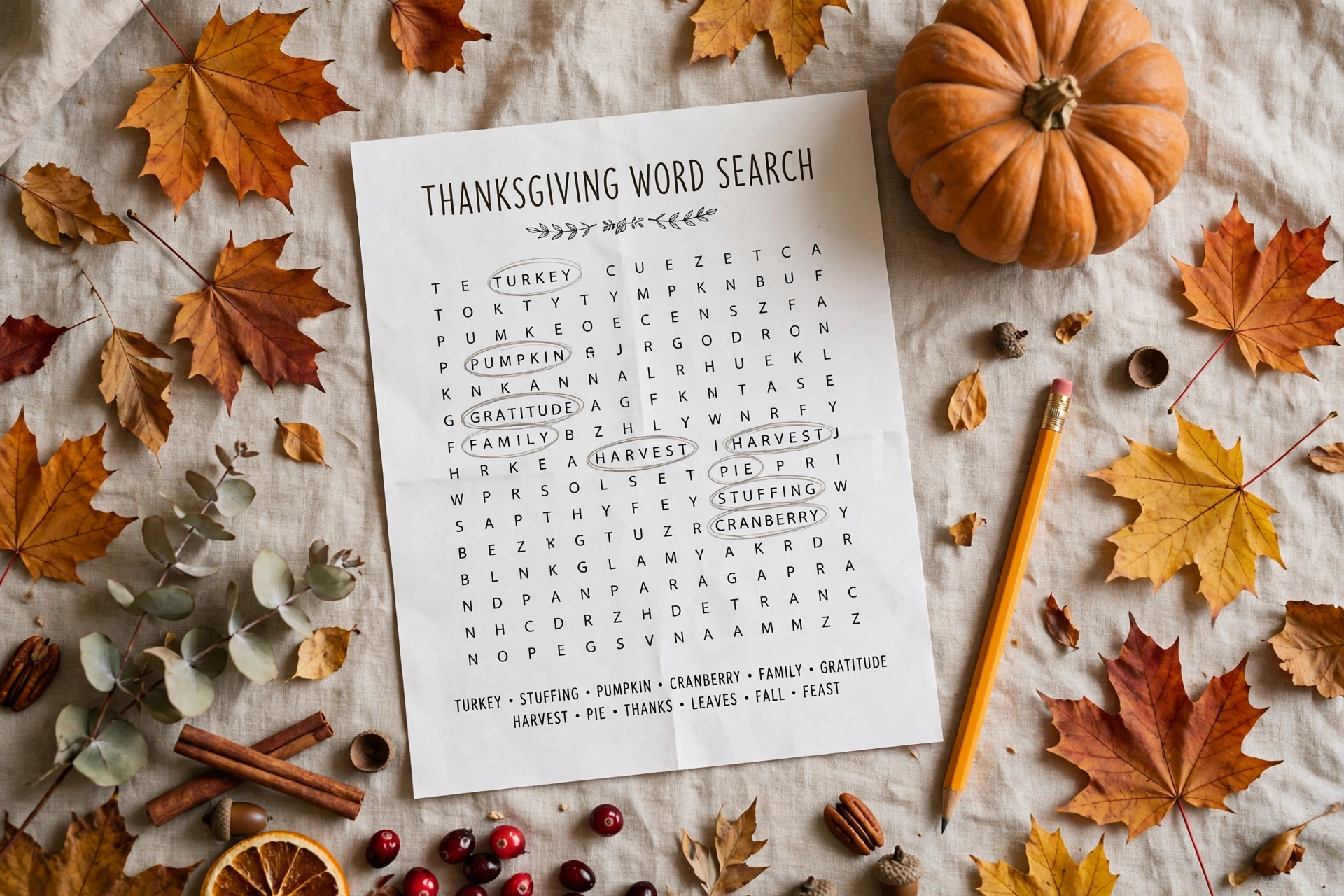
A free printable Thanksgiving word puzzle is a word game on a printed page with a Thanksgiving theme: a grid of letters with hidden words to find, a crossword with clues about the holiday, or a scramble where mixed-up letters need to be put back in order. You print it at home, hand out pencils, and play on paper. There is no screen and no login. The words come from the holiday itself: turkey, pumpkin, harvest, cranberry, gratitude, family, feast, and the rest of the words that belong to late November in the United States.
The holiday behind the theme is older than most people realise. The feast that Americans model Thanksgiving on was a 1621 harvest feast shared by the English colonists of Plymouth and the Wampanoag people, with about 90 Wampanoag guests and about 50 colonists sitting down together over several days, according to Encyclopaedia Britannica. That same source records that Congress fixed the date to the fourth Thursday in November in 1941, which is why the date moves from year to year and lands on 26 November in 2026. The parade habit is old too: the Macy's Thanksgiving Day Parade has run every year since 1924, with large balloons in the parade since 1927.
Which level should you print first?
Start with the people, not the puzzle. Count who is coming, note the ages, and then pick the level that fits the largest group at your table. If you have four kids under eight and two adults, print the easy set first and add one medium sheet for the adults. If you have a house full of teenagers and adults, print the medium set first and keep the hard set as the after-dinner round. The table below compares the three levels side by side, so you can see the choice in one glance.
Easy, for kids — Ages 5 to 8, early readers; 10 by 10 grid; 8 to 10 words; 4 to 7 letters; 5 to 8 minutes per puzzle; best moment: before dinner, at the kids' table.
Medium, for family — Ages 9 and up, mixed tables; 12 by 12 grid; 12 to 15 words; 5 to 9 letters; 10 to 15 minutes per puzzle; best moment: after the meal, whole table together.
Hard, for adults — Adults and keen teens; 15 by 15 grid; 18 to 22 words; 6 to 12 letters; 20 to 30 minutes per puzzle; best moment: late evening, teams of two.
The middle level is the one most families will use most, because it fits the widest spread of ages.
What words go in an easy puzzle for kids?
An easy Thanksgiving puzzle for kids should use words a child already knows or can sound out, and it should keep the words running in easy directions: across and down only, no backwards words, no diagonal words. Backwards and diagonal words look clever on the page, but they are the reason a young child gives up. Keep the first puzzle kind, and the child will ask for a second one. That is the whole trick with kids: the first page should end in a win.
Here is a word list for an easy kids' puzzle, with ten words that cover the holiday in plain language: TURKEY, PUMPKIN, APPLE, PIE, CORN, FAMILY, THANKFUL, FEAST, LEAF, FALL. Each word is four to eight letters long. Each one is a thing a child can picture: a turkey on a plate, a pumpkin on a step, a pie cooling on a counter, a leaf on the ground. When you build the grid, place TURKEY across the top row so the child finds a win in the first minute. Place PUMPKIN down the left side so there is a second early win. Spread the rest through the middle, with at least two words crossing each other, because a crossing word gives a child a free letter and a small clue about where to look next.
Read the list out loud with the child before they start. Say each word, ask what it means, and let them tell you in their own words. "What does thankful mean?" will get you a better answer than any dictionary line, because a child will say something like "when you are glad someone gave you something." That short talk checks that the child knows the words, and it warms them up for the search.
What words go in a medium puzzle for the family?
A medium puzzle for the whole family can use longer words, diagonal words, and one or two backwards words, because the players are older and they expect a bit of a hunt. The list below has fourteen words, and it mixes food, family, and the season, so different people will spot different words first. A cook will spot GRAVY. A gardener will spot HARVEST. A child will spot PUMPKIN. The list is: TURKEY, STUFFING, CRANBERRY, GRAVY, HARVEST, PUMPKIN, AUTUMN, GRATITUDE, FAMILY, FRIENDS, FEAST, CORNUCOPIA, PARADE, FOOTBALL.
CORNUCOPIA is the hardest word on this list, and it is in there on purpose. It is eleven letters long, and it gives the puzzle a centrepiece. Put it diagonally through the middle of the grid, and let it cross three or four shorter words. A cornucopia is a horn-shaped basket filled with fruit and vegetables, used as a sign of plenty at harvest time.
Build the medium grid at 12 by 12, and keep the word directions mixed but fair: about half the words across, a third down, and the rest diagonal or backwards. Mark the word list clearly at the bottom of the page, in a font large enough to read from across the table. Print the list in two columns if you need to, and leave a line under each word for a tick when it is found. That small tick box is worth adding, because it stops the argument about which words have been found already.
What makes a hard puzzle for adults?
A hard puzzle for adults should feel like a real test, not like a kids' page with longer words. That means a bigger grid, longer words, more directions, and words that need a bit of thought. The list below has twenty words, and it leans on the history and the cooking of the holiday, so it rewards people who know a little about both: TURKEY, STUFFING, CRANBERRY, SWEETPOTATO, GREENBEANS, CORNBREAD, PUMPKINPIE, PECANPIE, HARVEST, GRATITUDE, THANKFUL, TRADITION, CELEBRATION, GATHERING, CORNUCOPIA, MAYFLOWER, PLYMOUTH, WAMPANOAG, PROCLAMATION, NOVEMBER.
MAYFLOWER, PLYMOUTH, WAMPANOAG, and PROCLAMATION are the history words in this list. They give the puzzle a second layer: it is not only about food, it is about the story of the holiday. WAMPANOAG is nine letters long and has a double A in the middle, which makes it stand out in a grid if you place it across a row with few other A-heavy words nearby.
Grid reasoning matters most at this level. A 15 by 15 grid has 225 squares, and twenty words will fill about half of them if the words are long. If you fill the empty squares at random, you will create false words by accident: a row might spell CAT or DOG or EAT by chance, and a player will circle it and argue it counts. To avoid that, fill empty squares with letters that break up common patterns, and read each row and column once before you print.
How do you run a Thanksgiving puzzle round in 30 minutes?
A puzzle on its own is a quiet activity. A puzzle round is an event. The difference is timing, teams, and a score that everyone can see. The round below runs for thirty minutes, and it is written minute by minute so you can run it without thinking about the clock.
Minutes 0 to 5: hand out the medium puzzle and a pencil to each player, and read the rules out loud. Each player works alone. Words can run across, down, diagonal, or backwards. A word only counts when it is circled and the player can point to it. No phones, no shouting out answers, and no looking at another player's page.
Minutes 5 to 20: the scored round. Each word found is worth one point. The two longest words, CORNUCOPIA and CRANBERRY, are worth two points each, because they are the hardest to spot. The host keeps the time and calls out "ten minutes left" and "five minutes left" so the pace stays honest.
Minutes 20 to 25: teams. Pair up the players — fastest with slowest, adult with child — and give each pair the hard puzzle. Each pair works together for five minutes and counts how many words they find as a pair. The pair score is added to the individual scores, which means a slow player who pairs well can still climb the table. This is the part of the evening where the room gets loud, because pairs talk, point, and argue in a friendly way.
Minutes 25 to 30: answers and scores. Hand out the answer key, let each player check their own page, and read out the final scores. Scoring needs one more rule: if two players circle the same word, both score. There is no race to claim a word first. It takes ten seconds to say, and it saves a ten-minute argument about who saw CRANBERRY first.
How do you print the puzzles, and what do you do with the answer keys?
Printing is where a good puzzle can go wrong, and it is the part most people rush. A puzzle printed too small is hard to read. A puzzle printed too light is hard to circle. A puzzle printed on thin paper shows ink through when someone presses hard with a pen. All three problems are easy to avoid if you print a test page first and look at it before you print the full set. Print at 100 percent scale, not "fit to page," because "fit to page" shrinks the grid and the letters. Use black ink on white paper, at normal or high quality rather than draft, because draft mode prints pale grey letters that are hard to read in a dim dining room.
Print one copy first and check it with your own eyes. Hold it at arm's length and see if you can read the smallest letters. Circle a word with a pencil and see if the circle is clear. If any check fails, change the setting and print again. It is better to waste one test page than to print twelve pages that nobody can read. Once the test page looks right, print the full set, and print two spare copies of each level. Spare copies are for the person who spills gravy on their page, the child who wants a second go, and the guest who arrives late and still wants to play.
For the answer key, print it on a separate page, not on the back of the puzzle. An answer key on the back will show through thin paper, and a player who holds the page up to the light will see the answers. Print the key with the words circled in the grid, and print the word list beside it with a tick next to each word. Keep the keys in a folder or an envelope until the round is over, and hand them out only when the time is up. A host who keeps the keys safe is a host people trust.
How can teachers use these puzzles, and what works at the kids' table?
A classroom is not a dining table, and the puzzles need a different shape there. The class has thirty pupils, one teacher, and a fixed lesson time, and the puzzle has to fit into that shape without taking over the lesson. The best use is as a warm-up or a finish, not as the whole lesson. Ten minutes at the start of a lesson, or fifteen minutes at the end of the week, is enough. Start with the easy list for younger classes and the medium list for older classes, and print one puzzle per pupil plus the answer key for yourself.
Read the word list out loud together, and ask the class to say what each word means before they start. That short talk is the teaching part. It checks vocabulary, it gives shy pupils a chance to speak, and it makes the search easier, because a pupil who has just said a word will spot it faster. Then set a clear finish: "Find eight words in ten minutes." For a class with mixed reading levels, pair pupils up: a strong reader with a weaker reader is a fair pair, because the strong reader can read the list and the weaker reader can search the grid.
The kids' table is its own world. It is louder, messier, and more honest than the main table, and the puzzles there need to fit that world. Print the easy set, give each child a pencil and a crayon, and let them circle words in colour. Colour matters to a child: a red circle feels different from a pencil circle, and a page with red, blue, and green circles feels like a finished piece of work. Let them keep the finished page. A child who takes a puzzle home will show it to someone, and that showing is part of the fun. Keep the kids' table round short: five to eight minutes per puzzle is enough, and then move on. Short rounds, with a new puzzle each time, keep the energy up. Let the kids work in pairs, and let an older child help a younger one.
A simple checklist for Thanksgiving evening
A checklist is worth more than a good intention, because it stops you forgetting the small things that make the evening work. The checklist below is the one we use, and it is written in the order you will need things, from the day before to the end of the night. Tick each line as you do it.
- Day before: print a test page, check the letters are clear, and print the full set plus two spare copies of each level.
- Day before: print the answer keys on separate pages and put them in an envelope.
- Day before: count pencils, sharpen them, and put one pencil with each puzzle page.
- Morning: lay out the easy puzzles at the kids' table and the medium puzzles at the main table.
- Before dinner: run a five-minute warm-up round so everyone knows how the game works.
- After dinner: run the thirty-minute scored round from the plan above, with teams for the last five minutes.
- After the round: hand out the answer keys, read out the scores, and talk about three words nobody found.
- Next day: note the changes you want for next year, while the evening is still fresh in your mind.
What if someone finishes early?
Every puzzle round has a fast finisher, and a fast finisher with nothing to do is a problem. They will either distract the other players or sit quietly and feel bored, and neither one helps the evening. The fix is to have a next step ready before the round starts, not after someone finishes. The next step can be a harder puzzle, a crossword version of the same word list, or a new game entirely. One good next step is to ask the fast finisher to build a small puzzle of their own: give them a blank grid, a list of five Thanksgiving words, and ten minutes to hide the words in the grid, then let the table try to solve it.
Another good next step is a Christmas word search, because the family that plays together on Thanksgiving night is the family that will play together again in December. Our Christmas word search printable uses the same easy-to-hard shape, with Christmas words in place of Thanksgiving words, and it is a natural bridge from one holiday to the next. If someone asks "what do we play at Christmas?" — and someone always asks — you already have the answer, and you can point them to that page. That is the curiosity bridge for this article: the question that opens on another page is "what comes after Thanksgiving puzzles?", and the answer is Christmas puzzles, on the page linked here. For the player who wants a bigger test right now, our hard word search puzzles printable uses longer words and larger grids, so the hunt takes longer and the win feels bigger.
Where do you go next?
When Thanksgiving night is done, the family that played together will want a next game, and Christmas is only a few weeks away. Go to the free printable Christmas games page next, because it has the Christmas games that follow on from these Thanksgiving puzzles, with the same levels, the same clear printing, and the same answer keys, so you can run Christmas night the way you ran Thanksgiving night.