Quick answer: Christmas puzzle games printable means a set of Christmas-themed puzzles you print at home: a crossword, a word search, a maze and a sudoku on separate pages, with an answer key. This pack has all four, in easy, medium and hard levels, so kids, teens and adults can all play at the same table.
Christmas Puzzle Games Printable: Crosswords, Word Searches, Mazes and Sudoku in One Pack
Christmas puzzle games printable means a set of Christmas-themed puzzles you print at home: a crossword, a word search, a maze and a sudoku on separate pages, with an answer key. This pack has all four, in easy, medium and hard levels, so kids, teens and adults can all play at the same table.
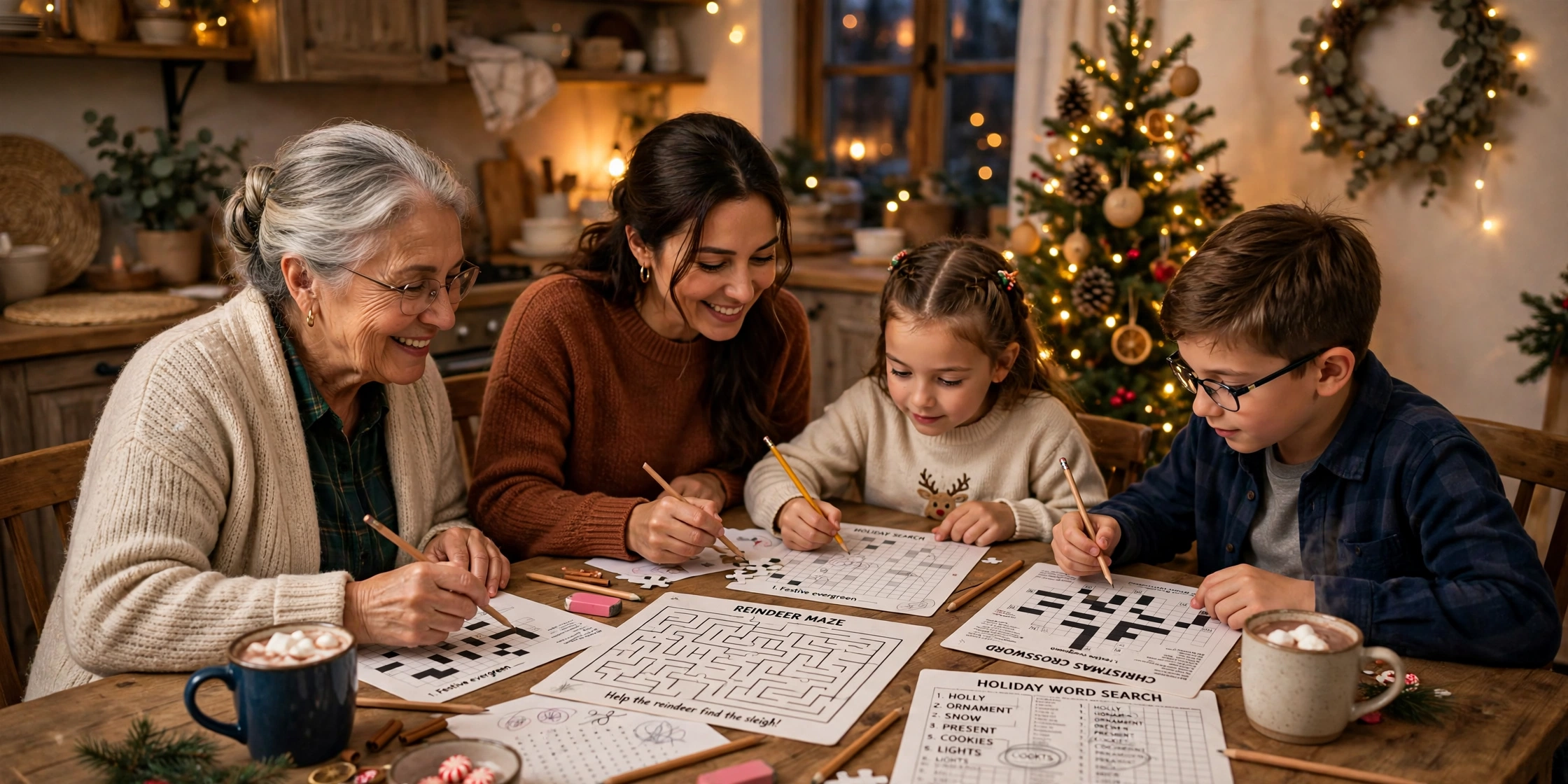
That is the whole idea in one paragraph. You print four pages, hand out pencils, and the table has something for everyone. The crossword keeps the adults busy. The word search suits the kids. The maze is a race. The sudoku is the quiet one for the person who likes numbers. And when the puzzles run out, the Christmas Games Bundle carries the same evening further, with 15 printable party games and a quiz for $4 — the ready-made next step if one pack is not enough for your group.
This guide gives you the full pack as it works in real life: what each puzzle is, a worked example you can try right now, which level fits which age, a 45-minute plan for a puzzle night, and the printing settings that keep the pages readable. Everything below is built for a home printer and a kitchen table, not for a classroom whiteboard.
What is a Christmas puzzle game?
A Christmas puzzle game is a puzzle with a Christmas theme that you solve with a pencil: a crossword with Christmas clues, a word search hiding Christmas words, a maze that leads a reindeer to the sleigh, or a sudoku with stars, trees, bells and gifts instead of plain numbers. The game part is the solving. The Christmas part is the words and pictures.
It is worth saying what a puzzle game is not. It is not a board game, and it is not an app. There is no screen, no timer built in, and no account to make. One printed page, one pencil, one person thinking. That is the whole setup, and it is also the reason puzzle games work so well at Christmas: they fit the ten quiet minutes before dinner, the wait while the turkey rests, and the hour after lunch when everyone is full and nobody wants to move.
MerryHub is a printable-games and planner shop by ReplyPilot, and these puzzles are built like our other printables: clear lines, big print, and pages that work on a home printer without wasting ink.
Christmas itself is older than any of these games. Christmas is a Christian festival celebrating the birth of Jesus, and most Christians observe it on December 25, as Encyclopaedia Britannica records. The puzzles are new. The date is not. That mix is part of the charm: a very old holiday, played with pencil-and-paper games that have been around for about a hundred years.
What is inside the pack?
Four puzzles, each on its own page, each with its own answer key at the back. Here is what each one is, and a worked example you can try before you print anything.
The crossword comes first. A crossword is a grid of squares with clues. You read the clue, think of the word, and write it in the grid, one letter per square. Words cross each other, so a letter you get right in one word helps you in another. The pack's mini crossword uses six clues, and here they are:
Across: 1. Santa's ride (6 letters). 3. Red-nosed reindeer (7 letters). 5. Hung by the chimney with care (8 letters).
Down: 2. White stuff on the roof (4 letters). 4. Round decoration for the tree (8 letters). 6. Santa's little helper (3 letters).
The answers are on the answer key at the back of the pack: 1 Across is SLEIGH, 3 Across is RUDOLPH, 5 Across is STOCKING, 2 Down is SNOW, 4 Down is ORNAMENT, and 6 Down is ELF. Try them on your own first. A crossword is more fun when you get at least one answer without help, and SLEIGH is the kindest place to start.
The word search comes second. A word search is a grid of letters with words hidden inside it, running across, down, or diagonally. You find each word in the list and circle it. The pack's word hunt works a little differently, and it is the one to try with young children first, because there is no grid to get lost in. Read this short story and find ten Christmas words hiding in it:
On Christmas Eve, snow covered the holly by the front door, and the lights in the window made the whole street glow. Inside, Grandma hung one last ornament on the tree while the kids left cookies and milk for Santa. Dad read the carol sheet out loud, Mom tucked a small present into each stocking, and outside, the reindeer waited beside the sleigh.
The ten words are SNOW, HOLLY, LIGHTS, ORNAMENT, COOKIES, CAROL, PRESENT, STOCKING, REINDEER and SLEIGH. Read the story again slowly and point at each one. A child who finds all ten has done a real word search, just without the grid. The full grid version is in the pack, with the same ten words hidden among the letters.
The maze comes third. A maze is a path with wrong turns. You start at the reindeer and find your way to the sleigh, and every wrong turn is a dead end you have to back out of. The pack's maze is called "Help the reindeer find the sleigh," and it works best as a race: two players, two copies, first one to the sleigh wins. The trick that helps children most is the one-wall rule: pick one wall of the maze and keep your pencil on it the whole way. It feels slow, but it stops you going around in circles, and it almost always finds the way out.
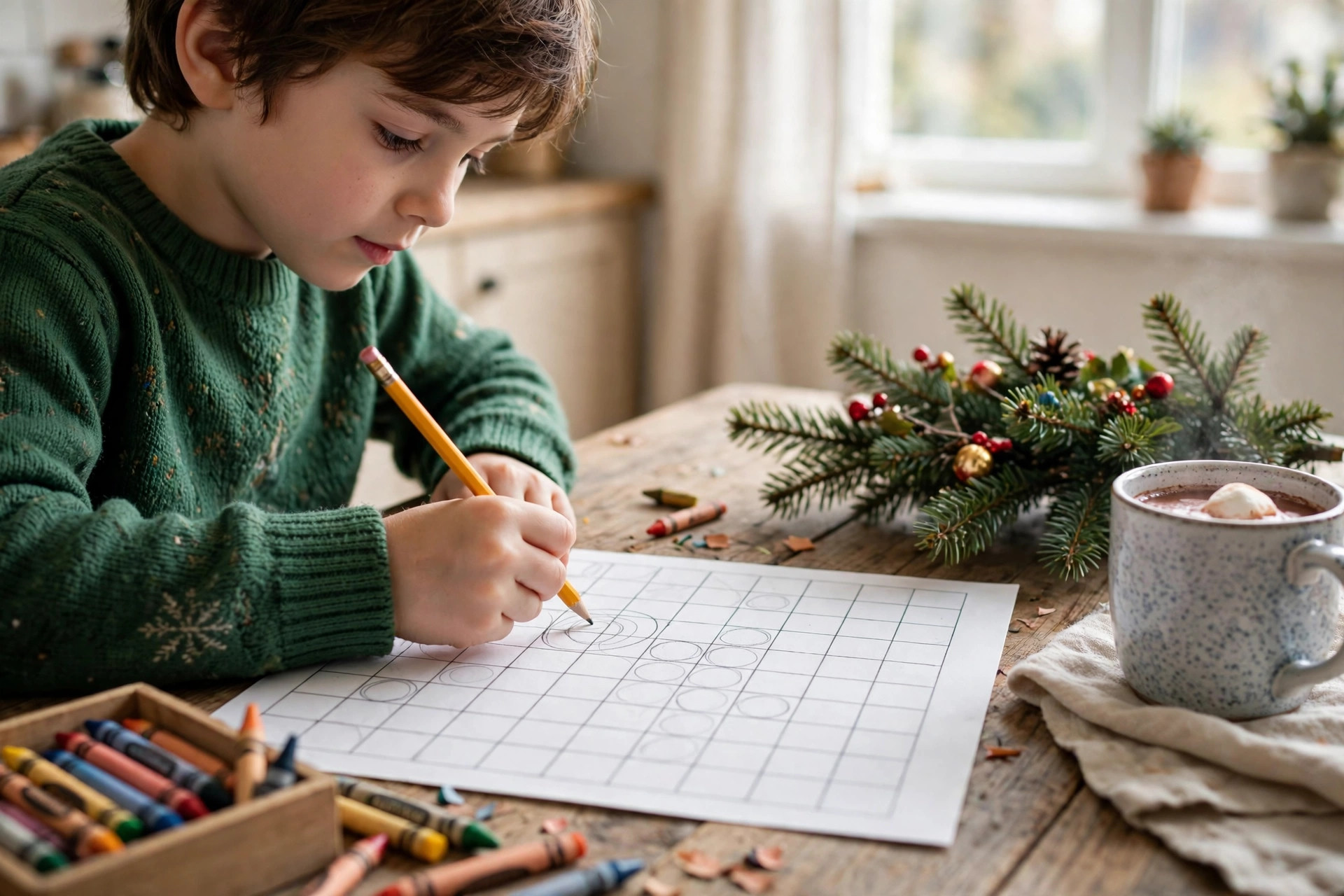
The sudoku comes last. A sudoku is a number grid where every row, every column, and every small box must hold each number once. The pack's mini sudoku is a 4 by 4 grid, and it uses pictures instead of plain numbers: 1 is a star, 2 is a tree, 3 is a bell, and 4 is a gift. Here is the puzzle, with dots for the empty squares:
Row 1: star, blank, bell, blank
Row 2: blank, gift, blank, tree
Row 3: tree, blank, gift, blank
Row 4: blank, bell, blank, star
The answer, in numbers, is: 1 2 3 4 on the first row, 3 4 1 2 on the second, 2 1 4 3 on the third, and 4 3 2 1 on the fourth. Check it yourself: every row has 1, 2, 3 and 4 once, every column has them once, and every little 2 by 2 box has them once. If you can solve this one, you can solve any 4 by 4 sudoku, because the thinking is the same at every size: look for the row or column that is nearly full, and fill in what must go there.
Those four puzzles are the pack. Four pages, four kinds of thinking, one answer key. Print them in order, or print only the ones your group likes. There is no rule that says you must play all four.
Which puzzles suit which age?
The same puzzle is not the right puzzle for every age. A maze that delights a five-year-old will bore a teenager, and a hard crossword will stop a seven-year-old cold. The levels below are the ones we use, and they hold up in practice.
Ages 4–6: Word hunt story, easy maze — 5–10 minutes — Read the clues out loud; let them circle instead of write
Ages 7–9: Word search grid, medium maze — 10–15 minutes — Pair a younger child with an older one for the crossword
Ages 10–12: Mini crossword, 4 by 4 sudoku — 10–15 minutes — Let them check the answer key themselves
Teens: Hard crossword, timed maze race — 10–20 minutes — Racing the clock is what makes it a game for teens
Adults: Hard crossword, full sudoku — 15–20 minutes — Adults like the crossword best; give them the hardest clues
Two things in that table are worth saying plainly. First, the ages are a guide, not a test. A clever eight-year-old will beat an adult at the maze, and a grown-up who never does crosswords will struggle with the easy ones. Start one level below where you think your group is, and move up if it feels too easy. A puzzle that is finished is better than a puzzle that is abandoned.
Second, mixed ages work best when everyone has their own page. Do not give one crossword to a table of six people and expect a game. Give each person a page, even if two people get the same puzzle. People solve at different speeds, and a person with their own page can go at their own pace without holding anyone up or being held up.
If you want a word search on its own, with more words and a bigger grid, our Christmas word search printable is the deeper version: puzzles by age, how to make your own, and classroom tips. The pack here is the sampler. That page is the full word search guide.
How do you run a 45-minute Christmas puzzle night?
A puzzle night needs a plan, or it drifts. Someone starts the crossword, someone else wanders off to the kitchen, and the pack is forgotten by the time the kettle boils. The plan below takes 45 minutes from start to finish, and it works because every part has a start time and an end time. Put it on the fridge, or read it out loud before you begin.
Minutes 0 to 5: warm-up. Everyone gets the word hunt story. Read it out loud together, and circle the ten words as you find them. This is the easy win that gets everyone sitting down. No scores yet. No timer yet. Just the story and ten words.
Minutes 5 to 20: the crossword. Everyone gets the same crossword page. Work alone, or work in pairs if the ages are mixed. The first person to finish all six clues calls it out. Give one point per correct answer, and a bonus point to the first finisher. If someone gets stuck, they can ask the table for one letter. One letter only. That rule keeps the game moving without giving the whole answer away.
Minutes 20 to 30: the maze race. Two copies of the maze, two players at a time, first to the sleigh wins the round. Losers step aside and the winners race each other. A table of six needs three rounds to find a champion, and that takes about ten minutes. Use a phone timer so nobody argues about who finished first.
Minutes 30 to 40: the sudoku. This is the quiet part of the night, and it is meant to be quiet. Everyone gets the 4 by 4 grid. No talking, no peeking, ten minutes. The person who finishes first gets a point. Anyone who finishes at all gets a point too, because a finished sudoku is a real achievement and it deserves one.
Minutes 40 to 45: answers and prizes. Read out the answer key together. Add up the points. The winner gets to pick the next game, or the first mince pie, or the best seat for the film. Keep the prize small. The prize is not the point. The point is that the night had a finish, and everyone knows who won.
That is 45 minutes. If you have an hour, add the bingo game for Christmas after the sudoku: ten bingo cards, one caller, and the same scoring. If you have only twenty minutes, do the warm-up and the crossword and stop there. A short puzzle night that ends well beats a long one that falls apart.
One practical note about teams. Pairs beat singles when the ages are far apart. Put a grandparent with a grandchild, or a teenager with a seven-year-old. The older player reads the clues. The younger player writes the answers. Both of them are playing, and neither of them is watching.
Do puzzles do anything for your brain?
It is fair to ask, because a puzzle night is fun either way, and fun is reason enough. But the research gives a real answer too, and it is stronger than most people expect.
In 2022, researchers at Columbia University and Duke University published a trial in NEJM Evidence. They took 107 older adults with mild cognitive impairment — people whose memory was starting to slip — and split them into two groups. One group did web-based crossword puzzles. The other group did computerized brain-training games. Both groups trained hard for 12 weeks, with booster sessions up to 78 weeks. The crossword group came out ahead: their scores on the ADAS-Cog memory test improved, while the games group's scores got slightly worse, and the difference held at both 12 weeks and 78 weeks. The full trial is published in NEJM Evidence, via PubMed Central.
The same paper points to a wider picture. A systematic review of 22 population studies found that complex mental activities — reading books, playing checkers, and completing crosswords or other puzzles — were linked to a 46% lower risk of developing dementia over a median of about seven years. That is a correlation, not a promise, and the researchers are careful to say the work needs repeating in bigger trials. But it is a serious number, from serious studies, and it says something simple: using your brain on hard little problems is good for it.
None of that means a Christmas crossword will make anyone smarter by New Year. What it means is that the quiet thinking a puzzle asks for is the same kind of thinking the research keeps finding value in. A puzzle night is a pleasant evening that also happens to be good exercise for the mind. That is a good deal, and it costs nothing more than paper and pencils.
How should you print the puzzles?
A puzzle that prints badly does not get played. The fixes are small, and they are worth doing once and then forgetting about.
Print at actual size, not "fit to page". Fit-to-page shrinks the grids, and small grids are hard to read and harder to write in. A crossword square should be at least as wide as a pencil tip, and a word search letter should be big enough to circle without covering its neighbors.
Use plain white paper. Colored paper looks festive, but it makes the grid lines harder to see and it uses up your color ink. Save the color for the Christmas cards. The puzzles are designed to work in black and white, and they look clean that way.
Set the printer to black and white, or grayscale. Color ink costs more without adding anything to a crossword. If your printer has a draft mode, do not use it for the puzzles: draft mode makes the lines faint, and faint lines are the first thing to disappear when a child presses hard with a pencil.
Print one copy per player, plus one spare. A spare copy is for the person who folds theirs, spills cocoa on it, or wants to do the maze twice. It costs one sheet of paper and it saves the night. Print the answer key once, on its own, and keep it face down until the last five minutes. An answer key that is lying around the table is an answer key that gets peeked at.
If a puzzle will be played more than once, slip it into a clear plastic sleeve and hand out dry-erase markers. The same page works ten times over, and children like wiping it clean and starting again. That trick is worth remembering for classrooms, where one printed set has to last a whole week.
What mistakes spoil a puzzle night?
Most puzzle nights fail in the same few ways, and all of them are easy to avoid once you know them.
The first mistake is starting too hard. A crossword that nobody can answer in the first two minutes kills the evening. Start with the word hunt, which everyone can do, and let the confidence build. The hard puzzle goes last, when the table is warmed up.
The second mistake is one copy for the whole table. Six people sharing one crossword is not a game, it is a queue. Print one per player. Paper is cheap. Waiting is not.
The third mistake is no answer key. Without answers, a puzzle night ends in an argument about whether SLEIGH has six letters or seven. Print the key, keep it face down, and read it out at the end. Arguments about answers are the fastest way to ruin a good evening.
The fourth mistake is letting one person dominate. Every table has one person who is good at crosswords and knows it. Pairs fix this: the strong player reads, the weaker player writes, and both of them have a job. If one person still takes over, give them the hard crossword on their own and let the rest of the table play the maze race.
The fifth mistake is tiny print. If the letters are smaller than a child's thumbnail, the puzzle is too small. Print at actual size, and if the grid still looks cramped, print it on A4 instead of letter, or use your printer's "enlarge" setting once. A puzzle you can read is a puzzle you can finish.
And one more thing that is not a mistake so much as a missed chance: do not throw the finished puzzles away. A solved crossword with a child's handwriting on it is a small keepsake, and the answer key is useful next year when the same pack comes out again. Keep the best one in the Christmas box with the decorations.
For a deeper word search collection, with harder grids and more words than the pack holds, our hard word search puzzles printable page carries medium, hard and expert levels with answer keys. It is the right next step when the easy puzzles start feeling too easy.
Where should you go next?
You have the full pack now: a crossword with six real clues, a word hunt with ten words to find, a maze race, and a 4 by 4 sudoku with a worked solution, plus the 45-minute plan and the printing settings that make it all work. If your group wants more games after the puzzles, start with our free printable Christmas games. It has 11 print-and-play ideas — trivia, bingo, word search, emoji pictionary and more — with simple rules and printing tips, and it is the natural next page after a puzzle night.