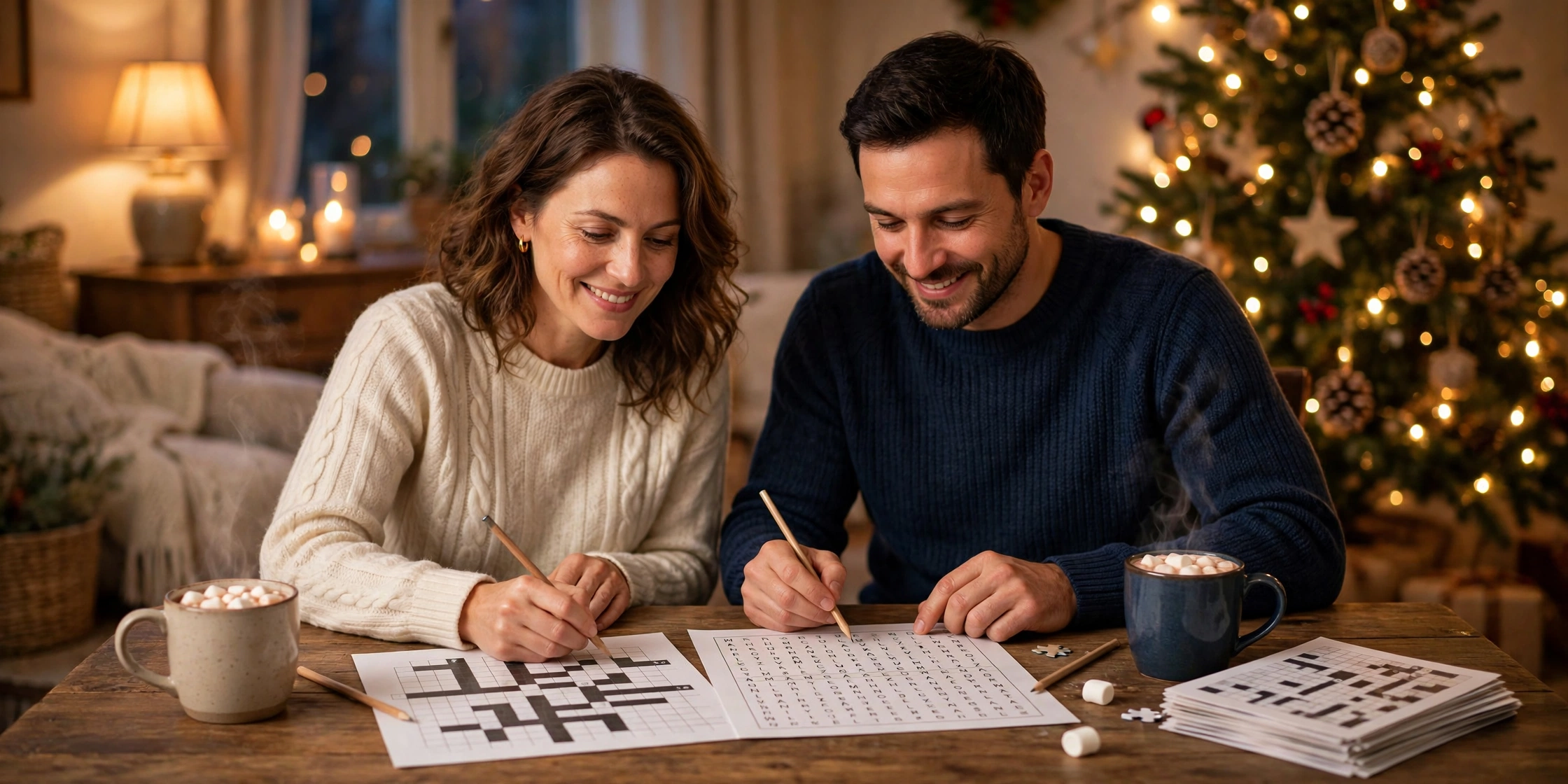
Quick answer: Free printable Christmas puzzles for adults are harder crosswords, word searches, mazes and sudoku with a Christmas theme, printed at home and solved with a pencil. This pack has all four in one PDF, in three difficulty levels, with answers and large print — built for quiet evenings, not for children.
Free Printable Christmas Puzzles for Adults: Crosswords, Word Searches and Sudoku for Quiet Evenings
Free printable Christmas puzzles for adults are harder crosswords, word searches, mazes and sudoku with a Christmas theme, printed at home and solved with a pencil. This pack has all four in one PDF, in three difficulty levels, with answers and large print — built for quiet evenings, not for children.
Most Christmas puzzles you find online are written for children. Big letters, tiny words, a reindeer to colour in. That is fine for a classroom. It is not much fun for an adult sitting by the fire with a mug of cocoa and an hour to spare. This page is the other kind: puzzles that respect an adult brain. Real clues, proper words, and grids that make you stop and think.
The pack itself is simple. Four puzzles, each on its own page, plus an answer key at the back. A crossword with six clues you can actually chew on. A word search with twelve words hidden properly, not sitting in a neat row. A maze with a wrong turn or two. A small sudoku that takes ten minutes and a pencil. If you want the whole Christmas bundle these puzzles come from, our printables page has the full set.
Free printable Christmas puzzles for adults are, in plain words, puzzle sheets with a Christmas theme that are hard enough for grown-ups: crosswords with real clues, word searches with long words, mazes with dead ends, and sudoku with numbers that need working out. They are printed at home, solved with a pencil, and they need no app, no sign-up and no screen.
What makes a Christmas puzzle "for adults"?
It is not the size of the letters. It is the size of the thinking. A children's puzzle asks you to find CAT in a grid. An adult puzzle asks you to work out that "Santa's team pulls it through the sky" is a six-letter word, and then to fit it into a grid where it crosses two other answers. The pleasure is different. One is spotting. The other is solving.
The first difference is the words. Adult puzzles use the full Christmas vocabulary: mistletoe, cracker, pudding, carol, tinsel, wreath, chimney, snowflake, bauble. These are ordinary words, but they are long, and long words are harder to hide in a grid and harder to fit in a crossword. A children's word search uses NOEL and STAR. An adult one uses MISTLETOE running backwards and diagonally. That is the whole game.
The second difference is the clues. A children's clue tells you the answer: "Red-nosed reindeer (7)". An adult clue makes you work a little: "He guides the sleigh, and his nose lights the way (7)". Same answer, different effort. The clue should feel fair when you get it and obvious once you see it. That is the test of a good clue, and it is the test this pack uses.
The third difference is the grid. Adult crosswords cross more. Each answer touches two or three others, so one right answer helps you with the next one, and one wrong answer blocks you in three places. That sounds harsh, and it is, a little. But it is also what makes finishing feel good. A crossword with no crossings is just a list of questions. A crossword with crossings is a puzzle.
The fourth difference is honesty about difficulty. Children's puzzles pretend everything is easy. Adult puzzles tell you the truth: this one is gentle, this one is proper, this one is fiendish. You pick the level that matches your evening. A tired evening after a long day wants the gentle crossword and a mug of cocoa. A quiet Sunday afternoon with nothing planned wants the fiendish one and a sharp pencil. There is no colouring in, either. Adult puzzle pages are black and white, clean, and quiet, like a newspaper puzzle page. That is deliberate: a page that looks grown-up gets treated like a grown-up puzzle.
What is inside this free printable Christmas puzzles pack?
Four puzzles, one page each, plus an answer key. Here is what each one holds, with a worked example so you can see the level before you print anything.
The crossword is the heart of the pack. Six clues, three across and three down, in a small grid that fits on one page. Try them now:
Across 1. Santa's team pulls it through the sky. (6 letters)
Across 3. Hung by the chimney with care. (8 letters)
Across 5. What carolers do at your door. (4 letters)
Down 1. The star sits on top of it. (4 letters)
Down 2. Red-nosed reindeer, first name. (7 letters)
Down 4. December 25 is this day. (9 letters)
The answers are SLEIGH, STOCKING and SING across, and TREE, RUDOLPH and CHRISTMAS down. If you got four of the six without checking, the proper level will suit you. If you got all six in under a minute, skip to the fiendish level. If you got two, start gentle and work up. The full pack's crossword is bigger than this taster, with more clues and more crossings, but the style is the same: fair clues, real words, no tricks.
The word search is the warm-up puzzle, and it is harder than it looks. Twelve Christmas words are hidden in a grid, running across, down, diagonally and backwards. Here are the twelve words to find:
REINDEER
SLEIGH
STOCKING
MISTLETOE
CRACKER
PUDDING
CAROLS
TINSEL
WREATH
CHIMNEY
SNOWFLAKE
BAUBLE
The trick with a good word search is that the easy words are found in the first minute and the last two take ten. MISTLETOE and SNOWFLAKE are the ones that hide: long, crossing other words, one of them running backwards. When you print the pack, the grid is big enough to circle letters without covering the neighbours, which is the single most common fault in free word searches online.
The maze is a reindeer maze: help the reindeer find the stable, with two dead ends and one long way round. It takes about five minutes with a pencil, and it is the puzzle to hand to the person at the table who says they do not like crosswords. There is no vocabulary in it and no spelling, which is why it works for mixed groups where one person is much better with words than everyone else.
The sudoku is a small one, four by four, using the numbers 1 to 4. It is a real sudoku, not a guessing game: every empty square can be worked out by logic, one step at a time. Here is the puzzle to try:
Row 1: blank, 2, 3, blank
Row 2: 3, blank, blank, 2
Row 3: blank, 1, blank, 3
Row 4: 4, blank, 2, blank
And here is the finished grid, so you can check your working:
Row 1: 1, 2, 3, 4
Row 2: 3, 4, 1, 2
Row 3: 2, 1, 4, 3
Row 4: 4, 3, 2, 1
Each row, each column and each little two-by-two box holds the numbers 1 to 4 exactly once. If you solved it, the method is the same one the bigger sudoku in the pack uses, just with more numbers. If you got stuck, the answer key at the back of the pack shows the same working, step by step.
The answer key sits on its own page at the back. Print it once, keep it face down, and read it out at the end. An answer key lying on the table gets peeked at. Everyone knows it, and everyone does it anyway.
How hard should an adult Christmas puzzle be?
There are three levels in the pack, and picking the right one matters more than people think. A puzzle that is too easy feels like a waste of an evening. A puzzle that is too hard ends up in the bin. The levels are honest, so pick by your mood, not by your pride.
Gentle level: for a tired evening, or for someone who puzzles now and then.
Short words, mostly four to six letters.
Clues that point straight at the answer.
Word search words run across and down only, never backwards.
Sudoku is four by four, like the one above.
A gentle puzzle takes about ten minutes. It is the one to start with after a long day, or to hand to a guest who says they are no good at puzzles. It lets them win, and winning once makes them want a second go.
Proper level: for a normal evening, or for someone who does a puzzle most weeks.
Words up to nine letters, including MISTLETOE and CHRISTMAS.
Clues need a moment of thought, and a few cross over.
Word search words run diagonally too, and one runs backwards.
Sudoku is six by six, with a few more numbers to place.
A proper puzzle takes about twenty minutes. This is the level most adults should start at. If you finish it and feel you could have done more, the fiendish level is waiting.
Fiendish level: for a quiet afternoon, or for someone who does crosswords every day.
Long words, and clues that play with meaning.
The crossword grid crosses heavily, so one wrong answer blocks three others.
Word search words run in every direction, and two of them overlap.
Sudoku is nine by nine, a full grid, and it needs real working out.
A fiendish puzzle takes forty minutes or more, and it is fine to leave it and come back. Some people do the fiendish crossword over three evenings, a few clues at a time. That is not failing. That is how hard crosswords are meant to be done.
Mix the levels across puzzles if that fits better. Do the fiendish crossword and the gentle word search in the same evening if that is what fits. Nobody is keeping score except you, and the pack is yours.
How do you run a Christmas puzzle evening?
A puzzle evening needs less planning than a party and more than just handing out sheets. The plan below runs about an hour for the full pack. Shorten it by dropping a puzzle, not by rushing one.
First ten minutes: the word search, everyone together.
Hand out the word search and a pencil to each person. No timer yet. Let people settle in, find the easy words, and get their eye in. The word search is the warm-up because everyone can do it, and the table relaxes.
Next twenty-five minutes: the crossword, in pairs if you have four or more people.
Pairs work better than solo play for crosswords, because one person reads the clue out loud and the other writes. The reader thinks about the meaning, the writer thinks about the letters, and together they get further than either would alone. If you have six, make three pairs and compare answers at the end, not during.
Next ten minutes: the maze race.
This is the noisy part. Everyone gets the maze at the same time, and the first person to reach the stable wins. A small prize helps: the winner picks the next carol, or gets the last mince pie. Keep it light. The maze is short on purpose, so the race is over before anyone gets frustrated.
Next ten minutes: the sudoku, quiet.
Sudoku is a solo puzzle, and it works best in silence. Put the kettle on, let people work, and do not talk over them. Ten minutes is enough for the small sudoku in the pack. If someone finishes early, they can start the fiendish one, or help a neighbour with a nudge, not the answer.
Last five minutes: answers and prizes.
Read the answer key out loud, one puzzle at a time. Let people mark their own sheets. Give a small prize for the most finished puzzles, and another for the best wrong answer, because the best wrong answer is usually funnier than the right one. Then stop. An hour is enough.
If you only have twenty minutes, do the word search and the crossword and stop there. If you only have ten, do the word search on its own. The pack is built so that any single puzzle stands alone. You do not need the whole evening to enjoy it.
Why do crosswords help your brain?
There is a real reason puzzles feel good, and it is not just the satisfaction of finishing. In 2022, researchers at Columbia University and Duke University published a trial in NEJM Evidence. They took 107 older adults with mild cognitive impairment — people whose memory was starting to slip — and split them into two groups. One group did web-based crossword puzzles. The other group did computerized brain-training games. Both groups trained hard for 12 weeks, with booster sessions up to 78 weeks. The crossword group came out ahead: their scores on the ADAS-Cog memory test improved, while the games group's scores got slightly worse, and the difference held at both 12 weeks and 78 weeks. The full trial is published in NEJM Evidence, via PubMed Central.
The same paper points to a wider finding. A review of 22 population studies estimated that complex mental activities, including crosswords and other puzzles, were linked to a 46 percent lower risk of developing dementia over a median of seven years. That is a big number, and it is worth stating plainly: puzzles are one small part of a much bigger picture that includes sleep, exercise and company, and no single study proves that crosswords alone keep anyone sharp. What the research does say, again and again, is that the kind of thinking a puzzle asks for — remembering words, holding a pattern in mind, trying one answer and testing it against the next — is the kind of thinking that stays useful.
Christmas itself is older than any of these games. Christmas is a Christian festival celebrating the birth of Jesus, and most Christians observe it on December 25, as Encyclopaedia Britannica records. The puzzles are new. The date is not. That mix is part of the charm: a very old holiday, played with pencil-and-paper games that have been around for about a hundred years.
None of that means a Christmas crossword will make anyone smarter by New Year. What it means is that the quiet thinking a puzzle asks for is the same kind of thinking the research keeps finding value in. A puzzle night is a pleasant evening that also happens to be good exercise for the mind.
How should you print the puzzles?
A puzzle that prints badly does not get played. The fixes are small, and they are worth doing once and then forgetting about.
Print at actual size, not "fit to page". Fit-to-page shrinks the grids, and small grids are hard to read and harder to write in. A crossword square should be at least as wide as a pencil tip, and a word search letter should be big enough to circle without covering its neighbours.
Use plain white paper. Coloured paper looks festive, but it makes the grid lines harder to see and it uses up your colour ink. Save the colour for the Christmas cards. The puzzles are designed to work in black and white, and they look clean that way.
Set the printer to black and white, or grayscale. Colour ink costs more without adding anything to a crossword. If your printer has a draft mode, do not use it for the puzzles: draft mode makes the lines faint, and faint lines are the first thing to disappear when someone presses hard with a pencil.
Print one copy per player, plus one spare. A spare copy is for the person who folds theirs, spills cocoa on it, or wants to do the maze twice. It costs one sheet of paper and it saves the night. Print the answer key once, on its own, and keep it face down until the last five minutes. An answer key that is lying around the table is an answer key that gets peeked at.
If a puzzle will be played more than once, slip it into a clear plastic sleeve and hand out dry-erase markers. The same page works ten times over.
What mistakes spoil a puzzle night?
Most puzzle nights fail in the same few ways, and all of them are easy to avoid once you know them.
The first mistake is starting too hard. A crossword that nobody can answer in the first two minutes kills the evening. Start with the word search, which everyone can do, and let the confidence build. The hard puzzle goes last, when the table is warmed up.
The second mistake is one copy for the whole table. Six people sharing one crossword is not a game, it is a queue. Print one per player. Paper is cheap. Waiting is not.
The third mistake is no answer key. Without answers, a puzzle night ends in an argument about whether SLEIGH has six letters or seven. Print the key, keep it face down, and read it out at the end. Arguments about answers are the fastest way to ruin a good evening.
The fourth mistake is letting one person dominate. Every table has one person who is good at crosswords and knows it. Pairs fix this: the strong player reads, the weaker player writes, and both of them have a job. If one person still takes over, give them the fiendish crossword on their own and let the rest of the table play the maze race.
The fifth mistake is tiny print. If the letters are smaller than a thumbnail, the puzzle is too small. Print at actual size, and if the grid still looks cramped, print it on A4 instead of letter, or use your printer's enlarge setting once. A puzzle you can read is a puzzle you can finish.
And one more thing: do not throw the finished puzzles away. A solved crossword with someone's handwriting on it is a small keepsake, and the answer key is useful next year when the same pack comes out again.
For a deeper word search collection, with harder grids and more words than this pack holds, our hard word search puzzles printable page carries medium, hard and expert levels with answer keys. It is the right next step when the proper puzzles start feeling too easy.
Where should you go next?
You have the full pack now: a crossword with six real clues, a word hunt with twelve words to find, a maze race, and a 4 by 4 sudoku with a worked solution, plus the hour-long plan, the three difficulty levels and the printing settings that make it all work. If your evening has children at the table too, start with our Christmas puzzle games printable. It is the family version of this pack — same four puzzle types, levels by age, and a 45-minute plan that works for kids, teens and adults at one table. MerryHub is a printable-games and planner shop by ReplyPilot, and the family pack is the natural next page after this one.