Quick answer: The best birthday card message for grandma has three parts: one thing you appreciate about her, one shared memory only the two of you have, and one specific wish for her year ahead. Three sentences built that way beat a whole page of generic wishes, because they could only have been written by you, for her.
The 3-part formula, worked once
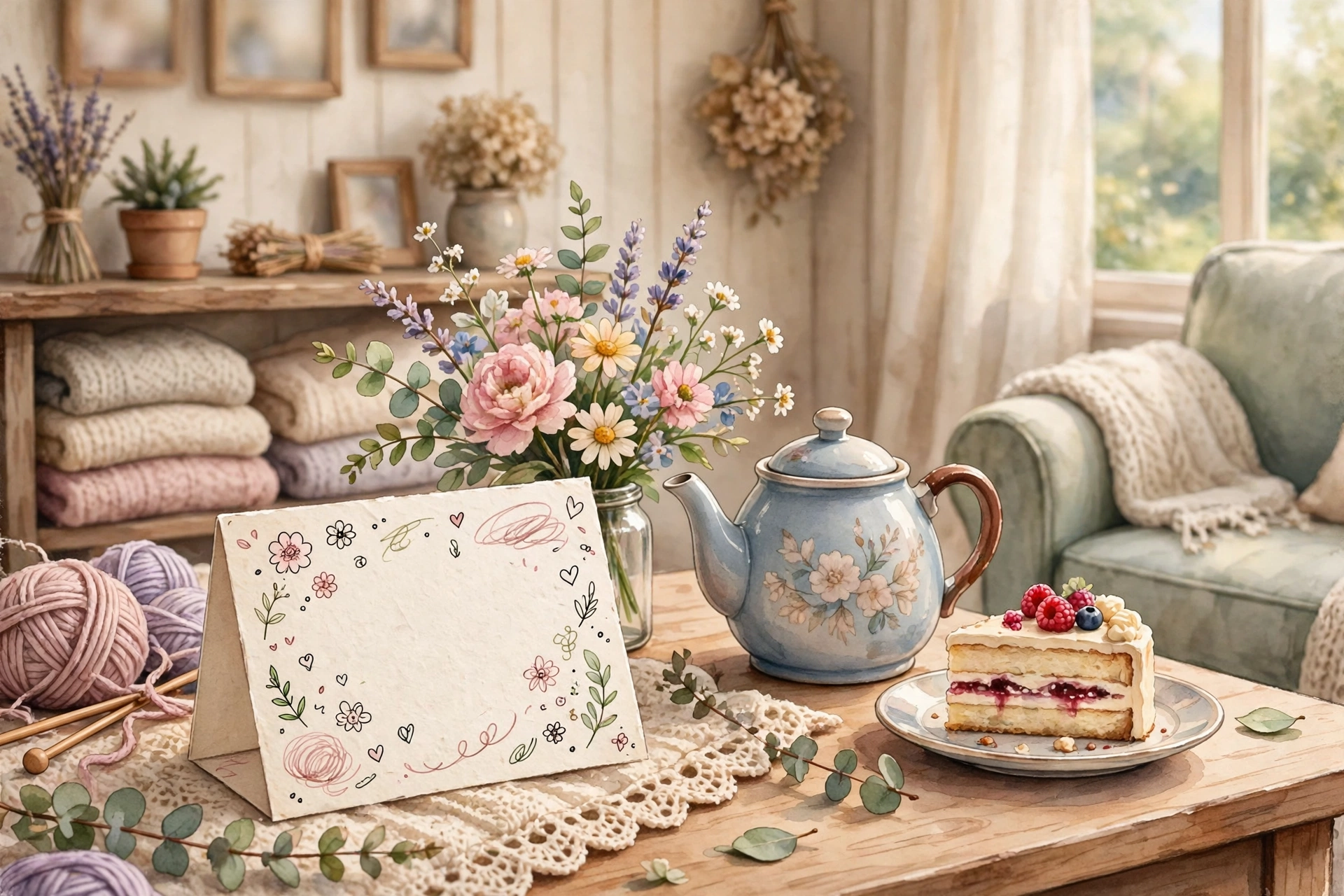
Start with appreciation, not with "happy birthday". "Thank you for making every Sunday feel like home" says more than "have a great day". Then add one memory: baking in her kitchen, a story she told a hundred times, a walk you still remember. Then close with a wish for her, not for the party: health, rest, more Sundays like those. Put together: "Grandma, thank you for making every Sunday feel like home. I still think about baking with you in your kitchen, flour everywhere and you laughing about it. I hope this year brings you as much warmth as you have given all of us." That is the whole card. If you write nothing else, write that shape. If you want her name actually printed in the card rather than handwritten, our card maker builds a personalised card in seconds, with your words inside. The messages below work in that card, in a shop-bought card, or on a printed sheet from the All-Occasion Cards and Tags set ($2) on our printables page.
Short messages, when the card is small
Small cards punish long writers. Pick one line, then add one memory in your own words if there is room.
A short message is not a lazy message. Grandmothers keep short cards too, especially the ones with one true sentence in them. "Thank you for the soup when I was ill last winter" will outlive any poem.
- Happy birthday, Grandma. I love you more than I can say.
- Thank you for making ordinary days feel like home.
- So lucky to have you. Happy birthday!
- Your love has shaped our whole family.
- Wishing you cake, laughter, and a proper rest today.
- Grateful for you, today and always.
Heartfelt messages, when you mean every word
Use these when you want to say thank you properly, and change one detail so it sounds like you.
Read your draft out loud before you write it in ink. If it sounds like something you would actually say to her face, keep it. If it sounds like a greeting-card factory wrote it, change one word until it sounds like you.
- Happy birthday to the woman who taught me that love is something you do, not something you say.
- You are not only my grandmother. You are one of the people I trust most.
- Every hug from you still feels like coming home.
- Thank you for showing me kindness in a hundred quiet ways.
- The older I get, the more I see how lucky I am to have you.
- You gave me memories I will carry for the rest of my life.
Funny, but gentle
Grandma humour works when it is warm, not when it teases her age. Safe ground: her cooking, her stories, her stubbornness about one thing.
Skip jokes about getting old, about forgetting things, or about anything health-related. A joke that makes her laugh at the table is good. A joke she reads alone later and winces at is not.
- Happy birthday, Grandma! Thanks for pretending my cooking was good all those years.
- You are the only person whose stories get better every time I hear them.
- Happy birthday to the best cook, the best storyteller, and the worst keeper of secrets, because you always tell us everything in the end.
From a child, from an adult, from far away
A child's card should be short and theirs: "Happy birthday, Grandma! I love you. Thank you for the biscuits." Let them draw on it. The drawing is the message. An adult grandchild can say the harder thing: "Being older has made me appreciate you more, not less. Thank you for the years you gave our family without ever asking for thanks." Grandmothers rarely hear that plainly, and it stays with them. If you live far away, say so honestly instead of pretending distance does not matter: "I wish I could be there today. I am thinking of your kitchen table, and I will call tonight so we can have cake together over the phone." Then actually call. A card that promises a call and gets one is worth ten cards that do not.
Messages for milestone birthdays: 70, 80 and 90
A milestone birthday deserves one line that notices the milestone without turning the card into a joke about age. The trick is to honour the years as experience, not as a number to tease her about. These lines are written to be copied, with one detail of your own added before the closing sentence. You will find more ready lines for every relation in the birthday wishes collection, but for a grandmother, the ones below are pitched exactly right.
- For a 70th: "Seventy years of you, and our family is better for every single one of them. Happy birthday, Grandma."
- For a 70th, from the heart: "You have spent seventy years making other people feel at home. Today we get to make you feel it. Happy birthday."
- For an 80th: "Eighty years young in the ways that matter: your stories, your cooking and the way this whole family still gathers around you. Happy birthday, Grandma."
- For an 80th, short and warm: "Happy 80th birthday to the head of our family and the heart of it too. We love you."
- For a 90th: "Ninety years, four generations, and one grandmother at the centre of all of it. Happy birthday — what a life, and what a family you built."
- For a 90th, gentle and simple: "Happy 90th birthday, Grandma. Thank you for ninety years of love, most of it given to us."
When grandma lives far away
Distance changes the card in one honest way: it has to do the travelling your arms cannot. A far-away card should name one concrete thing you are picturing — her table, her garden gate, the chair by her window — because a named picture lands like a visit in a way that "wish you were here" never quite does. Our family wishes collection has more lines in this same register for parents, grandparents and the whole table at once.
Try this shape: "Happy birthday, Grandma. It is [morning/evening] here and I am picturing your kitchen, the kettle on and your chair pulled up to the table. I cannot hand you this card, so I am sending the hug inside it instead. I will call at [time] your time, and I will have cake at my end too." Then keep the promise about the call — write the time in your own calendar the moment you seal the envelope.
If the card will arrive by post across borders, send it a full week earlier than feels necessary and write the date inside the card itself. A card that arrives early and says "for the 12th — open on the day if you can bear to wait" makes her smile twice: once at the postbox and once on the birthday. A card that arrives late should say so cheerfully rather than apologise for three lines; "the post took the scenic route, but the love did not" turns a delay into part of the gift.
For a great-grandma
A great-grandmother's card carries an extra layer, because the writer is often a child, a teenager, or a parent writing on behalf of both. Keep it simple, keep it grateful, and name the generation link plainly — great-grandmothers treasure being placed in the family line in words. "Happy birthday, Great-Grandma. I am so lucky I get to know you, not just hear stories about you." That one sentence, in a child's wobbly handwriting, is a keepsake.
From an adult writing for themselves and a little one, try: "Happy birthday from both of us. [Child's name] drew the picture inside, and I wrote the words, but the love is from the whole line of us that started with you." If she lives in a care home or with family, a card with a recent photo tucked inside often matters more than a longer message — she can show the photo to everyone who visits, and she will.
Avoid assuming she wants to be called a grand old age or the family matriarch in grand terms. Many great-grandmas prefer the plain thing: her name, her role, and one ordinary memory — the sweet tin, the song, the way she still insists on making the tea herself. Ordinary details are how love sounds when it is real.
From a grandchild who is all grown up
The grown-up grandchild's card can say things a child's card cannot, and grandmothers wait a long time to hear some of them. You can thank her for specific sacrifices you only understood once you had your own home, your own job or your own children: the years she minded you so a parent could work, the money that quietly appeared, the advice you ignored at sixteen and repeat at thirty. Naming one of those, plainly, is the deepest birthday gift most grandmothers ever receive.
A copy-ready version: "Happy birthday, Grandma. I am old enough now to understand what you gave our family, and young enough to still need you in it. Thank you for the years you never asked to be thanked for. I notice them now, all of them." Shorten it, change one detail, and it is yours — but do not soften the noticing; that is the sentence she will re-read.
If your relationship has grown more equal with age — you call for recipes, she asks you about your work — say that too. "You were my grandmother first. Somewhere along the way you became one of my favourite people to talk to as well." Grandmothers rarely get told they are good company. Being chosen, not just loved by duty, is a birthday message in itself.
When several grandchildren sign together
A joint card fails in a predictable way: one person writes a long message, everyone else just signs, and Grandma can tell exactly who did the work. Fix it with the relay method. One grandchild writes the opening line, each of the others adds exactly one sentence of their own — a memory, a thank-you, a small joke — and the youngest, or the one with the best handwriting, writes the closing. Four or five voices in four or five sentences reads like the whole family talking at her kitchen table, which is precisely the effect you want.
Copy-ready frame for a joint card: "Happy birthday, Grandma, from all of your grandchildren. [Sentence from grandchild one.] [Sentence from grandchild two.] [Sentence from grandchild three.] Different cities, different lives, one grandmother we all agree on. We love you." If the grandchildren are spread across countries, collect the sentences by message during the week, write the card in one hand, and note "dictated by" beside any name whose owner could not hold the pen — she will enjoy knowing the card travelled before it was posted.
One do and one do not. Do order the signatures oldest to youngest, or in the order the sentences appear, so she can match voice to name without puzzling. Do not let the card become a family newsletter — weddings, exam results and new jobs get one clause each at most. The card is for her birthday, and she should finish reading it feeling celebrated, not updated.
A card to go with flowers, a photo or a small gift
When the card travels with something else, the two should talk to each other. With flowers, one line is enough: "These are for the woman who taught me that a house feels loved when something is growing in it. Happy birthday, Grandma." If the flowers are her favourites, name them and say how you know: "Irises, because you always had them by the door." That detail proves the flowers were chosen, not grabbed.
With a photo — framed, or tucked loose inside the card — write about the photo, not about photography. "This is us at [place], the summer of [year]. I look at it whenever I need to remember what a good day feels like. I thought you should have a copy for your shelf too." A grandmother will keep that card with the photo long after a prettier card has been recycled.
With a small practical gift — hand cream, a scarf, her favourite biscuits in the good tin — one warm line joins them: "Something small for the hands that have done so much for all of us." Never mention the price, never apologise for the size, and never write "it is only a little something". A gift described as small by its giver is received as small; the same gift described by its meaning is received at full size.
When you do not see her very often
Some grandmothers are loved across a distance of diaries rather than miles: work, children, life in another town, visits that keep slipping to next month. The birthday card is not the place to confess all of that, and guilt makes a poor gift — she does not want to spend her birthday comforting you about your absence. But pretending the gap does not exist reads as careless, so steer the middle course: acknowledge it once, warmly, and spend the rest of the card on her.
Try: "Happy birthday, Grandma. We do not see enough of each other, and I think about you far more often than my visits suggest — usually when I am making your soup and getting it almost right. This year I would love to fix a proper day together; I will call this week and we will put it in the diary, not just in our intentions." The promise works because it is small, dated and kept by a phone call, not by a grand declaration.
If there has been distance for a harder reason — a family falling-out, a long silence — the birthday card can be a gentle door rather than a full reconciliation. Keep it short, kind and free of old business: "Happy birthday, Grandma. I have been thinking of you, and I wanted you to know it today of all days. I hope you are well, and I hope this year is kind to you." A card like that asks for nothing, which is exactly why it is so often answered.
Handwriting, signing and posting: getting the timing right
Three small practical things decide whether a good message becomes a good card. First, handwriting: write the card by hand if you possibly can, in your normal hand, slowly. Grandmothers recognise handwriting the way they recognise voices, and a handwritten card from a grandchild who usually types everything carries its own message before a single word is read. If your handwriting is genuinely hard to read, write a fair copy on scrap paper first, then copy it over — she should spend her time feeling things, not decoding them.
Second, the signature. Sign with the name she calls you, not the name on your bank card — the childhood nickname, the shortened version, whatever she has always used. Add "with love" rather than a bare name if that is your family's habit, and if children are signing too, let them write their own names however wobbly the letters are; a printed name under a child's drawing looks like a form, while their own attempt looks like love.
Third, timing. Post a card to arrive the day before or the morning of the birthday — a day early reads as eager, a day late reads as remembered-at-the-shop. If you are making the card digitally because the post cannot make it in time, send it early in her morning, not late in your evening, and follow it with the call you promised. And if the birthday falls close to a family party you are organising, the games side is already solved: our guide to birthday games for kids covers the children's half of the day, leaving you free to make sure Grandma's card, cake and chair are the centre of the grown-up half.
What to avoid in grandma's card
Do not write about her age as a joke, do not mention illness or money, and do not make the card about yourself for three paragraphs before mentioning her. One more: do not sign off with just your name if you are part of a family. "Love, all of us, and especially me" is a small thing that makes a grandmother feel claimed by the whole family, not just remembered by one person. And a practical note for party planners: if the birthday comes with a children's party, our birthday games guide has eight games with a running order by age, so the card is not the only thing you have ready.
Your next step tonight
Write your three sentences now: one appreciation, one memory, one wish. Then make the card itself on our card maker, with her name in it, and post it early enough that it arrives on the day, not the day after.