Quick answer: Word searches that are hard use bigger grids, longer words and more directions, so each word takes longer to spot. Look for a 20 by 20 grid or larger, words of eight letters or more, and words hidden backwards and diagonally. This guide explains how to judge the level, pick a set that suits you, and print it at home.
Word Searches That Are Hard: What to Look For First
Word searches that are hard use bigger grids, longer words and more directions, so each word takes longer to spot. Look for a 20 by 20 grid or larger, words of eight letters or more, and words hidden backwards and diagonally. This guide explains how to judge the level, pick a set that suits you, and print it at home.
A hard word search is a puzzle where the grid, the word list and the hiding pattern all work together to slow you down — not by being unfair, but by giving your eyes more ground to cover and fewer easy wins. If you have ever finished a word search in three minutes and felt short-changed, the puzzle was simply built for a lighter session than the one you wanted.
The trouble is that labels mean different things on different sites. A puzzle marked "hard" on one site might be easier than one marked "medium" on another, because there is no shared standard. So this guide gives you your own way to judge: how to read a puzzle before you print it, a ladder from medium to expert, a worked round, and themed sets for adults, teens and kids. If you want to skip straight to printing, the hard word search puzzles printable page has the ready-made sets this guide points to, with answer keys included.
What Makes a Word Search Hard?
Four things decide how hard a word search feels, and changing just one of them shifts the whole puzzle.
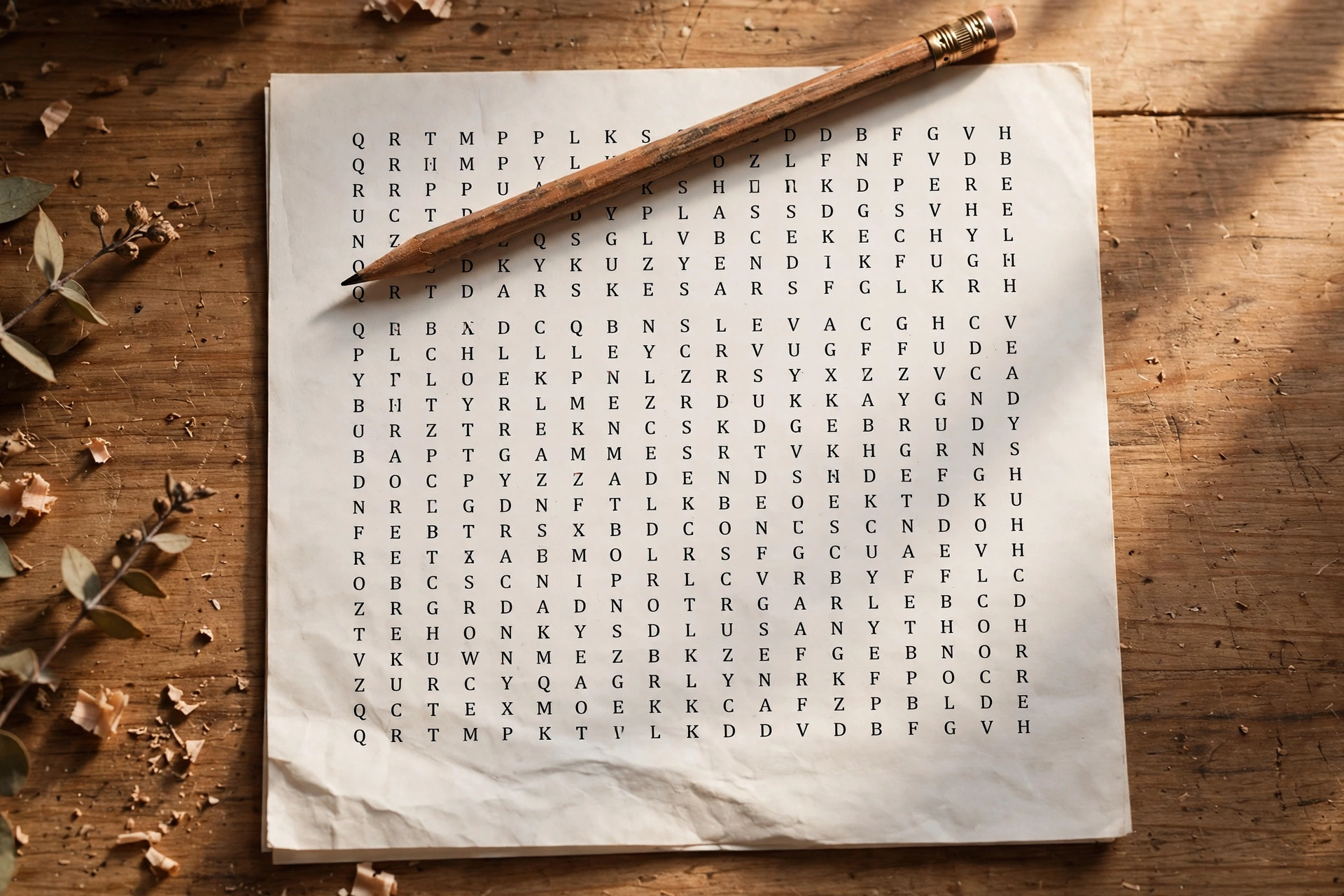
Grid size comes first. A 10 by 10 grid holds 100 letters, and your eyes can sweep it in a few passes. A 20 by 20 grid holds 400 letters, four times as many. The words do not get easier to find just because the grid got bigger — they get lost in a much larger field of filler letters.
Word length comes next. Short words are easy to spot: a three-letter word only needs three letters in a row. A twelve-letter word like "photosynthesis" has to sit in one unbroken line, and the letters around it have to avoid giving it away. Longer words also cross more rows and columns, so the filler starts to look more word-like.
Direction is the third factor. Easy puzzles hide words left to right and top to bottom only. Medium puzzles add diagonal words, and hard puzzles add backwards words as well, taking the count to eight. Every extra direction doubles the places a word could be hiding.
The fourth factor is theme density. A themed puzzle draws all its words from one subject, and when the theme is tight, the words share letters and letter patterns. A science puzzle full of words starting with "photo", "electro" and "thermo" is much harder than a mixed puzzle, because the shared beginnings create false leads.
The word list matters too. A good hard puzzle uses words you mostly know but cannot quite picture in letter form, like "quarantine" and "labyrinth". A puzzle full of words nobody knows is a guessing game, not a challenge.
How Hard Is Hard? A Simple Difficulty Ladder
Labels like "hard" and "expert" mean different things on different sites, so it helps to have your own ladder. The table below is the one I use, built from the four factors above — you can check any puzzle against it in about thirty seconds.
Level — Grid, Words, Word length, Directions, Typical time
Gentle — 10 by 10 to 12 by 12 grid, 8 to 12 words, 4 to 6 letters, across and down, 5 to 10 minutes
Medium — 15 by 15 grid, 15 to 20 words, 5 to 8 letters, across, down and diagonal, 15 to 25 minutes
Hard — 20 by 20 grid, 20 to 30 words, 7 to 12 letters, all 8 directions, 30 to 45 minutes
Expert — 25 by 25 or larger grid, 30 or more words, 8 to 14 letters, all 8 directions with heavy overlap, 45 minutes or more
A 15 by 15 grid with diagonal words is a fair medium puzzle, while the same grid with backwards words added jumps a level even though nothing else changed. Direction matters more than size once you pass a certain point.
The time column is a rough guide, not a promise — use it to compare puzzles, not to judge yourself. Word count and grid size also need to match: a 20 by 20 grid with only ten words feels empty, while a 15 by 15 grid stuffed with 30 feels crowded.
How Do You Know If a Word Search Is the Right Level for You?
Picking the right level is a skill you can build in a few minutes. The system below takes about three minutes on any puzzle page, and it saves you from printing a set that is either boring or frustrating.
Start with the grid: count the letters across the top row of the picture — fifteen or fewer means medium at most, twenty or more means hard. If there is no picture, look for the grid size in the description.
Next, read the word list — the part most people skip, and the part that tells you the most. Do I know most of these words? Are at least half of them seven letters or longer? Could any hide backwards without me noticing? Three yeses means the level is probably right; if you know none of the words, it will feel like work, not fun.
Then check the directions. "All directions" or "eight directions" means backwards and diagonal words are in play, while "across and down only" means the puzzle is gentle whatever its label says. If the page says nothing about directions, treat that as a warning sign.
Finally, run the two-minute test: print one puzzle, set a timer for two minutes, and count the words you find. Three or four means the level is about right; seven or more means it is too easy, and zero means it is too hard or badly made. Keep a short note of what works — grid size, theme, time taken — and after three or four puzzles you will know what "hard" means for you.
Can You Work Through a Hard Round Step by Step?
Yes — and doing it once with a clear method changes how you approach every puzzle after it. Here is a worked round from a hard science puzzle.
Picture a 20 by 20 grid with these words to find: PHOTOSYNTHESIS, CHLOROPHYLL, MITOCHONDRIA, GRAVITY, ELECTRON, NEUTRON, MAGNETISM and VACUUM. Eight science words, running in any of the eight directions.
Step one is sorting the list before you touch the grid: pick out the words with rare letters first. PHOTOSYNTHESIS has a PH and a Y, CHLOROPHYLL has a double L and a Y, and MITOCHONDRIA has a CH pair — these are your anchors, because rare letter pairs are easier to spot. GRAVITY, ELECTRON and NEUTRON are built from common letters, so they go last; VACUUM has a double U, so it moves up.
Step two is scanning for the anchor letters, not the whole word. Look for PH first: in a 20 by 20 grid there might be four or five P letters, but only one will have an H beside it. Check the letters around it in all eight directions: if the chain breaks after two letters, move on, and if it holds for four or five, you have found your word.
Step three is using found words as landmarks. Once PHOTOSYNTHESIS is circled, you can ignore that line when you hunt for the next word, and CHLOROPHYLL probably crosses it somewhere, giving you a starting point. Each word you find shrinks the grid.
Step four is the part people forget: when you get stuck, change direction, not effort. Turn the page upside down and scan again — backwards words hide from readers who only scan forwards. Or put the puzzle down for a minute: a short break resets your eyes, and words you missed three times often jump out on the next look. That is the whole method: sort by rare letters, scan for pairs, use found words as landmarks, and change angle when you stall.
What Do Hard Word Searches for Adults Look Like?
Adults usually want one of two things from a hard word search: a real challenge, or a quiet way to spend half an hour. The best sets give both.
History themes work well because the words are familiar but the spellings are not always obvious. An ancient-world puzzle might include "archaeology", "hieroglyph", "catacombs" and "excavation", while a 1960s puzzle might use "moon landing", "television", "protest" and "counterculture". The trick is the mix: a few words you know well, a few that stretch you.
Science themes are the classic hard set for adults: long words, unusual letter patterns, and themes that split neatly into smaller sets — space, the human body, weather, chemistry. A space puzzle with "constellation", "telescope", "asteroid" and "lightyear" feels different from a body puzzle with "skeleton", "artery", "vertebrae" and "diaphragm", even though both sit at the same level.
What About Hard Word Searches for Teens?
Teens sit in an awkward middle ground: easy puzzles bore them, and expert puzzles can put them off if the theme feels like schoolwork.
Vocabulary puzzles are the strongest fit here. A teen building words for exams or writing will get more from a puzzle full of words like "ambiguous", "diligent", "pragmatic" and "sceptical" than from a random mixed set — finding them in a grid helps fix the spelling in a way that reading a list never does.
Music and film themes work well too, because the words are ones teens already care about: a puzzle built around genres — "jazz", "reggae", "soundtrack", "acoustic", "headphones" — feels like a playlist in grid form, and the theme keeps the solver going when the grid gets tough.
One thing to watch with teens is the answer key: they are far more likely than adults to check it, and to feel cheated if it is missing or wrong. A set with a clear key on the last page is worth more than one with twice as many puzzles and no key — print it on a separate page. Time matters too: a teen between homework and dinner has about twenty minutes, so a 20 by 20 hard grid fits while a 25 by 25 expert grid does not.
Are There Hard Word Searches for Kids Who Want a Challenge?
Yes — and a child who asks for "a harder one" is telling you they are ready for the next step. The key is to raise the difficulty so it feels like a reward, not a punishment.
For children aged eight to ten, the step up is a 15 by 15 grid with diagonal words — the medium band in the table above. The words should stay familiar — animals, food, space, school — but the diagonal hiding makes them genuinely harder to find.
For children aged eleven and twelve, a 20 by 20 grid with words of seven or eight letters is fair, as long as the theme is one they know well. Dinosaurs, football, space and the natural world all work, because the words are long but familiar: "triceratops", "goalkeeper", "telescope", "waterfall". The letters are the challenge, not the meaning.
There is a limit, though. Backwards words are a step too far for most children under twelve — they make the puzzle feel unfair rather than hard, so leave them out of children's hard sets. The same goes for words the child has never heard. A practical tip: print the word list in a larger font than the grid, at the top of the page. Our printable colouring pages for kids are a natural next activity after a puzzle round.
Where Can You Find Hard Word Searches Worth Printing?
There are three honest sources, and each suits a different need.
The first source is a curated printable set — a ready-made pack with themes chosen, grid sizes set and answer keys checked. This is the fastest route: download, print, solve. The hard word search puzzles printable page is where our own curated hard sets live, built to the ladder in the table above.
The second source is a puzzle generator: type in your own words and it builds a grid around them, which is handy for a birthday or a classroom topic. The trade-off is quality control — a generator does not check whether the words are fairly placed. Generated puzzles are fun for a one-off, but they rarely match a curated set for fairness.
The third source is a puzzle book, bought or borrowed. A good book grades its puzzles from easy to hard, but you cannot print a page twice without photocopying it, and you cannot pick your theme. Books suit daily solvers; printable sets suit people who want a specific theme for a specific evening.
Here is the question that usually comes next: what do you do when the festive season arrives and everyone in the house wants a puzzle at the same time? That is where a themed seasonal set earns its place. Our Christmas word search printable page carries the festive sets, and the same difficulty rules apply there. Whichever source you choose, check three things before you print a full set: the grid size is stated, the word list is shown in full, and the answer key is included.
How Do You Print Hard Word Searches So They Stay Readable?
A hard puzzle lives or dies on its print quality: the grid is dense, the letters are small, and a bad print turns a fair challenge into a guessing game.
Print at full size on A4 or US Letter, never shrunk to fit. A 20 by 20 grid needs the full width of the page, and shrinking it by even ten per cent makes the letters noticeably harder to read. Turn off "fit to page" and use "actual size" instead.
Use black ink on white paper, and skip the coloured backgrounds — a pale grey or pastel background lowers the contrast, and in a hard puzzle you need every bit of it. Plain white paper with plain black letters is the easiest to read, and the cheapest to print.
Check the font first: the letters should be plain and even, not decorative — fancy letters blur into each other in a grid, so print one page and check it.
For children and for older solvers, print one puzzle per page rather than two — it gives the letters room to breathe and leaves space for notes. Two puzzles on a page halves the letter size, and in a hard grid that trade is rarely worth it. Finally, print the answer key on a separate page at the end, not on the back of the puzzle, where it can show through thin paper.
What Does the Research Say About Word Puzzles?
Most research looks at crosswords and word puzzles in general, not word searches on their own — but the findings still tell us something useful, as long as we do not stretch them further than they go.
A Columbia University and Duke University trial, published in NEJM Evidence, randomly assigned 107 people with mild cognitive impairment, average age 71, to either web-based crossword training or computer-based cognitive games. Training ran intensively for 12 weeks, with booster sessions up to 78 weeks. The crossword group showed greater cognitive improvement on the main measure, the ADAS-Cog scale, at both 12 weeks and 78 weeks, and brain shrinkage measured by MRI was less for the crossword group at 78 weeks. Read the Columbia summary in full on Columbia University's psychiatry site.
A longer study from Rush University Medical Center followed 1,157 people aged 65 or older who did not have dementia at the start, across nearly 12 years. People who took part in mentally stimulating activities more often saw their rate of cognitive decline fall by 52 per cent for each point on the study's five-point activity scale. It was published in Neurology — the press summary from the American Academy of Neurology gives the full numbers.
Neither study proves word searches on their own sharpen the mind. What the research does support is simpler: regular, enjoyable mental activity is linked with slower cognitive decline, and word puzzles are one of the most accessible forms of it.
MerryHub is a printable-games and planner shop by ReplyPilot. The puzzles on this site are made to be printed and solved at a table, with a pencil, away from a screen. A printed puzzle does not buzz, does not show adverts, and does not track your time.
What Are the Common Mistakes When Picking a Hard Word Search?
The first mistake is trusting the label. A puzzle marked "hard" on a site that mostly publishes easy puzzles may be easier than a "medium" puzzle on a site that specialises in tough ones. Check the grid size and the word list yourself — it takes thirty seconds.
The second mistake is picking by theme alone. A space puzzle sounds hard and a food puzzle sounds easy, but the theme tells you nothing about the grid. A food puzzle on a 25 by 25 grid with backwards words is harder than a space puzzle on a 15 by 15 grid running across only.
The third mistake is skipping the answer key. A hard puzzle without a key is one you cannot finish with confidence. Check that the key exists before you print, and if it does not, pick a different set.
Your Next Step: Print the Hard Sets and Start Solving
You now have a way to judge any hard word search in about a minute: check the grid size, read the word list, check the directions, and run the two-minute test. The last thing to do is pick a set and start.
Go to the hard word search puzzles printable page and choose a set that fits the level you want — the science, history and vocabulary sets there are built to the hard band in the table above, with answer keys on a separate page. Print one puzzle first and try the rare-letter method on it. The right level is the one that keeps you at the table for half an hour without you noticing the time pass.