Quick answer: Wordle for kids is a word-guessing game where a child works out a hidden word in six tries, using coloured clues after each guess. Green means a letter is right and in the right place, yellow means the letter is in the word but in the wrong place, and grey means it is not in the word at all.
Wordle for Kids: How to Play, Printable Puzzles and Classroom Ideas
Wordle for kids is a word-guessing game where a child works out a hidden word in six tries, using coloured clues after each guess. Green means a letter is right and in the right place, yellow means the letter is in the word but in the wrong place, and grey means it is not in the word at all.
That is the whole game. One hidden word, six guesses, and three colours doing all the talking. If you have ever watched a child light up when a tile turns green, you know why this small game has found its way into so many homes and classrooms.
This guide keeps it on paper. No app, no account, no screen needed. You will find the rules in plain words, one full round played out guess by guess so a child can follow the thinking, word lists sorted by age, and classroom ideas a teacher can use tomorrow morning. And if you want a ready-made pack to print and play straight away, the Kids Coloring & Activity Pack sits alongside these puzzles with colouring and activity pages that fill the same quiet afternoon slot.
What is Wordle for kids?
Wordle for kids is a slower, kinder version of the grown-up word game. One player, or one teacher, picks a secret word. The child guesses a word of the same length. After each guess, the letters change colour to show what was right. Six guesses, then the word is either found or revealed. That is all there is to it.
The grown-up game uses five-letter words and one puzzle a day. The kids' version is looser, and that looseness is the point. For a five-year-old, four-letter words work better. For an eleven-year-old, six letters add a proper challenge. On paper, you set the length, you pick the words, and you decide how many guesses feel fair. A child who is still learning to read should never feel rushed by a timer or a daily limit.
MerryHub is a printable-games and planner shop by ReplyPilot. The puzzles here are built for printing: grids a child can write in, word lists a teacher can cut up, and games that work just as well on a rainy afternoon as they do in a classroom.
So what makes this different from playing on a phone? Three things. First, the paper version belongs to the child. They hold the pencil, they colour the tiles, they keep the sheet. Second, you control the words. A phone game picks words at random, and some of them are words no eight-year-old has ever met. Your list can hold words from this week's spelling list, from a story the class just read, or from a child's favourite animals. Third, paper play is shared play. Two children can sit side by side with the same puzzle, point at the same grid, and argue happily about whether the next guess should be PLANT or PLANE. That talking is half the learning.
How do you play Wordle for kids?
Start with the simplest version, then add the extras once the child is comfortable. You need a sheet of paper, a pencil, and coloured pencils or crayons in green, yellow, and grey. That is the whole kit.
Step one: pick a secret word and keep it hidden. The person who picks the word is the word keeper. They write it down on a folded slip of paper, or on the back of the sheet, so nobody can peek.
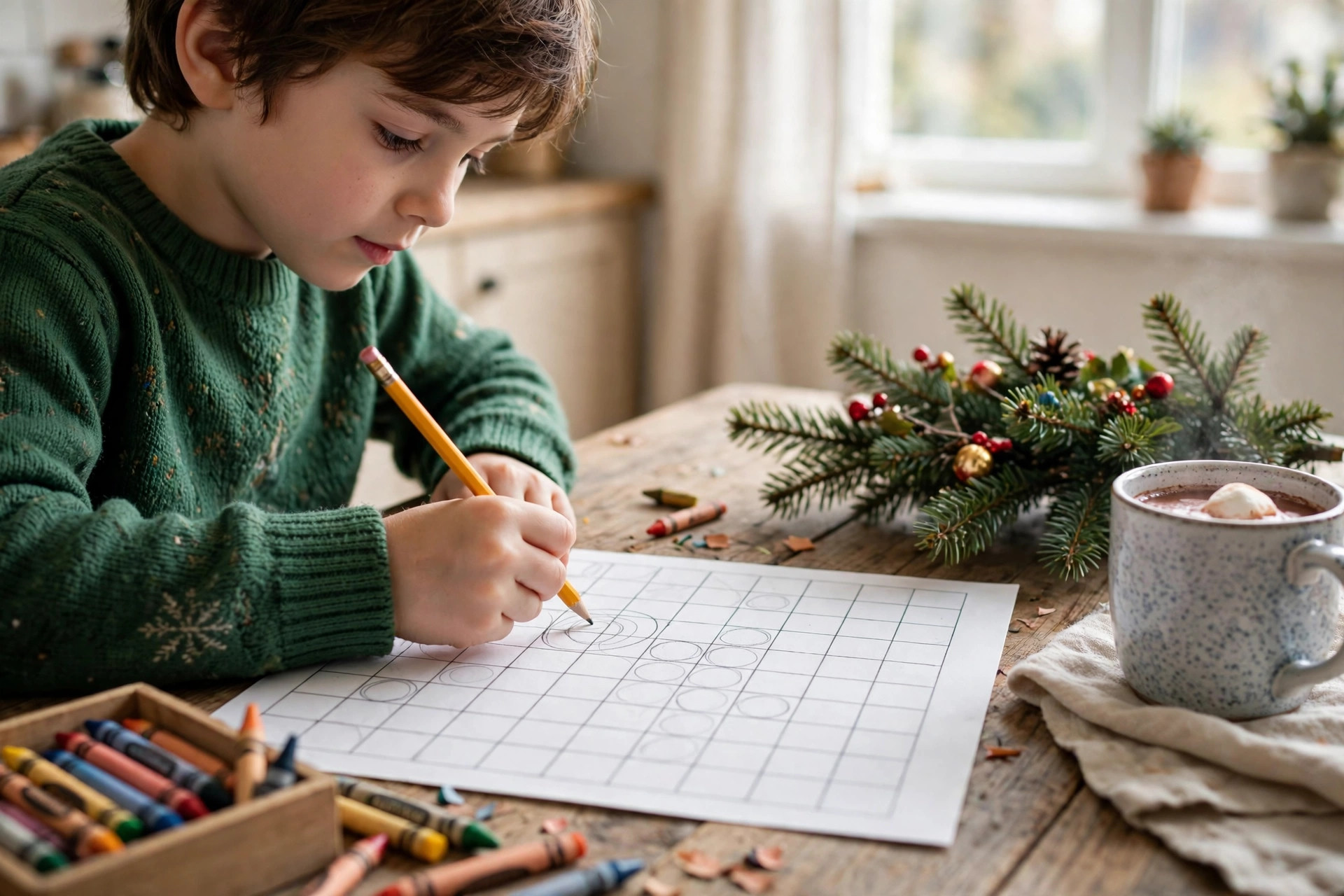
Step two: draw the grid. For a five-letter word, draw six rows of five boxes. Six rows, six guesses. Each row holds one guess.
Step three: the guesser writes a real word in the first row. It has to be a real word, and it has to be the right length. Made-up letter strings do not count. That rule matters. It stops a child guessing ZQXJK just to test letters, and it keeps the game honest.
Step four: colour the letters. This is the heart of the game, so take it slowly the first few times.
Step five: guess again, using what the colours taught you. Green letters stay where they are. Yellow letters move to a new spot. Grey letters are crossed off the list and not used again. Keep going until the word is found, or until the six rows run out. Six rows gone and no answer? The word keeper shows the secret word, everyone groans a little, and a new round starts.
A few house rules keep the game friendly. Young children get more than six guesses if they need them. There is no shame in seven or eight rows when a child is five. Let the guesser ask for one clue per round, such as "it is an animal" or "you can eat it". And when two children play together, let them take turns being the word keeper. Choosing the secret word is just as much fun as guessing it, and it teaches spelling from the other side.
- Green: the letter is in the secret word, and it sits in the right place.
- Yellow: the letter is in the secret word, but it sits in the wrong place.
- Grey: the letter is not in the secret word at all.
Can we walk through one full round together?
Yes, and this is the best way to teach the game. Sit with a child, play this round out loud, and talk through each guess. The secret word is PLANT. The guesser does not know that yet. Watch how the colours narrow it down.
Guess one is GRAPE. Say it out loud. "Grapes are a fruit. G-R-A-P-E. Five letters, a real word. Let's colour it."
After one guess, we know two letters and two positions. The word looks like _ _ A _ _, and it holds a P somewhere that is not in second place. Already the puzzle is smaller. Point at the green A and say, "That one stays. Everything else can move."
Guess two is PILOT. Why PILOT? Because it puts the yellow P in the first box, a new spot for it, and it tests two fresh letters, I and L, plus O and T. A good guess always tests something new when rows are still left.
Now the word looks like P L A _ T. Four letters known, one box empty. We know A sits third and the word holds a P. What fits P-L-A-something-T?
Guess three is PLANT. P-L-A-N-T. Every letter turns green. The word is found in three guesses, with three rows to spare.
- G is grey. There is no G in the secret word.
- R is grey. No R either.
- A is green. A is in the word, and it sits in the third box. The third letter is A.
- P is yellow. P is in the word, but it is not in the second box. It must sit somewhere else.
- E is grey. No E.
- P is green. P is in the word, and the first box is right. The word starts with P.
- I is grey. No I.
- L is green. L is in the word, and the second box is right.
- O is grey. No O.
- T is green. T is in the word, and the fifth box is right.
Which words work best for each age?
The wrong word list ruins the game faster than anything else. Words that are too hard make a child give up. Words that are too easy make an older child yawn. The list below sorts it out by age, and it is the same split teachers use when they set up a classroom round.
Age group — Word length, Words, Clue, Guesses
Ages 5 to 7 — 4-letter words, short everyday words a child can sound out (BALL, FISH, CAKE), picture clue or "you can eat it", 8 guesses
Ages 8 to 10 — 5-letter words, familiar words from school and stories (PLANT, BEACH, TIGER), one spoken clue such as "it grows", 6 guesses
Ages 11 and over — 5 to 6-letter words, longer words with trickier spellings (GARDEN, PLANET, PUZZLE), no clue or a riddle-style clue, 6 guesses
Here are starter lists you can print, cut up, and drop into a jar. Pull one slip out per round, and the word keeper never has to think of a word on the spot.
Ages 5 to 7, four letters: BALL, CAKE, FISH, DUCK, MILK, SONG, RAIN, BEAR, STAR, MOON, FROG, BOOK, LION, KITE, HAND, FOOT, DOOR, SHIP, COAT. Keep to words the child already says out loud. If a child cannot read the word yet, a small picture beside it does the job. The game still works, and the child still learns the shape of the word.
Ages 8 to 10, five letters: PLANT, BEACH, TIGER, APPLE, MOUSE, LIGHT, STONE, WATER, HAPPY, GREEN, HORSE, RIVER, CLOUD, MUSIC, PIANO, DANCE, BREAD, SUGAR, TABLE, CHAIR. These are words a child of this age meets in books and at school. A few have a doubled letter, like APPLE, which gives older children a little extra to think about.
Ages 11 and over, five to six letters: GARDEN, PLANET, PUZZLE, SECRET, BRAVE, WINTER, MARKET, TRAVEL, FAMILY, SCHOOL, BANANA, GIRAFFE, DOCTOR, SUNSET, BRIDGE, CASTLE, DRAGON, ISLAND, LETTER, NUMBER. Longer words need more careful guessing, and the six-letter words change the grid to six boxes. That small change makes the game feel new again for a child who has solved the five-letter version a dozen times.
How do you make printable Wordle puzzles at home?
You do not need a fancy template. A sheet of lined paper and a ruler will do. But a little preparation makes the game run smoothly, especially if you are printing a set for a whole class or a long car journey.
Start with the grid. Draw six rows of boxes, five boxes to a row, each box big enough for one capital letter. Leave a margin on the right side for the "ruled out" list, where the child writes grey letters as they find them. That list is more useful than it looks. It stops a child guessing the same dead letter twice, and it gives a younger child something concrete to check before each guess.
Then print the word list. Cut the age list above into slips, fold them, and put them in a jar or a small box. The word keeper draws one slip per round. No arguments about who picks, no long pauses while someone thinks of a word, and the game moves quickly.
Here is the ready-to-play checklist our family uses before a round starts. Run through it once, and the game rarely stalls.
That is the whole system: print, play, check. Print the grid and the word slips. Play the round. Check the colours and talk about what they mean. A set of ten grids will keep a classroom busy for a full lesson, and a set of five will fill a rainy afternoon at home.
Once the puzzle is done, children often want to keep going with something quiet. That is a good moment for colouring. Our printable colouring pages for kids sit in the same pack family, and they pair well with a puzzle session: puzzle first while minds are fresh, colouring after while hands stay busy.
And here is the question that usually comes next. Once your child is solving five-letter words without much trouble, what do you try next? Longer words, or a new kind of puzzle altogether? If the answer is a new kind of puzzle, our hard word search puzzles printable picks up where this leaves off, with bigger grids and words that hide in every direction. It is the natural next step, and it uses the same patient, pencil-first style.
- Grid drawn, six rows, right number of boxes.
- Secret word picked and hidden.
- Green, yellow, and grey pencils on the table.
- Ruled-out list space kept clear on the side.
- Clue agreed before the first guess, or no clue at all.
- Guesser knows how many guesses they get.
Why do word games help children read?
Word games work because they ask a child to look closely at letters. A child guessing PLANT has to think about which letters the word holds, where each letter sits, and which letters cannot be there. That is spelling practice, but it does not feel like spelling practice. It feels like solving something.
The numbers behind this are worth knowing. Children's spoken vocabulary typically grows from about 300 words at age two to more than 5,000 words by age five, according to the Victorian Government's Literacy Teaching Toolkit. A guessing game is one more way to put new words in front of a child and give them a reason to care about each letter.
The same toolkit gives a second number that puts the long game in view. By age 17, spoken vocabulary typically ranges from 36,000 to 136,000 words. The gap between those two ends is wide, and it is built word by word, year by year, through reading, talking, and playing with language. A five-minute word game will not close that gap on its own. But a small daily habit of word play adds up across a school year in a way that is easy to miss and hard to replace. You can read the milestones in full in the Victorian Government's Literacy Teaching Toolkit, which sets out the ages and stages for spoken vocabulary.
Reading Rockets, a literacy site for parents and teachers, makes a similar point in practical terms. Its six games for reading use ordinary card games to practise word recognition, spelling patterns, and letter-sound knowledge, and it advises choosing words from books the child is reading. That is the same advice behind the word lists in this guide: the words that teach best are the words a child already half knows from a story.
What classroom ideas actually work?
Teachers use this game in more ways than a quick filler. Here are the setups that hold up across a full term, tried in real classrooms and easy to run with paper and pencils.
The morning starter is the simplest. One puzzle on the board, the whole class guessing together. The teacher writes each guess, colours the letters, and the class talks about the next guess. Ten minutes, one puzzle, and the day starts with everyone thinking. It works because nobody is put on the spot alone. The class guesses as a team, and a wrong guess is shared, not blamed.
Pair play works well for spelling practice. Two children share a grid. One is the word keeper, one guesses, then they swap. The word keeper has to spell the secret word correctly to hide it, and the guesser has to spell each guess correctly to play it. Both sides are spelling without realising it. Give each pair words from their current spelling list, and the game becomes revision that children ask for.
The word wall is a longer project. Each week, the class solves one puzzle a day and adds the secret words to a wall display. By half term, the wall holds forty or fifty words the class has solved together. The wall becomes a record of what the class can do, and it grows in front of them.
A Friday puzzle club gives the keenest children somewhere to go. Six-letter words, riddles for clues, and a class total of rounds solved in the fewest guesses. Keep the total friendly: track the class number, not individual scores, so quieter children are not left behind. The club works best when the puzzles get harder slowly, one small step a week.
For children who need extra support, shrink the game, do not drop it. Four-letter words, eight guesses, and a picture clue for every round. Let the child keep a letter bank on the side, with every letter they know in the word kept visible. Let them guess with a partner who reads the letters aloud. The game still teaches the same thinking, just at a gentler pace.
How can you keep it screen-free and calm?
The paper version is calm by nature, but a few choices keep it that way. Play at a table, not on the move. Keep the pencils in one place so nobody is hunting for the green one mid-guess. Agree the number of guesses before the first word goes down, so nobody argues about an extra row later.
Short sessions beat long ones. Ten minutes of focused guessing teaches more than half an hour of tired guessing. When a child starts guessing at random, that is the sign to stop.
Keep the mood light when a round is lost. A lost round is not a failed lesson. Say the secret word out loud together, spell it together, and talk about which guess came closest. Children remember the near misses more than the wins, and a near miss teaches more. The child who lost by one letter will play the next round with sharper eyes.
What if a child gets stuck?
Every child gets stuck. It usually happens on the third or fourth guess, when the green letters are in place but the missing letter will not come. The worst thing to do is give the answer. The next best thing is to give a smaller hint and let the child finish the job.
Try the sound-it-out hint first. Say the known letters slowly, with a gap where the missing letter sits. "P... L... A... something... T." Let the child hear the shape of the word. Often the missing letter arrives on its own once the word is heard aloud.
Try the category hint next. "It is something that grows." One fact narrows the field without handing over the word. A child who hears "it grows" and looks at P-L-A-_-T will often find N by themselves.
And if a child is truly stuck and upset, end the round kindly. Show the word, spell it together, and start a fresh round with an easier word from the younger list. Today, the child needs to leave the table feeling like a puzzle solver.
Where should you go next?
You have the rules, a full round to copy, word lists for three age groups, and classroom ideas that are ready to use. The next step is a new kind of puzzle that builds on the same skills. Our hard word search puzzles printable takes the letter-spotting your child just practised and turns it into bigger grids, with words hiding forwards, backwards, and diagonally. It is the natural next page after this one, and it prints just as easily. Start there when the five-letter words start feeling easy.