Quick answer: An Elf on the Shelf kit is a set of letters, daily notes and a plan covering the elf's whole visit, from arrival night to goodbye morning. A good kit gives you one idea for each of the 24 days, so you never think up a scene late at night. This guide shows what to look for, plus the plan.
What an elf kit really is
An Elf on the Shelf kit is not the elf itself. It is everything around the elf that keeps the tradition going for a whole month. The elf is a small toy that sits in a new spot each morning. The kit is the set of letters, notes, cards and plans that give those mornings meaning, so children find something new to read, do or laugh at every day from the start of December to Christmas Eve.
Without a kit, the tradition rests on one parent thinking up a fresh idea every single night. That works for a few nights. Then comes a late evening at work, a sick child, a busy weekend, or simple tiredness, and the elf ends up sitting in the same spot as yesterday, with nothing new to say. Children notice. A kit exists to stop that slide. It hands you the words and the plan in advance, so the nightly job shrinks from inventing something to simply placing the elf and leaving the note.
A kit also gives the month a shape. Arrival night opens the story. The middle weeks build the fun, with jokes, kindness tasks and small surprises. The final week raises the excitement as Christmas gets closer. Goodbye morning closes the story with warmth, so the elf leaves on a happy note and children look forward to next year. When you buy or build a kit, you are really buying that shape: a beginning, a middle and an end, already written.
The buyer's checklist: what a good 24-day kit must contain
Not every set sold as an elf kit covers the full month. Before you spend anything, check it against this list. A good 24-day kit must contain all five of these parts. If one is missing, ask yourself whether you are happy to fill that gap yourself, night after night.
Two extra features are worth looking for, though they are not essential. The first is a matching design across all the pieces, so the letters, notes and cards look like they came from the same elf. The second is a size that prints easily at home, on ordinary paper, without special supplies. If a kit needs fancy paper, tiny print or complicated cutting, it will cost you time on the very nights you bought it to save time.
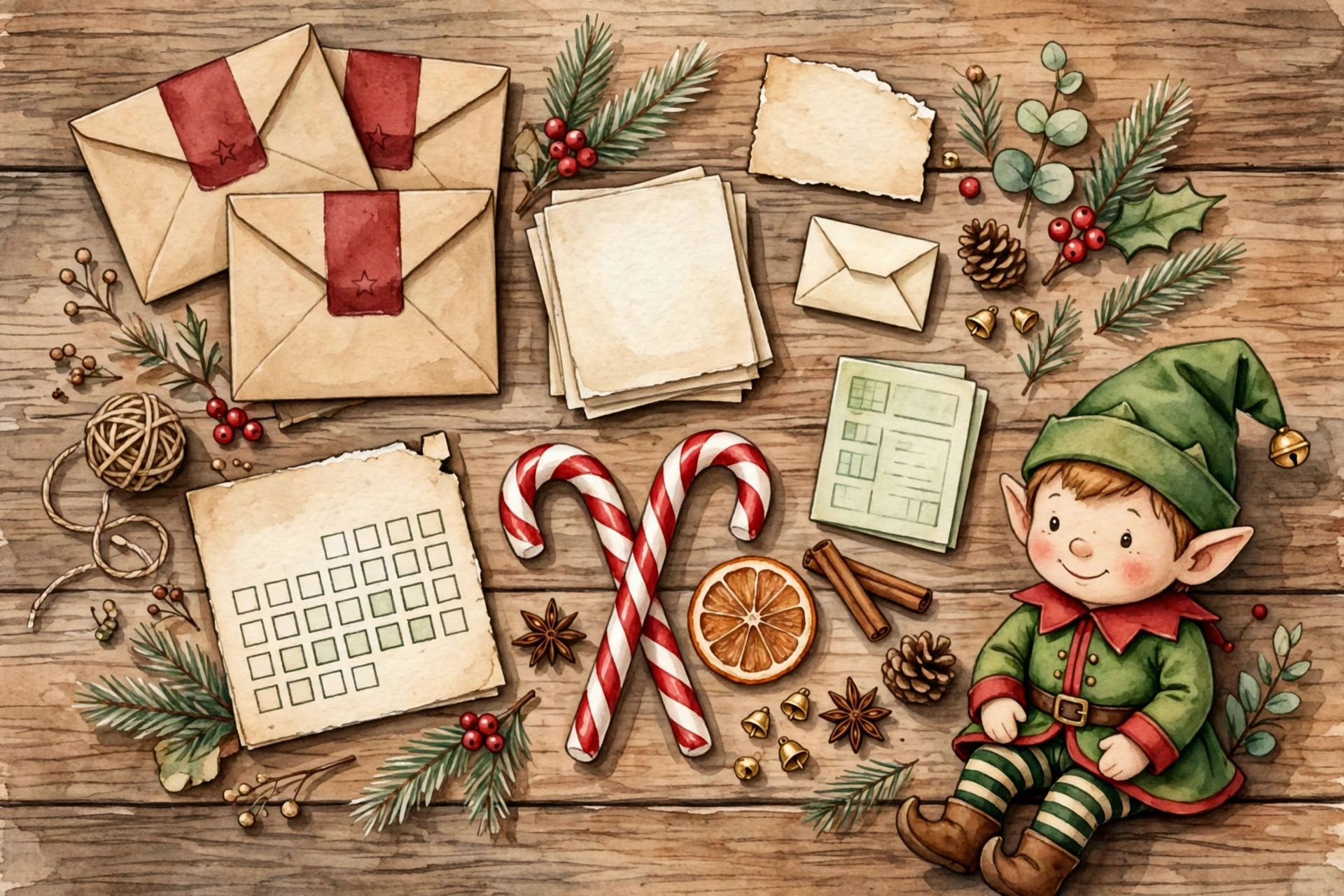
- Arrival letter: a short letter from the elf that announces its return, names the child, and sets the one rule children love to repeat, which is to look with their eyes and not touch, so the magic stays strong. The arrival letter is the most important piece in the kit, because it opens the whole tradition.
- Twenty-four daily notes or ideas: one for each morning from 1 to 24 December. Notes can be jokes, kindness challenges, countdown messages or silly confessions. Ideas can be simple scenes, like the elf sitting in a mug or hiding in the tree. What matters is that there is one for every day, with no gaps, so you never face a blank evening.
- Goodbye letter: a warm letter for Christmas Eve or Christmas morning that thanks the child, praises something real from the month, and promises to return next year. Without it, the elf simply vanishes, and children are left wondering where it went.
- Report card: a small card where the elf reports back on the child's behaviour, kindness or helpfulness during the visit. Children take report cards seriously, and a kind, honest report card becomes a keepsake. It also gives you a gentle way to praise real good behaviour you noticed during December.
- Day-by-day plan: a simple order for using the pieces, telling you which note or idea belongs to which day. A pile of notes with no order is not a plan. The plan is what turns a bag of cards into a month you can run without thinking.
The complete 24-day plan
Here is a full plan for the elf's visit, built so that any kit with the five parts above can run it. The plan has four phases: arrival, the steady middle weeks, the final week, and goodbye. You do not need a complicated scene on any night. A note beside a simply placed elf is a complete elf morning.
Arrival night comes first. On the night before 1 December, place the elf somewhere obvious and exciting, where children will spot it first thing in the morning, and leave the arrival letter beside it. The letter should name the child, say the elf missed them, and remind them of the looking rule. Keep the scene simple on purpose. The letter is the star of arrival morning, not the props. If you have a countdown or calendar nearby, point the elf toward it, so children connect the elf's arrival with the countdown to Christmas.
Days 1 to 7 are the settling-in week. Use light, funny notes and easy placements while children learn the routine of hunting for the elf each morning. Good early notes are jokes, silly confessions and one small kindness challenge. Place the elf at child height, in places children already look: on a shelf, in a mug, beside the breakfast bowls, peeking from behind a curtain. The goal of week one is habit. Children should wake up expecting to find the elf, and parents should learn that the nightly job takes only a few minutes.
Days 8 to 17 are the middle stretch, and this is where most elf traditions fade. Beat the fade by mixing the note types. Alternate jokes with kindness tasks, so children never know which kind of morning they will get. Add one slightly bigger scene in the middle of this stretch, like the elf wrapped in a blanket with a book, or the elf sitting among the baubles on the tree. One bigger scene in ten days is plenty. The rest can stay simple, because the notes carry the variety. If a child has a birthday in this stretch, give that day its own special note, even if it is only two lines long.
Days 18 to 23 are the final week, and the excitement should rise. Switch the notes to countdown messages: how many sleeps are left, what Santa might be doing, and small jobs children can help with, like wrapping a present or writing a card. Place the elf in slightly more adventurous spots, higher up or tucked into the decorations, because older excitement makes the hunt more fun. Keep one kindness note in the final week too, so the month ends on warmth, not only on wanting presents.
Goodbye morning closes the visit. On Christmas Eve or Christmas morning, leave the goodbye letter and the report card beside the elf, in a place of honour, like under the tree or beside the stockings. Read them together, slowly. Thank the elf out loud. Then put the letters, notes and cards away in an envelope, so next year's kit starts with this year's memories.
The nightly rhythm: 2-minute, 5-minute and weekend tiers
The secret to surviving 24 nights is deciding in advance how much effort each kind of night gets. Think in three tiers, and pick the tier that fits the evening you actually had, not the evening you wished for.
Keep the kit itself in one place, out of children's sight, like a drawer or the back of a cupboard. Each evening, take out the next note, leave it with the elf, and put the kit away. The system only works if the kit is easy to reach for you and impossible to find for them.
- The 2-minute tier is your rescue tier. Move the elf to a new spot, leave the next daily note beside it, and go to bed. That is the whole job. Use this tier on late nights, sick nights and exhausted nights, without guilt. A note beside a simply placed elf is still a full elf morning.
- The 5-minute tier is your normal tier. Move the elf, leave the note, and add one small touch: a mug, a blanket, a book, a pair of sunglasses, a trail of flour footprints on the counter. One touch is enough. Children will notice it, and it takes less time than making a cup of tea.
- The weekend tier is your showpiece tier. Once a week, usually on a Friday or Saturday night when you have more time, build one bigger scene. The elf might be caught mid-mischief, like tangled in tinsel or sitting in a bowl of marshmallows. Keep it to one scene a week. More than that turns fun into a chore, and children enjoy one big surprise far more than a daily production.
Free versus paid: an honest comparison
Both routes can give your family a lovely December. The difference is not quality. It is effort, and it is worth being honest about that trade before you choose.
Scattered free pages and guides work well if you enjoy the nightly work. You can read idea lists, copy notes by hand, and print a single arrival letter page. The ideas are good, and copying them costs nothing. What it costs is time and planning. Each night, you must find the next idea, copy or print it, and decide where the elf goes. On a good week, that is a pleasure. On a hard week, it is one more job at the end of a long day, and it is the job most likely to be skipped.
One printed kit saves the nightly thinking. Everything is already written, in order, in one design, and the only nightly job is placing the elf and leaving the next card. You pay for that convenience, and for the design and the completeness, not for better ideas. A kit does not make the elf funnier or kinder than a hand-copied note. It makes the tradition easier to finish, and finishing is the part families actually struggle with.
So choose by your December, not by your ideals. If you love crafting, have time in the evenings, and enjoy hunting for ideas, free pages will serve you happily. If your December is busy, if you have more than one child to surprise, or if you simply want the whole month handled in advance, a complete kit is the honest choice. There is no wrong answer, only a mismatch between the route and the reality of your evenings.
What MerryHub's kits include
MerryHub's elf pieces are sold as printable bundles on the printables page, and it helps to know exactly what each one contains before you pick.
None of these is a free complete kit download, and this guide does not pretend otherwise. The free pieces on this site are single guides and pages, like the arrival letter guide and the ideas hub, which you can read and copy from. The complete, ordered, ready-to-print kits are the paid bundles above. Pick the smallest bundle that covers the five checklist parts, and you have everything the 24-day plan in this guide needs.
- Elf Notes and Letters Pack, 3 dollars: arrival and goodbye letters, 24 notes and a report card. This is the notes-first option, for families who already have an elf and want the words for the whole month.
- Elf on the Shelf Kit plus Advent Bundle, 4 dollars: the full elf kit plus 25 Advent activity cards. This is the combined option, for families who want the elf month and a daily Advent activity alongside it.
- Complete Christmas Bundle, 7 dollars, 68 pages: the largest bundle, whose Elf Kit section is an arrival letter, a goodbye letter, 24 daily elf note cards and an elf report card, alongside the bundle's other Christmas printables. This is the option for families who want the elf kit as part of a whole Christmas set.
Setting your kit up before December starts
The best elf month is prepared in November. Print the kit, cut the cards if they need cutting, and put them in an envelope or folder in date order. Read the arrival and goodbye letters once, so you know the story they tell. Pick the elf's arrival spot and its goodbye spot in advance, and make sure you know where the elf itself is stored.
Then tell yourself the one rule that saves every elf parent: a simple morning beats a skipped morning. If a night goes wrong, use the 2-minute tier and move on. Children remember the month as a whole, not any single scene. Twenty-four mornings, each with a note and a new spot, add up to a December they will talk about for years, and a kit is simply the easiest way to make sure all twenty-four actually happen.
Try it on MerryHub
- Printables
- Elf on the Shelf Arrival Letter
- Easy Elf on the Shelf Ideas
- Elf on the Shelf Notes Printable