Quick answer: Elf notes are short messages your elf leaves beside itself each morning: a joke, a challenge, a kindness task, or a countdown note. Copy the 24 ready messages below, one for each night from 1 to 24 December, and leave one with the elf every evening. They are the easiest elf idea of all, because one note takes a minute.
Why notes are the smartest elf idea
Moving an elf into a new scene every night is fun, but it is also the part parents dread. Notes change the maths completely. A note beside a simply-placed elf — sitting on a shelf, in a mug, on the tree — gives children something new to discover even when the scene itself is simple. The words do the work that elaborate props used to do.
Notes also give children something scenes cannot: a message addressed to them. A joke they can repeat at school, a compliment that makes their morning. Children keep elf notes. They pin them to fridges, carry them in pockets, and read them to grandparents on video calls. A scene is seen and forgotten; a note is kept.
And notes solve the December problem honestly. On a night when you are ill, late, or simply out of ideas, a note is still a full elf morning. The elf does not need a zipline or a baking scene. It needs one line, written with love, left where small eyes will find it.
How to use elf notes, night by night
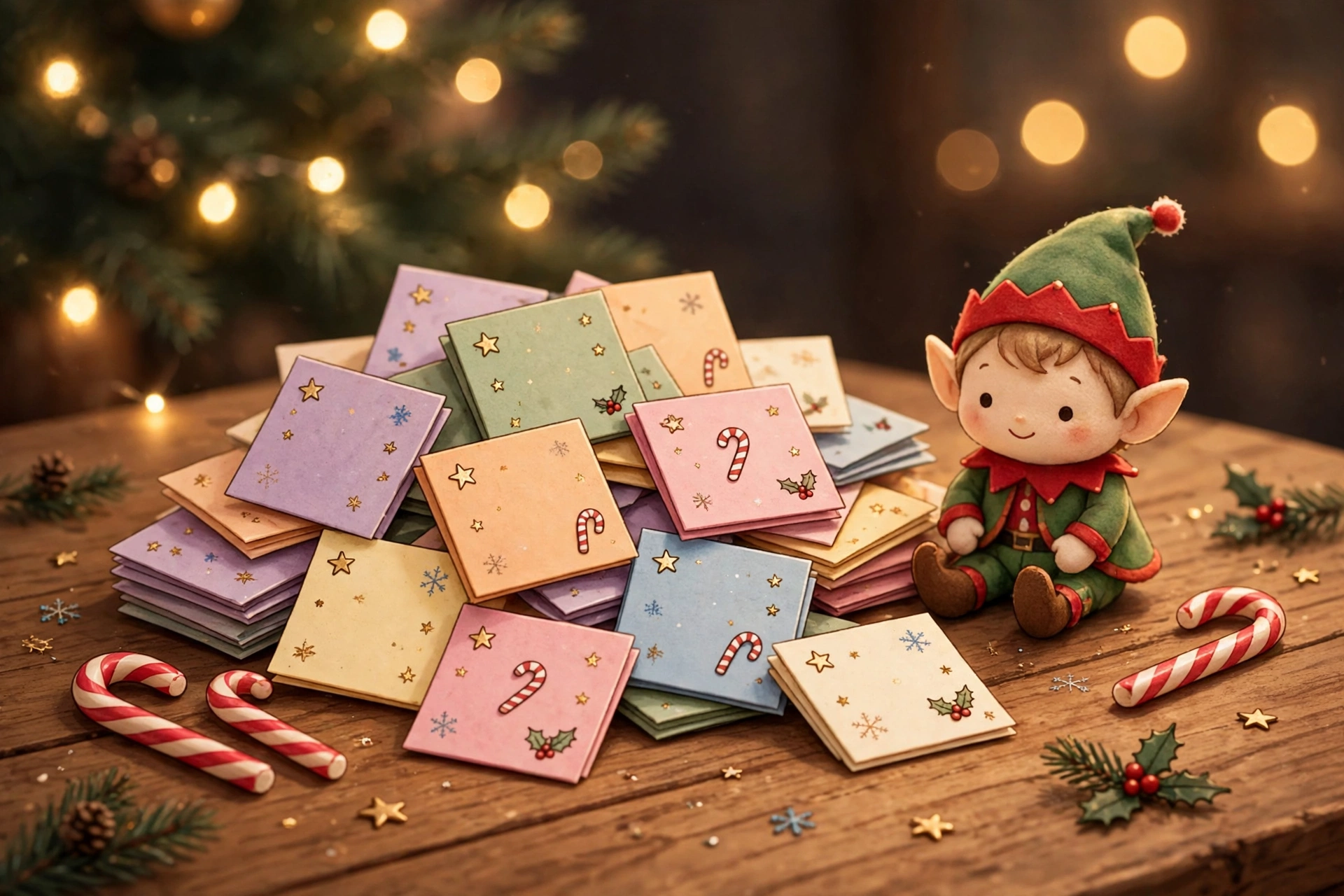
The system is simple. Print or copy the notes below, cut them into small cards if you like, and keep them somewhere children will not find them — a drawer, a folder, or the back of a cupboard. Each evening, pick the next note, leave it beside the elf, and move the elf somewhere new, even if the new spot is only the next shelf along.
If you want a ready set rather than copying from this page, MerryHub's printable pack includes 24 daily elf notes in a matching design, so you can print the whole month at once. Either way — copied by hand or printed — the mornings work the same.
- One note per morning. More than one feels like homework. One note feels like a gift.
- Match the note to the day. A countdown note works best in the final week; a kindness challenge works best on a school day; a joke works any morning, especially Monday.
- Leave a pencil with the note sometimes. Children love replying, and a reply note from a child is a keepsake you will treasure far longer than they will.
- Keep the handwriting small and playful. If your handwriting is recognisable, write in small capitals or print the notes instead. The mystery is part of the fun.
- Do not explain the notes. If a child asks how the elf writes so neatly, smile and say the North Pole teaches excellent handwriting. The game works best when adults play along lightly.
The 24 notes: jokes, challenges and countdown messages
Here is a full month of notes, grouped by type so you can reorder them to fit your family's days. Each one is short enough to fit on a small card, and each one works on its own, without any scene at all.
Read through the list once and swap any note that does not suit your family. The best set is one that sounds like your elf — funny, kind, and a little bit cheeky.
- Jokes to start the day: "Why did I sit in the fridge? I wanted to be a cool elf!"; "I tried to wrap myself as a present. It did not work. Send help (and tape)."; "Knock knock! Who's there? An elf who hid your left socks. Good luck finding them!"; "I counted the Christmas lights last night. There are lots. I lost count at the tree."; "Why do I love hide and seek? Because I am elf-abetter at it than you!" — children love a groan-worthy pun, and this is the place for it.
- Kindness challenges: "Today's mission: give someone a compliment before breakfast."; "Leave a kind note for someone in this house. I will check tonight!"; "Share a toy with someone today. Sharing is the best kind of magic."; "Say thank you to someone who helps you today. Mean it."; "Do one helpful job without being asked. I am watching (proudly, not creepily)."; "Hug someone you love today, and tell them why."
- Christmas countdown notes: "Only 10 sleeps to go! I can hear the sleigh bells getting closer."; "One week left! Have you been good? I have been taking notes."; "Five more sleeps! Tonight, dream about what Santa might bring."; "Three more sleeps! Help wrap a present today — badly wrapped presents are the best kind."; "Tomorrow is Christmas Eve! Leave out milk and cookies, and I will leave you a goodbye letter."; "Merry Christmas Eve! It has been the best December ever. See you next year!"
- Silly elf confessions: "I ate one of your biscuits last night. It was delicious. I regret nothing."; "I tried on your shoes. They are too big. My feet are tiny and fabulous."; "I fell asleep in the sock drawer. It was warm. 10 out of 10, would sleep again."; "I borrowed your crayons and drew a picture. It is on the fridge. Be honest — it is a masterpiece."; "I attempted to build a snowman from marshmallows. It melted. Science is hard."; "I hid in the Christmas tree all day. The lights are lovely from the inside. You should try it. (Do not try it.)"
Notes for special days: arrival, birthdays and goodbye
Some days deserve a note of their own, not a generic one. The arrival note is the most important of the month, because it opens the whole tradition. Keep it short, warm, and personal, naming the child and the elf.
A child's birthday in December deserves its own note too, even if it is only two lines: "Happy birthday! Santa told me to tell you that birthdays near Christmas are extra special, because the whole month is a celebration." Children with December birthdays often feel overlooked, and an elf note that notices their day means a great deal.
The final note of all is the goodbye note, left on Christmas Eve or Christmas morning. It should thank the child, praise something real from the month, and promise to return. "Thank you for the best December ever. I loved our adventures, your jokes, and your kindness. I have to fly home now, but I will be back next year. Merry Christmas! Love, your elf." Keep it, with the arrival note, as a pair of bookends for the whole season.
- Arrival note: "I'm back! I missed you so much. Look for me somewhere new every morning, and remember: look with your eyes, not your hands, so my magic stays strong. Love, your elf."
Making notes last: printing, folding and hiding tips
Small details make notes feel special. Fold each note once, so opening it feels like opening a letter. Write the child's name on the outside for important notes, like the arrival and goodbye ones. Tuck the note under the elf's arm, lean it against the elf, or pin it to the fridge with a small magnet — visible, but clearly part of the elf's visit.
If children are too young to read, read the note aloud together every morning, slowly, with silly voices for the elf's lines. The ritual matters more than the reading. Within a week, children will start "reading" the notes from memory, which is really just them loving the routine — and that is a wonderful thing.
For older children, try a week of puzzle notes: a riddle whose answer is the next hiding spot, a coded message, or a treasure map drawn on the back. Older children who solve a note feel clever, and clever children stay in the game longer. Just keep the puzzles easy enough to solve before school, or the morning turns stressful.
A ready-made week of notes: copy one a day
If choosing a note every night feels like one decision too many, plan the week in one go on Sunday evening. Write seven notes, fold them, and number them on the back. Then each night is just picking up the next folded card. Here is a week that mixes jokes, kindness and one quiet, proud note, so the elf never sounds the same two mornings running.
Swap the days around to suit your own week — the kindness note lands better on a school day, and the drawing note needs a slow weekend morning. If you run out of steam after one planned week, the nightly setups in our Easy Elf on the Shelf Ideas guide pair well with these notes, because a simple scene plus the right note still feels like a full visit.
- Monday: "New week, new hiding spot! Your mission today is simple: make someone smile before lunch. You are very good at that."
- Tuesday: "I watched you tie your shoes all by yourself yesterday. That took practice. Practice is just magic you do slowly."
- Wednesday: "Joke day! Why did the snowman look through the carrots? He was picking his nose. Sorry. I will do better tomorrow."
- Thursday: "Today, leave the last biscuit for someone else. Hardest mission of the week. I believe in you."
- Friday: "It is nearly the weekend! Tonight, choose a Christmas song and teach me the dance. I will be watching from the shelf."
- Saturday: "Slow morning, just how I like it. Can you draw me a picture of your favourite hiding spot of mine so far? Leave it by the tree."
- Sunday: "One quiet note from me: I am proud of how kind you have been this week. Same time tomorrow? I will be somewhere new."
Notes for travel nights and sleepovers away from home
December is full of nights that do not happen at home: a sleepover at a cousin's house, a weekend with grandparents, a long drive to visit family. The elf does not have to miss those nights, and the note is how it travels. An elf cannot be packed in a suitcase without breaking the no-touching game, but a folded note slipped into the top of an overnight bag breaks nothing at all.
Try wording like this: "Surprise! Elves are not allowed in suitcases, so I sent this note instead. Sleep well tonight, be kind to your cousins, and look for me back home tomorrow — I will be in a brand-new spot." Children who are nervous about sleeping away from home often settle faster with a familiar note waiting on the pillow, because a small piece of the December routine has come with them.
For a hotel night, or a night at home while the grown-ups are out, leave the note somewhere the child will find it at bedtime rather than in the morning. A note under the pillow, found while pyjamas go on, does a different job from the morning notes: it closes the day instead of opening it. Keep that one short and calm. No challenges, no countdown excitement — just one warm line and the promise of a hiding spot waiting at home. The full run of arrival, daily and goodbye notes is gathered together in our Elf on the Shelf Kit guide, if you want the whole month planned in one matching design.
Three note mistakes that quietly spoil the fun
Notes are forgiving, but a few habits quietly undo them, and none of them takes long to fix. If you would rather print than handwrite, the matching set sits in our printables collection — but every fix below works just as well with a pen and a scrap of card.
- Writing a note that sounds like a parent. If the note mentions homework, tidying or behaviour in a telling-off voice, children stop hearing an elf and start hearing you. Keep every note in the elf's world: kind, funny, a little bit proud, never cross.
- Making the note too long. A note is a card, not a letter. Past about forty words, small children stop listening and older children start skimming. Say the one thing, sign it, and let the morning move on.
- Repeating the same joke twice in one week. Children keep notes and compare them. A repeated joke tells them the elf ran out of ideas, which is exactly what notes are meant to hide. Cross each note off your list as you use it, the way you would cross days off a calendar.
- Leaving the note somewhere it will be missed. A brilliant note under a cereal box nobody opens is just litter by breakfast. Put it where morning eyes already go: beside the elf, leaning against a mug, or on top of the school bag by the door.
When notes save the month
Every elf parent has a week where everything goes wrong: illness, work deadlines, visitors, exhaustion. That is when notes earn their place. A parent who has a stack of notes ready can deliver a full elf morning in sixty seconds, on the worst night of the year, and children will never know the difference.
So here is the practical advice: prepare the notes before December starts. Copy the 24 above onto small cards, or print the matching set from the pack, and put them in an envelope marked with the dates. Then, whatever December throws at you, the elf mornings are already written. The scenes can be simple. The notes carry the month.
Love these? The printable Elf Notes & Letters Pack ($3) has the arrival letter, goodbye letter, 24 daily notes and the official report card — and the Elf + Advent Bundle ($4) adds 25 Advent activity cards. See them on our Printables page.
When you are ready to give the month a proper ending as well as a beginning, our Elf on the Shelf Goodbye Letter guide has three copy-ready letters to leave on the last night, so the notes finish with the same warmth they started with.
Try it on MerryHub
- See the printable cards & games pack
- Easy Elf on the Shelf Ideas
- Elf on the Shelf Arrival Letter
- Printable Advent Calendar Activity Cards