Quick answer: A free ADHD cleaning planner PDF gives you printable cleaning pages at no cost: a short daily reset, a weekly grid, room-by-room lists and a low-energy plan for hard days. Print only the pages you need, tick boxes as you go, and start with one small task — a simple, visual way to keep a home tidy.
What Is Inside a Free ADHD Cleaning Planner PDF?
A free ADHD cleaning planner PDF gives you printable cleaning pages at no cost: a short daily reset, a weekly grid, room-by-room lists and a low-energy plan for hard days. Print only the pages you need, tick boxes as you go, and start with one small task — a simple, visual way to keep a home tidy.
An ADHD cleaning planner PDF is a printable set of cleaning checklists and planning pages made for brains that find starting, sequencing and finishing chores hard. Instead of holding a whole clean-up in your head, the plan sits on paper in front of you. You look, you do the next line, you tick it off. That is the whole idea, and it is why so many people with ADHD reach for paper before they reach for an app.
If you are looking for the free download itself, start with our printable planner pages. The free pages live alongside the fuller planner bundle there, so you can try the system at no cost and only move to the paid bundle if you want more pages. MerryHub is a printable-games and planner shop by ReplyPilot. We make planners you can see, touch and tick off — not another list buried in a phone.
This article walks through the free PDF page by page — the daily reset, the weekly grid, the room lists and the low-energy plan — then gives you a 7-day starter plan using only the free pages, honest printing tips, and a straight comparison of free against paid.
Why Does a Paper Planner Help When Your Brain Will Not Start?
Cleaning with ADHD is rarely about knowing what to do — most of us know the kitchen needs wiping and the laundry needs folding. The hard part is starting, then keeping going when a task has ten steps and no clear end. A long chore feels like one giant block, and your brain slides away to something easier. Paper breaks the block into lines.
A checklist does three small jobs at once: it tells you where to start, shows you the next step, and gives you a tick box — a small visible win every time you finish a line. The CDC page on ADHD in adults notes that adults with ADHD can struggle with managing attention, completing lengthy tasks unless interesting, and staying organised. A paper plan does not fix those struggles — it works around them, by moving the remembering out of your head and onto the page.
The numbers back that up. About 15.5 million adults in the United States — around 6 in every 100, or roughly 1 in 16 — had a current ADHD diagnosis in 2023, and roughly half of them were first diagnosed as adults, according to CHADD. In 2022, about 7.1 million children in the United States aged 3 to 17 — 11.4% — had ever received an ADHD diagnosis, the same CHADD article reports. A messy home was never a character flaw — it was an executive-function problem with a practical answer.
Paper has one more edge over apps: it stays where you put it. A printed page on the fridge is just there, every time you walk past — no lock screen, nothing to open. And when you finish a line, the tick is physical. You can see the day getting done, box by box.
What Is Free, Exactly — and What Is Not?
Let us be clear, because "free" gets stretched a lot online. The free ADHD cleaning planner PDF is free in the plain sense: you download the file, print it, and use it. There is no charge for the pages themselves — only your own paper and ink. No trial period runs out, and the pages do not stop working after a week. Once printed, they are yours to reuse as often as you like.
Inside the free file is a starter set, not the whole shop: a daily reset sheet, a weekly grid, room-by-room lists for the main rooms, and a low-energy plan for days when your battery is flat. That is enough to run a home for a week and to learn whether this style of planning suits you. It is deliberately small — a handful of pages is easier to start than a 60-page pack that feels like a project of its own.
What is not in the free file is the deeper bench: monthly deep-clean pages, zone-rotation sheets, seasonal checklists and extra room pages for spaces like a garage or a home office. Those live in the paid ADHD-Friendly Planner bundle, and the free pages say so plainly. Nothing here is a cut-down teaser with half the boxes missing — the pages you get are complete, and they work on their own.
One honest note: free does not mean no effort needed. You still have to print the pages, put them somewhere visible, and look at them. What the free file does is lower the starting cost to zero, so you can test the system for a week before you spend anything.
What Is on Each Page of the Free PDF?
Here is the page-by-page tour, so you know which pages to print first.
The cover and how-to page
The first page is a plain cover with the planner name and a short note on how the set works. Under it, a how-to page explains the three habits the system rests on: pick one room, set a timer, tick as you go. It also explains the tick-box symbols: an empty box means "not started", a half-tick means "started", a full tick means "done". On a slow day, a half-ticked box still counts as movement.
The daily reset page
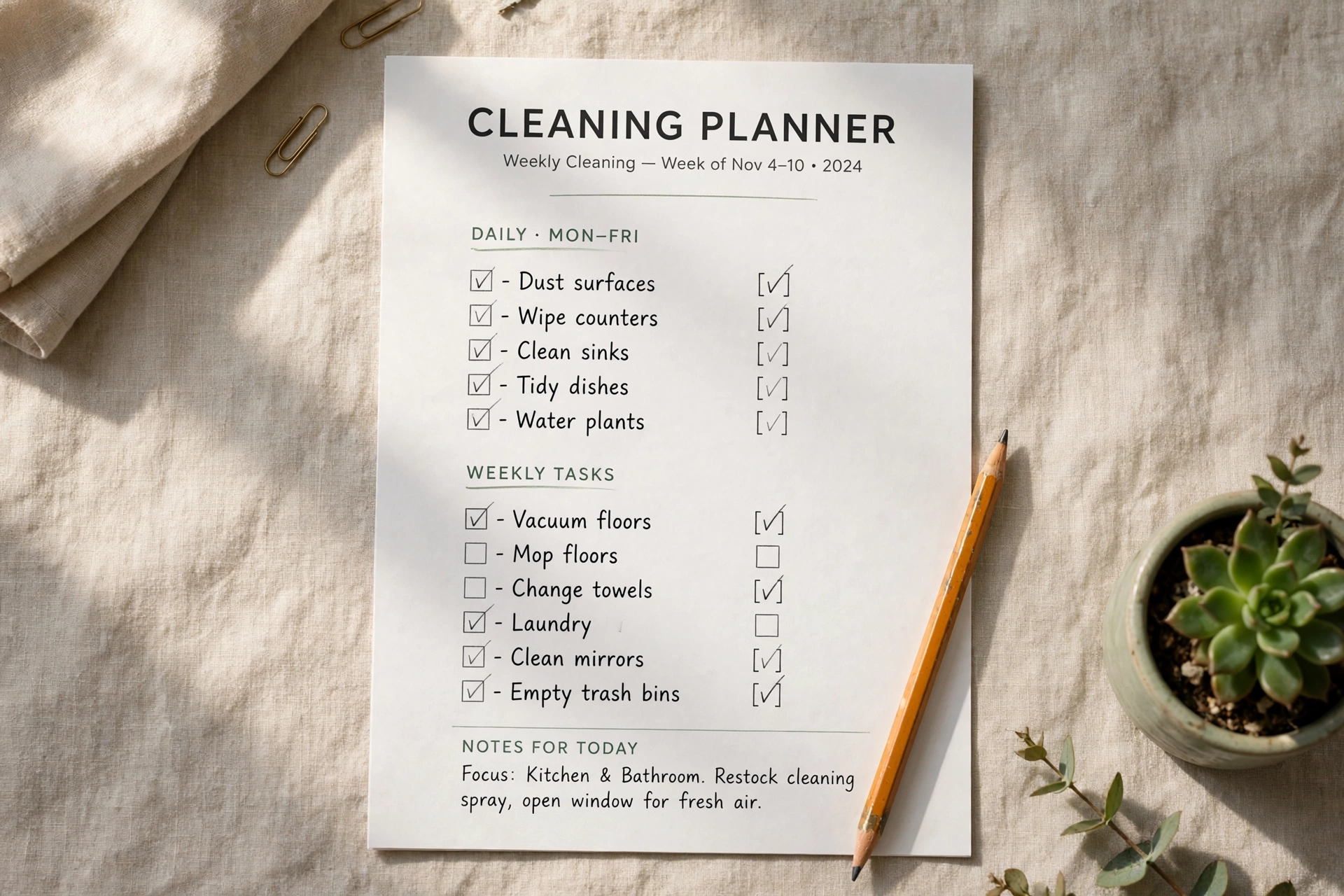
This is the page you will use most. A daily reset is a short list of small jobs that keep a home from sliding backwards: make the bed, clear the kitchen surfaces, run the dishwasher or wash the dishes, take the rubbish out if the bin is full, and a five-minute tidy of the room you are in. Together they take about fifteen minutes, spread across the day.
The reset page has space for the date and for one "main job" — the single cleaning task that matters most that day. One main job, rather than ten, is deliberate: ten jobs on a tired day is a list you will avoid, while one job is a list you can start. If you want an even simpler page for the fridge, our free printable ADHD cleaning checklist pairs well with this reset sheet.
The weekly grid
The weekly grid is a simple table: seven days across the top, a few cleaning zones down the side, one small task in each cell. Monday might hold "bathroom sink and mirror"; Tuesday might hold "vacuum the living room". The grid does the remembering for you — you look at today, see one or two cells, and do those. You do not have to plan the week. Someone already did.
The grid runs on rotation, not on doing everything every day. Each room gets a turn once or twice a week, and nothing appears daily except the reset jobs. A grid that asks for everything daily gets abandoned by Wednesday; this one asks for a little, often. If a day gets missed, just pick up the next day's cell — the missed one waits for its next turn, a few days away.
The room-by-room lists
These are the most detailed pages in the free file. Each main room — kitchen, bathroom, bedroom and living room — gets its own list, broken into small steps in the order you would do them. The kitchen list runs: clear surfaces, load or run the dishwasher, wipe the hob and counters, clean the sink, take the rubbish out, sweep or mop the floor. You do not have to work out what "clean the kitchen" means, because the list spells it out.
Room lists help twice over. They stop the mid-task freeze where you stand in a room, cloth in hand, unable to decide what to do next. And they let you stop part-way without losing your place: ten minutes buys you the first three lines, and the list holds your place until tomorrow.
The low-energy plan
This page is the one people mention most, and it is what makes this planner an ADHD planner rather than a generic cleaning list. A low-energy plan is a short list of tiny jobs for days when your energy is low or everything feels too much: put the dishes in the sink to soak, throw one bag of rubbish away, clear one surface, put the clean laundry in a pile on the bed. Each job takes under five minutes, and you can stop after one job and still call it a win.
It works because it respects the day you are actually having, instead of demanding the day you wish you were having. On a good day, use the daily reset and the weekly grid. On a hard day, use this page and nothing else. Keep it where you can see it — on a hard day you will not go looking for it.
The brain-dump and notes page
The last page is a notes page with a few prompts: "jobs I keep putting off", "things to buy for cleaning", "what worked this week". If a job pops into your head while you are doing something else, write it here instead of trying to hold it. Over a few weeks, this page becomes your own record of what actually works in your home.
How Do You Use the Free Pages for 7 Days?
Here is a worked 7-day starter plan that uses only the free pages. Each day has a reset, one main job from the weekly grid, and a time limit — so you stop while you still have energy left, which makes it easier to start again tomorrow.
Day 1 — Monday: kitchen reset. Do the daily reset, then make the kitchen your main job: clear the surfaces, load the dishwasher, wipe the hob and counters, clean the sink. About 25 minutes in total — Monday is for starting small and finishing.
Day 2 — Tuesday: bathroom. Daily reset first, then the bathroom list: sink and mirror, toilet, shower or bath wipe-down, floor, fresh towels. About 20 minutes, with the mirror as the quick win.
Day 3 — Wednesday: living room. Daily reset, then the living room: clear surfaces, fluff the cushions, vacuum or sweep, tidy the cables and remote controls, empty the bin. About 20 minutes. Use the notes page too: write down what keeps cluttering the living room. You do not have to fix it today — noticing it is enough.
Day 4 — Thursday: bedroom. Daily reset, then the bedroom: make the bed properly, clear the bedside table, put clean clothes away, gather the dirty laundry into one pile, vacuum or sweep. About 20 minutes. A made bed changes how the whole room feels.
Day 5 — Friday: floors and laundry. Daily reset, then a floors-and-laundry day: run a wash, hang it or put it in the dryer, vacuum the main traffic areas, mop the kitchen floor if it needs it. About 30 minutes, split into two short bursts with a break in between.
Day 6 — Saturday: one room of your choice. Daily reset, then pick the room that bothers you most and use its room list. About 25 minutes. Saturday is a choice day on purpose — choosing your own room builds the habit of deciding. If friends or family are coming over, pick the room they will see first. That is priorities, not cheating.
Day 7 — Sunday: low-energy plan and a look back. Sunday is a rest day with a light touch. Use the low-energy plan only: a few tiny jobs, about fifteen minutes, and then stop. Then spend five minutes with the notes page: what worked this week, and what would you change? Write two or three lines. That short review turns a week of ticking boxes into a system you actually own.
If you miss a day, do not try to catch up by doing two days at once — that is how a missed Tuesday becomes a skipped week. Just do the next day as printed. If the whole week goes sideways, start again on Monday with the daily reset only.
Wondering how the weekly grid grows into a full cleaning system for the whole home, with monthly pages and zone rotation? Our ADHD cleaning planner guide walks through exactly that, step by step. The free pages are the first week of that system.
How Should You Print It So It Actually Gets Used?
A planner that stays in a drawer is paper in a drawer. Keep the printing choices simple.
Print on plain A4 or US Letter paper — the pages fit both, with margins that leave room for a hole punch or a binder clip. Use your printer's normal quality setting; draft or standard is fine for checklists and saves ink. Print double-sided and the pack is half as thick.
Colour or black-and-white both work — the headings and tick boxes read well in grey too. If ink is tight, print in black-and-white and use a coloured pen for your ticks. Print one copy of each page first and try it for a day before you print a month's worth.
Ordinary 80 gsm copy paper is fine; 100 gsm holds up better to daily handling. A clipboard, a bulldog clip or a cheap binder keeps the pages together and gives you a hard surface to write on. Keep the set where the cleaning happens — kitchen counter, hallway shelf or fridge door — not in a desk drawer.
Free vs Paid: an Honest Comparison
Should you pay for the fuller bundle, or is the free file enough? It depends on your home. Try the free pages for a full week first: if the tick boxes help you start and you want more rooms or a monthly view, the bundle is the next step. If the free pages cover your home as it is, keep using them.
Free vs paid — Price, Daily reset page, Weekly grid, Room-by-room lists, Low-energy plan, Monthly deep-clean pages, Zone rotation sheets, Seasonal checklists, Notes and brain-dump page, Best for
Free PDF — Price: no cost. Daily reset page: yes. Weekly grid: yes, one week. Room-by-room lists: main rooms only. Low-energy plan: yes. Monthly deep-clean pages: no. Zone rotation sheets: no. Seasonal checklists: no. Notes and brain-dump page: yes. Best for: trying the system for a week.
ADHD-Friendly Planner bundle ($4) — Price: $4, one-off. Daily reset page: yes, plus a morning and evening version. Weekly grid: yes, four weekly grids. Room-by-room lists: main rooms plus extra rooms. Low-energy plan: yes, plus a "rough week" plan. Monthly deep-clean pages: yes. Zone rotation sheets: yes. Seasonal checklists: yes. Notes and brain-dump page: yes, with extra prompts. Best for: running the system month after month.
The trade-off is plain: the free file covers one week in a standard home, while the bundle covers a month and more. If your home is small and your week is steady, the free file may be all you need for a long while.
One more honest point: a paid planner does not clean better than a free planner. The paper, the tick boxes and the habit are the same. What you pay for is range — more pages, more rooms, more weeks. If range is what you need, it is a fair swap.
What If You Miss a Day, or the Whole Week?
You will miss a day. Everyone does. Most cleaning systems treat a missed day as a broken streak, and a broken streak feels like a reason to stop. This planner treats it as a normal day that did not get a tick. Nothing breaks. You just turn the page.
Here is a small reset system for coming back after a gap. It has three lines, and it fits on a sticky note.
The three-line reset:
1. Pick one room. Not the whole home. One room, the one you are standing in or the one that bothers you most. 2. Set a timer for ten minutes. Do what you can in those ten minutes, using the room list for that room. 3. Tick what you did, then stop. Even one tick counts.
That is the whole system. It works after a missed day, a missed week, or a month untouched — because it asks for ten minutes, not a fresh start. Fresh starts are heavy. Ten minutes is light. And a single tick after a gap proves the system still works, which makes the next day easier to start.
It helps to know why gaps happen, so you can stop blaming yourself for them. Life gets busy, energy dips, visitors come, work runs late, or a cold knocks you flat for a week. None of those are a failure of character. They are ordinary life.
If you keep missing the same day every week, look at the grid rather than at yourself. Maybe that day's jobs are too big, or they land at the wrong time of day. Move them — the grid is a printed suggestion, not a contract. A planner you have changed to fit your life is a planner you will keep using.
What Do Other People Ask Before They Download?
How is this different from the ADHD cleaning planner PDF guide?
The guide at our ADHD cleaning planner PDF page explains the full planner system: how the pages fit together, how zone cleaning works, and how to build a routine around it. This article is about the free download itself — what is inside it, how to use it for seven days, how to print it, and how it compares with the paid bundle. Read this one to decide whether to download; read the guide when you want the system behind it.
What if I have ADHD but I live with other people?
Yes, and it can help the whole household. One page per person works well: each person gets their own daily reset, and the weekly grid shows who is doing what. The tick boxes suit children too — a visible box and a clear next step work for young brains as well as adult ones. Or keep one shared set in the kitchen and let anyone tick a job they have done.
Where Do You Go From Here?
You now know what is inside the free PDF, how each page works, what a week with it looks like, and how it compares with the paid bundle. Next step: print the daily reset page and the weekly grid, try them for two days, and see how the tick boxes feel.
When you are ready to see how those free pages grow into a complete system — monthly deep cleans, zone rotation, and the full routine behind the weekly grid — the next page to read is the ADHD cleaning planner guide: ADHD cleaning planner guide.