Quick answer: A letter from Santa feels real when it names the child, mentions one true detail from their year, and arrives like real post — in an envelope. This guide gives you three letters you can copy tonight, the five details that make any letter believable, and the printing and hiding method that sells it.
The five details that make a letter feel real
Children do not believe a letter because of fancy paper. They believe it because of specifics. A letter that says "you have been good" could be for anyone. A letter that says "I heard about the goal you scored in the rain last month" could only be for one child. That is the whole trick, and it costs nothing. Use three to five of these, never all of them at once — a letter stuffed with facts reads like a report, not a letter from Santa:
If you are writing for two children, do not send the same letter twice with only the name changed. Children compare. Change one detail and one sentence for each child, and they will each feel singled out. The same detail can go on a personalised card made with our card maker, so the letter and the card tell the same story.
- The child's name, spelled exactly as they spell it, plus one thing they are proud of this year.
- One small, true moment: a lost tooth, a new bike, a kind thing they did for a sibling, a school play.
- One North Pole detail that only Santa would know: the reindeer are resting, Mrs Claus burned the first batch of biscuits, the elves are wrapping in shifts.
- A mention of something the child asked for — without promising it. "I have seen your list" is magic. "You will get the bike" is a promise you may not be able to keep.
- A sign-off in Santa's voice: short, warm, a little old-fashioned. "Keep being kind. I am watching with a smile" beats a paragraph of exclamation marks.
Three letters you can copy tonight
Pick the one that fits your situation, fill in the blanks, and print it. Each one is short on purpose — a letter a child can read twice, fold up, and keep. Letter one: the first letter, for a child who has never had one. "Dear ____, Hello from the North Pole! I have been watching over you this year, and I wanted to write to you myself. I heard about ____, and it made me smile all the way up here. The elves are busy, the reindeer are practising their landings, and your name is safe on my Nice List. Keep being kind, keep asking good questions, and leave me a biscuit on Christmas Eve if you can spare one. With love and a little snow, Santa Claus. P.S. Tell ____ I say hello too." Letter two: the reply, for a child who wrote to Santa first. "Dear ____, Thank you for your letter — it arrived at the North Pole covered in snow, and I read it twice. I loved hearing about ____, and I have passed your list to the elves, who are already checking it twice. I cannot promise every single thing, because some things are tricky even for elves, but I promise a Christmas full of surprises. Keep up the good work, and do not stay up too late on Christmas Eve. Merry Christmas, Santa Claus." Letter three: the Christmas morning letter, left beside the presents. "Dear ____, Merry Christmas! I stopped by while you were sleeping, and I hope you like what I left under the tree. The reindeer behaved beautifully this year — well, almost. Thank you for the ____ you left out for me; it was just what I needed after a long night. You have made me very proud this year, especially when you ____. Keep that kindness going into the new year. Love, Santa Claus." A note on tone: keep it warm and a little teasing, never formal. Santa is not a headteacher writing a report. If a sentence sounds like it came from a school letter, rewrite it the way you would tell a story at bedtime.
How to print it so it looks like real post
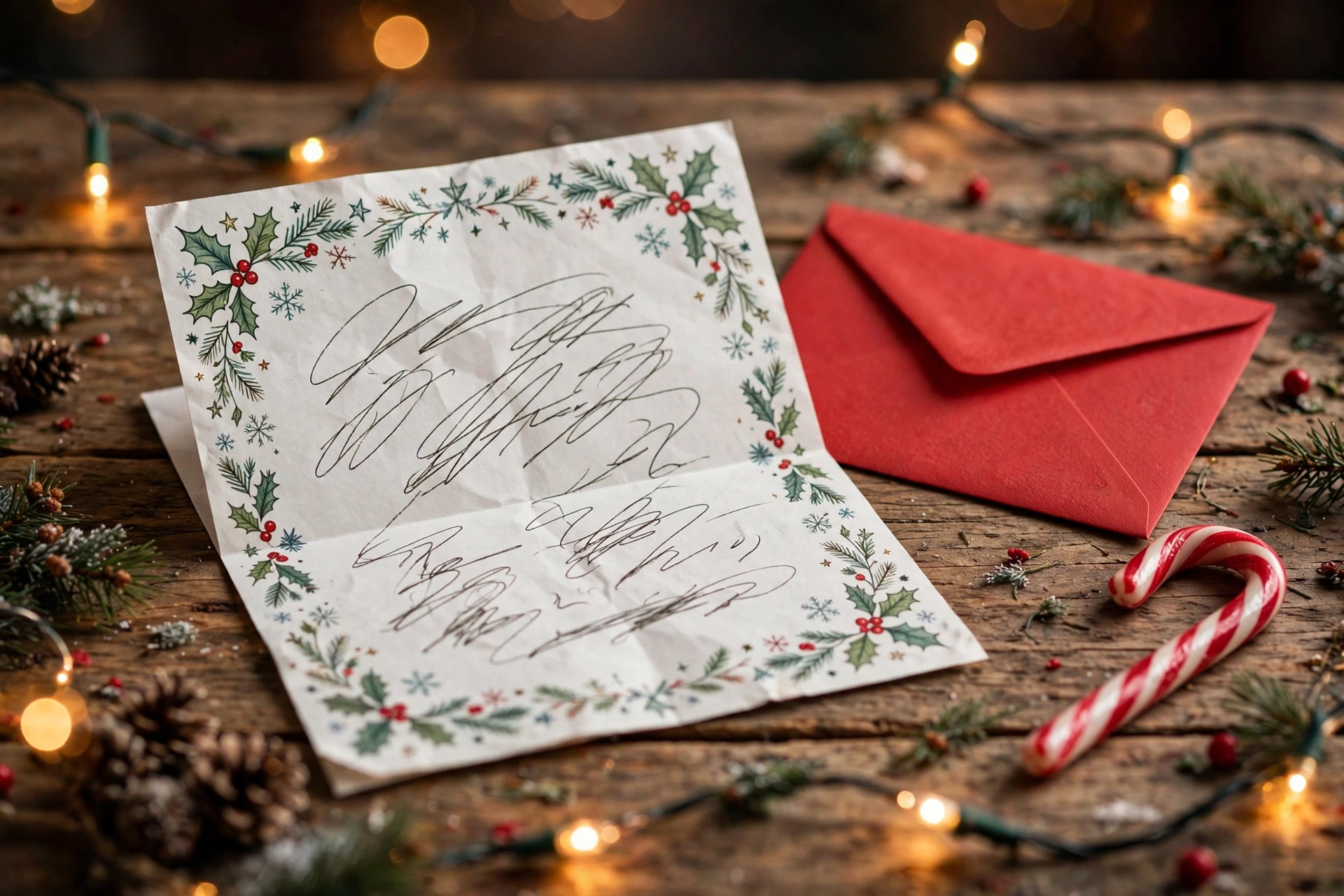
Paper matters more than people think, but not in the way the shops suggest. You do not need special stationery. You need three small choices. First, print on slightly thicker paper if you have it — plain card, or the back of a sheet you have already used for something else, is fine. Thin printer paper flutters like a bill. A sturdier sheet feels like a letter. Second, make an envelope. Fold a sheet of red or brown paper around the letter, or use any envelope you have and write "North Pole" in the top corner, with the child's name in the middle, in your least tidy handwriting — or better, in someone else's handwriting, if another adult is willing. The handwriting is the giveaway: if Santa's writing looks exactly like Mum's, the game is up for an older child. A different hand, or a printed letter with a handwritten P.S. in a different pen, solves it. Third, add one physical detail: a dusting of glitter shaken off before delivery (not in the envelope, or it goes everywhere), a tiny candy cane tucked behind the letter, or a North Pole "stamp" drawn in the corner. One detail. Two details is a craft project. One detail is magic. If you want a matching set rather than a single letter — an editable letter you can type names into, plus gift tags and cards in the same design — the printables page holds the Cards, Gift Tags and Santa Letters Bundle for $3, which carries exactly that set. The letters above are free and complete on their own; the bundle is the version that saves you retyping names for every child, every year.
Posting it for real, and the hiding places that work
There are two ways to deliver a letter, and both work — pick the one your child will remember. The posted letter: in the United States, children can genuinely post a letter to Santa, and the Postal Service's long-running programme answers some of them. The USPS Operation Santa announcement explains the 2026 season: letters go to Santa Claus, 123 Elf Road, North Pole, 88888, and must be postmarked by 5 December to be eligible. There is no guarantee a letter is answered, so treat this as a bonus, not the plan — write your own letter as well, and the posted one is a second delight if an answer comes. The hidden letter: this is the reliable one. Leave it where the child will find it without being told — tucked into a stocking, leaning against the milk bottle, under the pillow, or beside the advent calendar on 1 December. Morning deliveries beat evening ones, because a child who finds a letter before school talks about it all day. If your elf is visiting this year, the elf can deliver it: leave the letter where the elf "arrived" and let the elf take the credit. Our Elf on the Shelf Kit guide shows how the arrival letter and the Santa letter fit together across December. One hiding place to avoid: inside a present. A letter inside a wrapped gift is found last, opened fastest, and remembered least. A letter found on its own is an event.
What never to promise in a Santa letter
This is the part most guides skip, and it is the part that matters most. A Santa letter is a promise machine — children remember what it said, word for word, for years. So do not write these, however tempting they are in the moment:
The kindest letters are the ones that praise something real, promise nothing specific, and end with warmth. That is not less magical. That is the magic, done responsibly.
- Do not promise a specific present. "You will get the bike" becomes a contract. "I have seen your list" keeps the magic without the obligation.
- Do not use the letter to threaten behaviour. "Be good or else" turns Santa into a surveillance system, and it stops working the moment a child tests it.
- Do not write that Santa watched something private. A letter that knows too much feels watched, not loved. Stick to things the child has told people proudly.
- Do not promise a reply next year, or a visit, or anything dated. Keep the letter in this Christmas.
Make a card to go with it
A letter is wonderful. A letter plus a card with the child's name on it, made in your own words, is a keepsake. Our card maker lets you build a personalised card in seconds — put the child's name and one line from your letter on it, print it or send it, and tuck it in with the envelope. Children keep cards. They keep them in drawers for years. A letter they read twice and a card they keep is a better Christmas than either alone.
Choose the line for the card carefully. The best line is not "Merry Christmas" in big letters, though that is fine on the front. It is the one specific sentence from your letter that only your child will recognise: the goal in the rain, the lost tooth under the pillow, the kind thing done for a sibling. Put that line inside the card, where it feels like a secret shared between Santa and one child. If grandparents or another parent helped with the letter this year, let them add a tiny handwritten line of their own at the bottom of the card, signed in their own name rather than Santa's. Two voices, kept separate, make the keepsake richer without breaking the spell.
Personalising the letter for three very different children
The three letters above are starting points, and the personalising is where they come alive. Consider three children who might find an envelope this December. The first is five, shy at school, and proudest this year of something very small: she finally walked into her classroom without clinging to her mother's coat. Her letter should be gentle and unhurried, naming that brave walk in one plain sentence and asking for nothing big in return. Keep the North Pole detail soft for a child like this, biscuits and resting reindeer rather than jokes about naughty lists, and end early. A short letter she can have read to her twice at bedtime beats a long, clever one she drifts away from.
The second child is nine, bright, and starting to test the edges. He has asked, in a challenging tone, how Santa gets into flats without chimneys, and he will be reading this letter like a detective, checking the handwriting first. For him, lean on specifics he cannot easily explain away: a true detail from his own letter to Santa, answered in the same words he used, and one small, funny North Pole problem only Santa would mention. If you have not seen his letter yet, our Letter to Santa Template guide shows the four templates children write from, so your reply can echo the exact questions and wishes he actually sent. Do not try to out-argue a doubting nine-year-old. A warm, confident letter that does not protest too much gives him room to enjoy one more Christmas on his own terms.
The third child has moved house this year, and everything about Christmas feels new and slightly uncertain: a different street, a different fireplace, a stocking hook that is not the old one. Her letter can do a real kindness by noticing the move directly. Santa can say he has updated his list with the new address, that the reindeer liked the look of the new road, and that the important things, the people and the stocking itself, have come with her. A child who has been quietly worrying whether Santa will find the new house sleeps better for the whole of December after a letter like that. It costs one extra sentence. Few sentences you write all year will work harder.
Writing one letter each when children are in two homes
Many children spend December between two households, and a Santa letter can either add to the juggling or quietly steady it. The simplest approach that works: one main letter, agreed between the adults if you can, delivered in whichever home the child wakes in on the chosen morning, and the same true detail and the same sign-off used in any second copy. Children compare letters across homes just as siblings compare them across a breakfast table. Two letters that contradict each other on a detail, one saying the reindeer loved the carrots and another never mentioning them, invite exactly the cross-examination everyone wanted to avoid.
Grandparents who want to help can be given a job that adds love without adding confusion. Let them hand-write the envelope, supply the stamp corner drawing, or write their own separate card in their own name to sit beside Santa's letter. What they should not do, however kindly meant, is send a second, rival letter from Santa with different promises in it. One Santa, one voice, one set of details. If a grandparent lives far away and posts a letter for delivery at their own house during a December visit, agree the date and the detail with the parents first, so the child receives one story that happens to arrive in two places, rather than two stories. Handled this way, a letter across two homes becomes proof that the adults in a child's life are pulling together, which is a Christmas gift in its own right. The certificate tradition pairs well here too: our Nice List Certificate guide can be delivered in the other home, so each household holds one piece of the same December story.
A final checklist before you hide the letter
You have chosen the letter, filled in the blanks and printed it. Before it goes into its hiding place tonight, give it two calm minutes against this list. Most Santa letters that fall flat do so on one of these small points, and every one of them is fixable at the kitchen table, in pencil, before bed.
- The child's name is spelled exactly as they spell it, and any sibling mentioned is named correctly too.
- One true detail from this year is in the letter, and it matches what the child actually wrote or did, with no invented events added for effect.
- No specific present is promised anywhere. Check the postscript as well, because promises like to hide there.
- Nothing in the letter threatens behaviour, mentions watching anything private, or sets up a promise about next year.
- The handwriting on the envelope is not obviously yours, or the letter is printed with only the postscript handwritten in a different pen.
- The hiding place is set for a morning discovery, stocking, pillow, milk bottle or advent calendar, and not inside a wrapped present.
Your next step tonight
Pick one of the three letters above, fill in the blanks with one true detail from your child's year, print it, and hide it where it will be found in the morning. Then make the matching card on our card maker — it takes a minute, and it turns tonight's letter into something they will still have next Christmas.