Quick answer: A nice list certificate works when it names the child, names one real kind thing they did, and is signed by Santa with a date. Copy one of the three wordings below, print it on slightly thicker paper, and deliver it where the child will find it, in a stocking, by the tree, or brought by their elf.
What goes on a certificate, and what does not
A certificate is not a report card. It has five parts, and only five: a title, the child's name in big letters, one sentence about what earned it, Santa's signature, and a date. That is it. The moment you add grades, behaviour scores or a list of rules, it stops feeling like a prize and starts feeling like school. The one sentence in the middle is where most certificates fail. "For being good" could be said about any child. "For sharing your toys with your little brother all autumn, even when it was hard" could only be said about yours. Write the sentence about something true, and the certificate goes on a bedroom wall instead of in the recycling. If you want a ready-made version with the name typed in rather than handwritten, the printables page holds the Complete Christmas Bundle for $7, whose Santa set includes a certificate with a type-in name field, plus the letter to Santa and the letter from Santa in the same design. The wordings below are complete on their own, no purchase needed.
Wording 1: simple, for younger children
Official Nice List Certificate. This is to certify that ____ has been officially placed on Santa's Nice List for 2026. Signed, Santa Claus. North Pole. Date: ____. Short sentences, big name, done. For a four-year-old, this is perfect. They will point at their name and then at the signature, and that is the whole experience.
If you are writing this one by hand, leave the name line a little longer than you think you need. Young children write big, and a name that runs off the line feels like a mistake even when it is not. Use a thick pen or a gold marker for the name if you have one. It does not need to be neat calligraphy. It just needs to look different from the rest of the words, so a child who cannot read yet can still find the part that is theirs. Read it aloud once before you deliver it, slowly, and point to each part as you go. That little ceremony, name first and signature last, is what makes a three- or four-year-old stand a bit taller.
Wording 2: heartfelt, for a child who needs to hear it
Official Nice List Certificate. This certificate proudly states that ____ is on Santa's Nice List this Christmas, in recognition of ____. Santa and the elves have noticed, and they are very proud. Signed with love, Santa Claus, North Pole. Date: ____. Fill the blank with the real thing: helped a friend who was sad, learned to ride a bike after falling off ten times, looked after a younger sibling without being asked. If your child has had a wobbly year, this wording matters more, not less. A certificate that only rewards perfect children is a certificate most children never earn.
Wording 3: short and funny, for older children
Official Nice List Certificate. Certified: ____ made the Nice List. Reason: ____. Warning: excessive kindness detected. Reindeer approved. Signed, Santa Claus. Date: ____. Older children, eight and up, enjoy being in on the joke. Keep the funny line short and let the real reason underneath it stay true. "Reason: survived a whole term of early mornings without complaint" lands because it is true and it is funny at the same time.
One caution with the funny version: aim the joke at the situation, never at the child. "Survived a whole term of early mornings" is kind. A joke about a messy bedroom, a lost temper or a bad school report is not, even if everyone laughs in the moment. Older children reread these things when they are alone. Let them find a joke they can repeat proudly to a friend, and a true reason underneath it that still stands up in January.
How to print it so it looks official
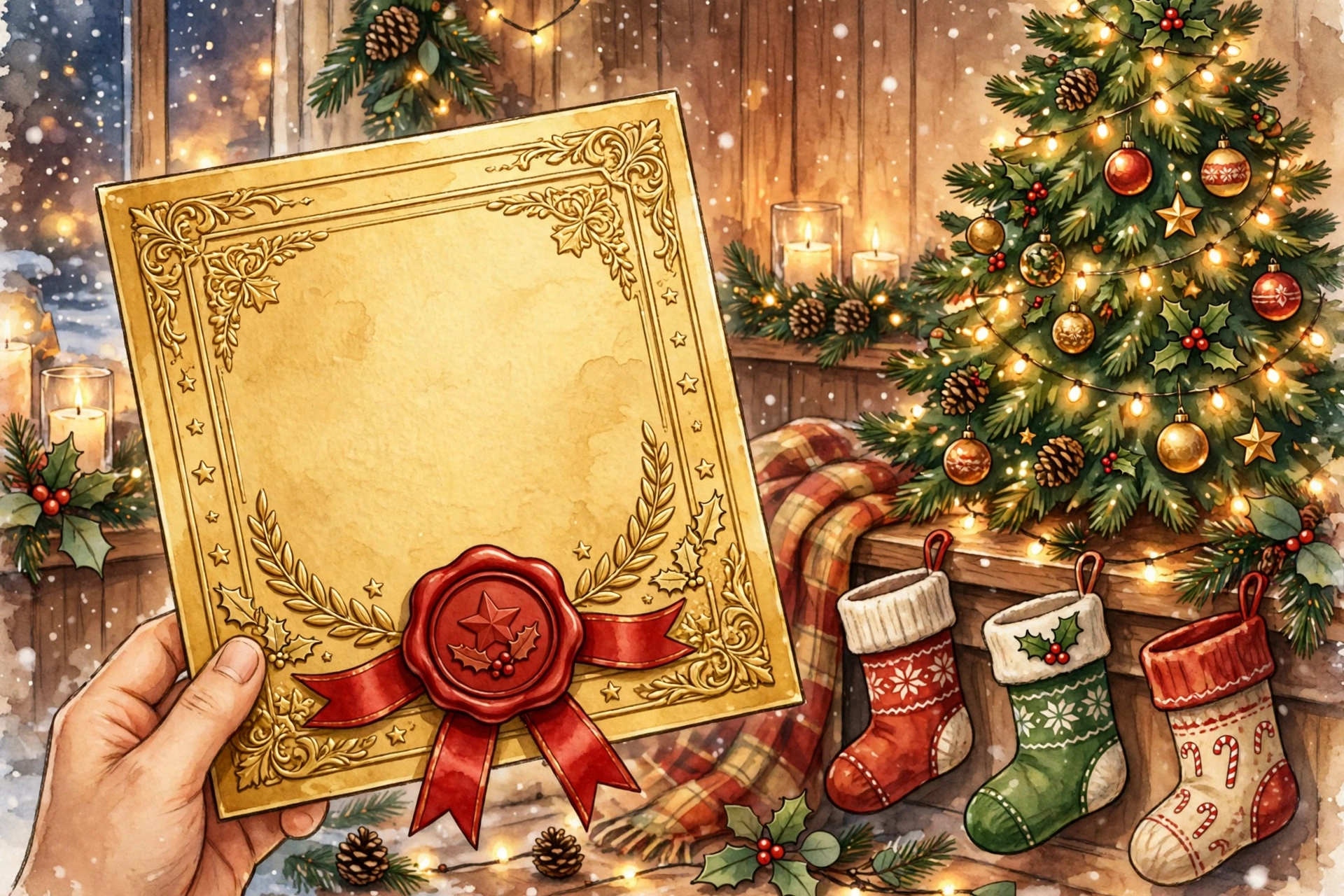
Print on the thickest paper your printer will take, or on ordinary paper glued to a sheet of card. Colour looks best, but a greyscale print with a hand-coloured border, done by you or by the child, looks more handmade and often more loved. Add a seal if you like: a circle of red paper, a sticker star, or a thumbprint in gold paint. One seal. Two seals is a craft project. Cut it out neatly and, if you have one, roll it like a scroll and tie it with ribbon. A rolled certificate found in a stocking feels like a document. A flat sheet found on the kitchen table feels like homework.
Five delivery ideas that actually delight
The delivery is half the magic, so do not just hand it over. Leave it in a stocking on Christmas morning, leaning against the tree where the presents will go, tucked into the advent calendar pocket on 24 December, or brought by the family elf, who can leave it beside a tiny note. Our Elf on the Shelf Kit guide shows how an elf delivery fits into the full December plan. The fifth idea is my favourite for anxious children: leave it early, in the first week of December, with no fuss. A child who is quietly worrying whether they made the list stops worrying for the whole month. That is a kinder gift than any surprise on Christmas morning.
What never to write on a certificate
Do not threaten with it. "Stay on the list or else" turns a prize into a warning, and children remember the warning longer than the prize. Do not mention a naughty list at all, not even as a joke, for a child who is already anxious. And do not write that Santa watched something private. A certificate that knows too much feels watched, not loved. Stick to things the child did openly and proudly.
Choosing the one true reason: worked examples by age
The blank in the middle is the whole certificate, so spend your two minutes there, not on the border. Think back over the last few months and pick something specific, small and true. Not the biggest achievement of the year, necessarily. Often the best reason is a quiet habit nobody has praised out loud yet: the child who always fills the dog's water bowl, the one who waits for a slower friend at the school gate, the one who learned to zip their own coat and then started helping everyone else in the cloakroom.
For a three- or four-year-old, keep the reason to one simple action they can picture: "For giving your red car to Sam when he was crying" or "For helping Mummy carry the shopping, one bag at a time." For ages five to seven, you can name effort as well as kindness: "For practising your reading every night, even the tricky words" or "For teaching your little sister to ride her scooter and running beside her so she felt safe." Children this age know exactly how hard those things were. Hearing Santa name the effort, not just the result, lands deeply.
For ages eight and up, be more precise and a little more grown-up in tone: "For looking after your grandfather's garden while he was in hospital, without anyone asking twice" or "For sticking up for the new boy at lunch in your first week at a new school." If you are stuck, ask yourself one question the night before: what did this child do this year that I have told another adult about with pride? That story, trimmed to one sentence, is your reason. If the certificate will sit alongside a reply letter this year, our Letter From Santa guide uses the same trick in reverse, naming one true detail so the letter and the certificate tell the same story.
Certificates for siblings, twins and a whole classroom
Making one certificate is sweet. Making three, or twenty-eight, without starting a comparison contest takes a little planning. The rule is simple: same paper, same size, same ceremony, different reason. The moment one child's certificate is bigger, glossier or delivered with more fuss, the others notice. Children are forensic about fairness in December.
For siblings, write the reasons on different evenings if you can, so you are not reaching for the second child's sentence while the first is still fresh and better worded. Deliver them at the same moment, in identical envelopes or rolled the same way. Twins need this most of all. Give twins reasons from completely different parts of life, one about kindness at home and one about effort at school, for example, so neither certificate reads like a copy of the other with the name swapped.
Teachers use these differently, and it works beautifully when it stays kind. A classroom set should never rank children, never leave anyone out, and never be handed out as a behaviour league table in the last week of term. Instead, write one true, noticed thing for every child in the class, including the quiet child in the middle who is easy to overlook, and slip each certificate into their tray or school bag to be found, rather than read aloud. If time is short, a sentence starter helps: "Santa noticed how you..." followed by helped, shared, tried, waited, listened or cheered. A teacher who does this in the final week gives some children the only specific praise they will hear written down all year. Keep a list of the reasons you used, too. Next year's class will be different, but your own children at home should not receive the exact sentence a cousin got last Christmas.
- Same paper, same size and same delivery moment for every child.
- A different, true reason for each child, from a different part of life.
- For a class: every child included, nothing read aloud as a ranking, nothing left in plain sight for others to compare.
- Keep a note of reasons you have used so you do not repeat one next year.
When a grandparent is sending one from far away
A certificate posted by grandparents who live in another town, or another country, carries a different kind of weight. The child knows Santa found them, and also that Grandma and Grandad were part of it, even from a distance. If you are the grandparent, ask the parents first for the one true reason, in their words, rather than guessing from photographs and video calls. Parents know the small, recent thing. You might only know the big news.
Post it early. December post is slow everywhere, and a certificate that arrives on 28 December has missed its moment. Aim to send it in the last week of November, in a stiff envelope marked "do not bend" if you can, with the certificate flat rather than folded if the envelope allows it. Write a short note on separate paper, in your own handwriting and your own name, to sit behind the certificate. The certificate is from Santa. The note is from you. Keeping those two voices separate protects both. On the note you can say the ordinary, loving things a certificate cannot: that you are proud, that you saw the school photo, that you will wave on the video call on Christmas morning. Families who do this once tend to do it every year, and children start asking, quite early in December, whether the post from Grandma's town has come yet.
What to say when a child asks, "Am I really on the list?"
Some children ask this lightly, fishing for reassurance between bites of toast. Others ask it at bedtime, in a small voice, because a classmate has told them they are on the naughty list, or because they shouted at their brother that morning and the worry has been sitting on them all day. The certificate answers the question better than a speech does, but the conversation still matters.
Do not rush to over-promise, and do not turn the talk into a review of their behaviour. A calm answer sounds like this: "The list is about how you treat people, not about being perfect. Santa knows children have hard days. I have seen how kind you are to..., and that is the sort of thing that counts." Name the same true thing that will appear on the certificate, so the words and the paper agree when it arrives. If a child is doubting Santa altogether and asking you directly, you do not have to stage a bigger production to win them back. Keep the certificate short, keep it warm, and let them decide how to hold it. Many older children enjoy the tradition perfectly well once nobody is insisting they believe it in exactly the way they did at five. The elf tradition can carry some of this gently, too: our Elf on the Shelf Notes guide shows small, kind notes an elf can leave on ordinary December mornings, so reassurance does not all have to arrive in one big Christmas-morning moment.
A five-minute making checklist for the night before
You do not need a craft evening. You need five quiet minutes after bedtime, with the door shut and everything in one place. Work through this list in order and the certificate will be finished before a cup of tea goes cold.
- Choose the wording: simple for younger children, heartfelt for a child who needs to hear it, short and funny for older children.
- Write the child's name exactly as they write it themselves, including a shortened name if that is what they use every day.
- Fill in one true reason, one sentence only, checked against something that really happened this year.
- Add Santa's signature and this year's date, and one seal only: a sticker star, a red paper circle or a gold thumbprint.
- Decide the delivery spot now, not in the morning: stocking, tree, advent pocket, or beside the elf.
- Put it straight in its hiding place, out of sight of early risers, and note the reason you used so siblings match in fairness.
Your next step tonight
Pick one wording above, fill in the child's name and one true kind thing, and print it tonight. Then open our Letter to Santa Template guide and write the letter that goes with it, so the certificate and the letter arrive as a pair.