Quick answer: Sight words worksheets are printable practice sheets that help a child read common words at a glance, without sounding each one out. This guide gives you free worksheets sorted by grade, from Dolch pre-primer to third grade, with tracing, matching, sentence and game pages, plus answer keys, a short daily routine and printing tips for home or class.
Sight Words Worksheets: Free Printable Practice by Grade, With Answer Keys
Sight words worksheets are printable practice sheets that help a child read common words at a glance, without sounding each one out. This guide gives you free worksheets sorted by grade, from Dolch pre-primer to third grade, with tracing, matching, sentence and game pages, plus answer keys, a short daily routine and printing tips for home or class.
That is the whole idea in one paragraph. A child who can read the, and, was and said without stopping can read a whole sentence without getting stuck on every other word. The sheets below build that skill one small step at a time. Print a page and sit beside your child for ten minutes. And when the worksheets run out, the Kids Coloring & Activity Pack carries the same quiet-table habit further, with coloring and activity pages that sit beside these reading sheets.
What are sight words?
Sight words are words a reader recognizes instantly, without sounding them out. When you read the word the, you do not stop and sound out t-h-e. You just know it. That instant recognition is what the word "sight" means here. A sight word is any word a child can read at a glance, the way you recognize a friend's face without thinking about it.
Some of these words follow normal spelling rules. Many do not. Said, was, of, where — these are the words that trip children up when they try to sound them out, because the letters do not behave the way the child expects. A child who has to stop and puzzle out said in every sentence will lose the thread of the story. A child who knows said on sight keeps reading, and keeps enjoying the book.
MerryHub is a printable-games and planner shop by ReplyPilot, and these worksheets are built like our other printables: clear lines, big print, and pages that work on a home printer without wasting ink.
The numbers behind this are worth knowing before you start. About 100 words account for approximately 50% of the words used in school and colleges, according to research cited by Reading Rockets. Teach a child those 100 words, and half the words on the page stop being obstacles. Reading Rockets makes the same point from the child's side: the 100 most frequent words make up approximately 50% of the words kids see in any text, and the 300 most frequent reach about 75%, as explained in their guide to teaching sight vocabulary.
One more thing to clear up early. People use "sight words" and "high-frequency words" as if they mean the same thing. They overlap, but they are not twins. High-frequency words show up a lot in print. A sight word is any word a reader knows instantly, whether it is common or not. Your child's name is probably their first sight word, and it is not on any frequency list. The lists in this guide are high-frequency lists, because those are the words most children meet first. But the goal is always the same: words a child reads without stopping.
Which sight words should a child learn first?
Start with the words your child meets most often, and add a few at a time. The Dolch list, put together by Edward Dolch in the 1930s, is still the list most schools use: 220 words in five lists by grade, plus 95 common nouns.
Pre-primer — 40 words — Preschool and early kindergarten — a, and, I, see, the, can, go, look
Primer — 52 words — Kindergarten — he, she, was, they, there, like, have, want
First grade — 41 words — First grade — of, from, could, were, once, know, when
Second grade — 46 words — Second grade — always, because, before, first, many, right, their, would
Third grade — 41 words — Third grade — about, better, bring, carry, clean, laugh, together, warm
Nouns — 95 words — Kindergarten to second grade — apple, bird, father, house, school, tree
Do not teach all 40 pre-primer words in one week. Pick five words. Work on those five until your child reads them without thinking. Then add five more, and keep the old five in the mix so they do not fade. Five new words a week is fast progress. In eight weeks, that is forty words — the whole pre-primer list — learned properly instead of memorized for a day and forgotten.
If your child's school uses the Fry list instead, the same approach works. The Fry list holds the 1,000 most common words, grouped in sets of 100. Ask the teacher which list the class uses, and follow that one. The list matters less than the steady practice.
And here is a question worth asking before you print anything. Does your child already know some of these words? Sit down with the pre-primer list and point at each word. Tick the ones your child reads straight away. Those are done. The words your child hesitates on are the ones to practice.
How do sight words worksheets actually help?
A worksheet helps because it makes a child look at a word, say it, write it, and use it — four meetings with the same word on one page.
Take the word said. A child traces it, says it out loud, reads it in a short sentence — "Mom said yes" — and finds it in a little word hunt. Four meetings, one page. That is why a worksheet beats a flashcard on its own.
Reading Rockets puts it plainly in their guide to sight words and orthographic mapping: creating a sight word means forming lasting connections between a word's letters, its pronunciation, and its meaning in memory. The same guide notes that skilled readers may need as few as one to four practices to commit an irregular word to memory. That is good news. You do not need hours of drilling. You need a few good meetings with each word, spread across a few days.
What does a 10-minute daily routine look like?
Ten minutes is enough. It is also about as long as a young child can focus well on one thing, so there is no point pushing past it. The routine below is the one I use with my own family, and it works because it never changes. The child knows what comes next, and that takes the arguing out of it.
First, warm up with yesterday's words. Lay out five word cards, or point at five words on last week's sheet. The child reads each one. Any word that comes out straight away gets a tick. Any word that needs a pause goes back on today's list. Two minutes, no more.
Second, meet three new words. Say each one, spell it out loud together, and use it in a short sentence. "The dog ran." "I can see you." Keep the sentences short and a bit silly if you can. A silly sentence sticks better than a dull one.
Third, do one worksheet page. Just one. Trace the words, circle the right one, or fill in the missing word in a sentence. The page should take about five minutes. If it takes fifteen, the words are too hard, or the page is too full. Drop back a level.
Fourth, read one short line together. It can be a line from a book, a line you write on the sheet, or a line from yesterday's worksheet. The point is to meet the new words inside real reading, not just on a practice page. One line is enough.
Fifth, finish with a win. Ask your child to read the three new words one more time. When they get them right, stop. End on a good note and put the pencils away. A child who ends happy comes back tomorrow.
That is the whole system: warm up, meet, practice, read, win.
What is inside a good worksheet set?
Not all worksheets are equal. A page that asks a child to copy the same word twenty times teaches very little after the third copy. The hand gets tired, the mind wanders, and the word stops meaning anything. A good set mixes six kinds of page, and each kind does a different job.
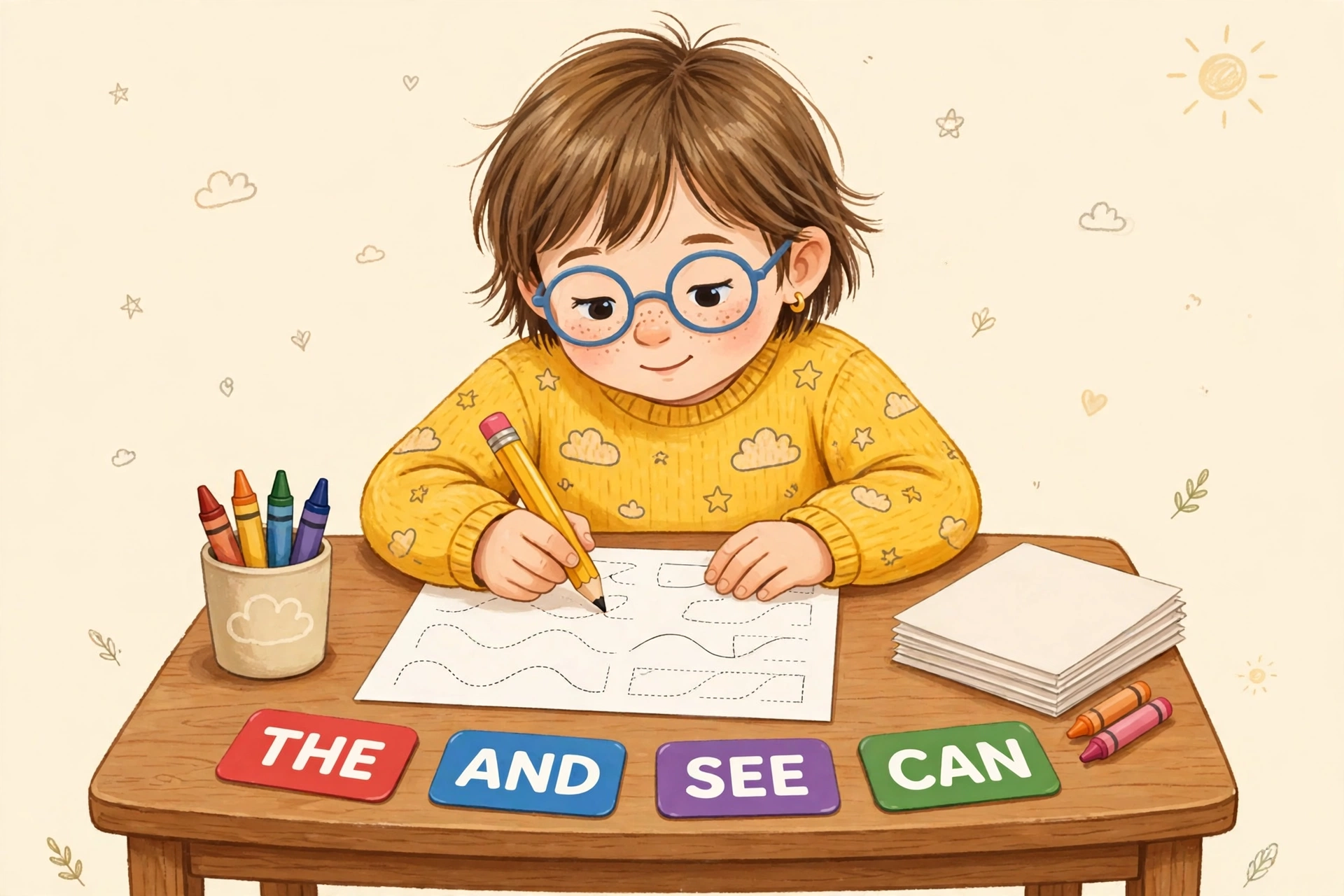
Tracing pages come first. The word appears in dotted letters, and the child traces over it. Tracing teaches the shape of the word and slows the child down enough to really look at it. Keep the letters big — a young child needs room. One word per line, with space between the lines, works better than words squeezed together.
Matching pages come next. The child draws a line from a word to a picture, or from a word to the same word in a different font. Matching teaches the child to tell words apart. Was and saw look alike to a beginner, and so do on and no. A matching page catches those mix-ups early.
Fill-in pages ask the child to complete a sentence. "The cat sat ___ the mat." The child picks on from three choices and writes it in. This is the first time the word has a job to do inside a sentence, and that job is what makes the word stick.
Sentence pages ask a little more. The child writes a sentence of their own using the word. "I like to play." It does not need to be clever. A word a child uses is a word a child keeps.
Word hunt pages hide the week's words inside a small grid or a short paragraph, and the child circles each one. This is the closest a worksheet gets to real reading: the child has to spot the word among other words, which is exactly what reading a book asks for.
Game pages turn the week's words into play. A simple bingo card with nine words, or a memory game with word cards. Games are the pages children ask for again. Our Wordle for kids game works the same way, with word lists to print and play.
A good set mixes the six kinds above, changing the mix through the week. Monday tracing, Tuesday matching, Wednesday fill-in, Thursday word hunt, Friday game. The words stay the same. Only the job changes.
Which words go on each grade's worksheets?
Here are the Dolch lists in full. Use the list that matches your child's grade, and work through it five words at a time.
Pre-primer, 40 words — preschool and early kindergarten: a, and, away, big, blue, can, come, down, find, for, funny, go, help, here, I, in, is, it, jump, little, look, make, me, my, not, one, play, red, run, said, see, the, three, to, two, up, we, where, yellow, you.
Primer, 52 words — kindergarten: all, am, are, at, ate, be, black, brown, but, came, did, do, eat, four, get, good, have, he, into, like, must, new, no, now, on, our, out, please, pretty, ran, ride, saw, say, she, so, soon, that, there, they, this, too, under, want, was, well, went, what, white, who, will, with, yes.
First grade, 41 words: after, again, an, any, as, ask, by, could, every, fly, from, give, going, had, has, her, him, his, how, just, know, let, live, may, of, old, once, open, over, put, round, some, stop, take, thank, them, then, think, walk, were, when.
Second grade, 46 words: always, around, because, been, before, best, both, buy, call, cold, does, don't, fast, first, five, found, gave, goes, green, its, made, many, off, or, pull, read, right, sing, sit, sleep, tell, their, these, those, upon, us, use, very, wash, which, why, wish, work, would, write, your.
Third grade, 41 words: about, better, bring, carry, clean, cut, done, draw, drink, eight, fall, far, full, got, grow, hold, hot, hurt, if, keep, kind, laugh, light, long, much, myself, never, only, own, pick, seven, shall, show, six, small, start, ten, today, together, try, warm.
And the 95 Dolch nouns, for kindergarten to second grade: apple, baby, back, ball, bear, bed, bell, bird, birthday, boat, box, boy, bread, brother, cake, car, cat, chair, chicken, children, Christmas, coat, corn, cow, day, dog, doll, door, duck, egg, eye, farm, farmer, father, feet, fire, fish, floor, flower, game, garden, girl, goodbye, grass, ground, hand, head, hill, home, horse, house, kitty, leg, letter, man, men, milk, money, morning, mother, name, nest, night, paper, party, picture, pig, rabbit, rain, ring, robin, Santa Claus, school, seed, sheep, shoe, sister, snow, song, squirrel, stick, street, sun, table, thing, time, top, toy, tree, watch, water, way, wind, window, wood.
That is 315 words in total. No child needs to learn them all at once, and no child needs to learn them in this order. Your child's teacher may teach them in a different sequence, and that is fine. Follow the school's order when there is one.
These lists are also the answer keys for the matching and fill-in pages: every word on a worksheet comes from these lists, so you can check your child's answers against them in seconds.
A quick note on the nouns. The nouns are the easy words on the list. Apple, dog, school — a child can sound most of these out, and the picture gives the meaning away. Use the nouns as warm-up words: start a session with three your child already knows.
How should you print the worksheets?
A worksheet that prints badly does not get used. The fixes are small, and they are worth doing once and then forgetting about.
Print at actual size, not "fit to page". Fit-to-page shrinks the letters, and small letters are hard for a young child to trace. Keep the letters at least as tall as your child's thumbnail.
Use plain white paper for tracing and matching pages. Colored paper makes the dotted lines harder to see and uses up your color ink, so save it for the game pages.
Set the printer to black and white, or grayscale, for most pages. The sheets are designed to work in black and white, and color ink costs more without adding anything to a tracing page.
Print one week at a time, not one month at a time. A stack of forty pages on the table looks like homework. Five pages for the week looks like a small job. Print Monday's page on Monday. It takes thirty seconds, and it keeps the pile small.
If a page will be used more than once, slip it into a clear plastic sleeve and hand your child a dry-erase marker. The same page works ten times over, and the child likes wiping it clean and starting again.
What mistakes slow children down?
Most sight word practice fails in the same few ways.
The first mistake is too many words at once. Ten new words in one sitting is too many for a five-year-old. Five words is the right number. Three is fine too. Slow and kept beats fast and forgotten.
The second mistake is flashcards only. A card shows the word once, and one meeting is not enough. Use the cards for the warm-up, then move to the page.
The third mistake is skipping the writing. Reading a word and writing a word are two different skills, and writing locks the word in more firmly than reading alone. A child who can read said but cannot spell it has only half learned it. Every worksheet session should include writing the word at least once.
The fourth mistake is drilling the same page until the child is bored. A page done three times in one day teaches less than the same page done once a day for three days. Spreading the practice out is what builds memory. That is why the routine above uses a different page type each day for the same words.
What if a child keeps forgetting the same word?
Every child has one word that will not stick. For one child it is was. For another it is they. The word looks simple, the child has seen it fifty times, and still it slips away. That is normal, and it has a fix.
First, check that the child can say the word's sounds. Some words are forgotten because the child has never really heard them properly. Say the word slowly. Was is w-a-s, but it sounds like w-u-z. Point out the odd part — the a that sounds like u — and name it out loud. "This a is a trickster. It says uh." A named trick is easier to remember than an unnamed one.
Second, give the word a home. Put it in a sentence the child cares about. "They are coming to my party." A word inside a sentence the child wants to say is a word the child wants to remember.
Third, move the word to a different page type. If tracing has not worked, try a word hunt. If the word hunt has not worked, try a game. A new job for the same word gives the brain a fresh way in.
Fourth, leave it alone for a day and come back. Forgetting is part of learning, not a sign of failure. A word that is forgotten and then remembered is remembered more firmly than a word that was never forgotten at all.
And if your child can read a word but cannot yet write it, that is a different skill, and it has its own practice. Writing letters needs hand control that reading does not. Our free name tracing worksheets work on exactly that side of things: dotted letters, the right order to learn them in, and a short daily plan that builds the hand strength for writing. Reading and writing grow side by side, and a little work on each helps the other.
How can a teacher use these worksheets in class?
A classroom changes the routine, but it does not change the words. The same five-words-a-week pace works for a class of thirty as well as it works for one child at a kitchen table. Start the day with the word wall: put the week's five words where everyone can see them, and read them together. Use the matching and word hunt pages as pair work — two children, one page, checking each other's answers. Use the game pages on Friday: a bingo game with the week's words takes ten minutes and shows you in one glance which words the class knows and which ones need another week.
Where should you go next?
You have the word lists by grade, six kinds of worksheet, a ten-minute routine, and the printing tips that make the pages work. If reading is coming along but writing the letters is still hard, start with our free name tracing worksheets. They teach a child to write their own name, letter by letter, with dotted guides and a short daily plan — the writing side of the same skill you have just been building. Start there, and the reading and the writing will grow together.