Quick answer: Pick one detail that could only be true of them, add one honest feeling, and finish with a wish for the year ahead. That is the whole method: detail, feeling, wish. Three short sentences written that way will sound more personal than a long message copied from a list, whoever the card is for.
Why the cards we keep are the short, true ones
I have a drawer full of birthday cards I could not throw away, and the ones in it are not the longest or the fanciest. They are the ones where someone wrote one thing that was actually true. A friend who remembered the exact café where we used to hide from the rain. My grandmother, who wrote that she was proud of me for a reason I had forgotten myself. That is what this guide is for: writing the kind of card that ends up in someone's drawer, not in their recycling. If you want to skip straight to making the card, the card maker puts the person's name on it for you, which already makes a shop-bought-looking card feel personal. And if you want a card you can print at home instead, the printable bundles hold an all-occasion set with birthday cards and gift tags in one file. MerryHub makes printable games, cards and planners for parties and family events that families download and print at home.
What a birthday card message is
A birthday card message is a short note that says three things: I noticed you, I am glad you exist, and I wish you well for the year ahead. It is not an essay, and it is not a performance. The best ones are written the way the writer actually talks, with one detail that proves the card was written for this person and nobody else.
The 3-part method
Every good birthday message, long or short, has three parts. Use them in this order and you will never stare at a blank card again.
Three sentences, one per part, and you have a card. If you only have room for one sentence, use the detail. It is the part people remember.
- The detail. One thing that could only be true of them. "You still make tea exactly the way Mum taught you" or "You are the only person I know who dances at bus stops." If you cannot think of a detail, think of the last thing that made you both laugh. That is your detail.
- The feeling. Say the thing you do not usually say out loud. "Life is better with you in it" or "I am lucky to have you as a sister." Short and plain beats fancy here. Fancy feelings sound borrowed.
- The wish. Look forward, briefly. "Here is to a year with more of the good stuff" or "Hope this year brings you the trip you keep talking about."
By person: who are you writing to?
The method stays the same; the detail changes. Here is how it sounds for the people most cards are actually for.
If the card is for a grandmother specifically, there is a whole guide for that one relationship, because grandmothers get the most generic cards of anyone: What to Write in a Birthday Card for Grandma.
- For Mum or Dad: thank them for something concrete, not for "everything". "Thank you for every lift home, no questions asked. Happy birthday, Dad." Or: "Happy birthday to the woman who still tells me to take a coat. You were right every time."
- For a partner: keep it private and a little teasing. "Happy birthday to the only person I would let pick the film. Twice." Inside jokes are allowed here. They are the point.
- For a sister or brother: shared history is your material. "Happy birthday to the only person who remembers exactly how embarrassing I was at fourteen. Thank you for your silence."
- For a best friend: say what they actually do for you. "You make the good days better and the hard ones easier. Happy birthday."
- For a colleague: keep it warm, short and safe. "Happy birthday. The office is better with you in it." No age jokes unless you are sure they land well with that person.
- For a child: write words they can read themselves, about things they love. "Happy 7th birthday. You are the best at cartwheels, dinosaurs and making everyone laugh."
By age: the number is your hook
Milestones give you a ready-made opening. Use the number, then make it about them, not about getting old in general.
Age jokes work only when the person enjoys age jokes. If you are not sure, do not risk the one card they keep.
- For a young child: name what they love and what they can do now. Short words, big feelings.
- For a teenager: take them seriously. "Thirteen looks good on you" lands better than a joke about moodiness.
- For a 21st, 30th or 40th: mark the door they are walking through. "Thirty, and somehow still the first person I call" says more than any joke about ageing.
- For an older birthday: honour the life, not the number. "Eighty years of you, and you still beat me at cards" is a compliment, not a reminder.
- For a 100th, or any age you are not sure about: skip the number entirely and write about the person. Nobody ever complained that a card was too kind.
Funny or heartfelt? Pick one, not both
Cards that try to be funny and heartfelt at the same time usually end up being neither. Pick the tone that fits your relationship and stay in it. Funny works when you share the joke: "You are not old. You are just increasingly difficult to describe as young." Heartfelt works when you mean it plainly: "I do not say this enough, but I am grateful to have you in my life." Both are good. Mixing them — a joke, then a sudden serious paragraph, then another joke — reads like you could not decide, and the reader feels it. If you are writing to someone going through a hard year, skip funny altogether. "I know this year has been hard. I am glad you are here, and I hope the next one is kinder" is a card someone keeps for years.
Late, far away, or both
A late card is better than no card, and a far-away card is better than a text. Do not apologise for three paragraphs; one line is enough.
Then write the real message. The apology is not the message; it is just the door you walk through to get to it.
- Late: "This is late, but so am I to everything, so at least it is on brand. Happy birthday."
- Far away: "Miles apart, but you are the first person I thought of this morning. Happy birthday."
- Both: "Late and far away — the two things I am worst at. Thinking of you, and wishing you a brilliant year."
Short messages that still work
Sometimes the card is small, or the gift is the main event, and you need one or two lines. These all follow the method — detail, feeling, wish — in miniature.
Copy one if you need to, then change one word to make it theirs: their favourite food, their city, their joke. One changed word is often the difference between a copied line and a personal one.
- "Wishing you a birthday full of good people, cake, and reasons to smile."
- "Here is to another year of you. Lucky us."
- "Hope today reminds you how much you mean to the people lucky enough to know you."
- "Another year older, and still the best company I know. Happy birthday."
Making the card itself
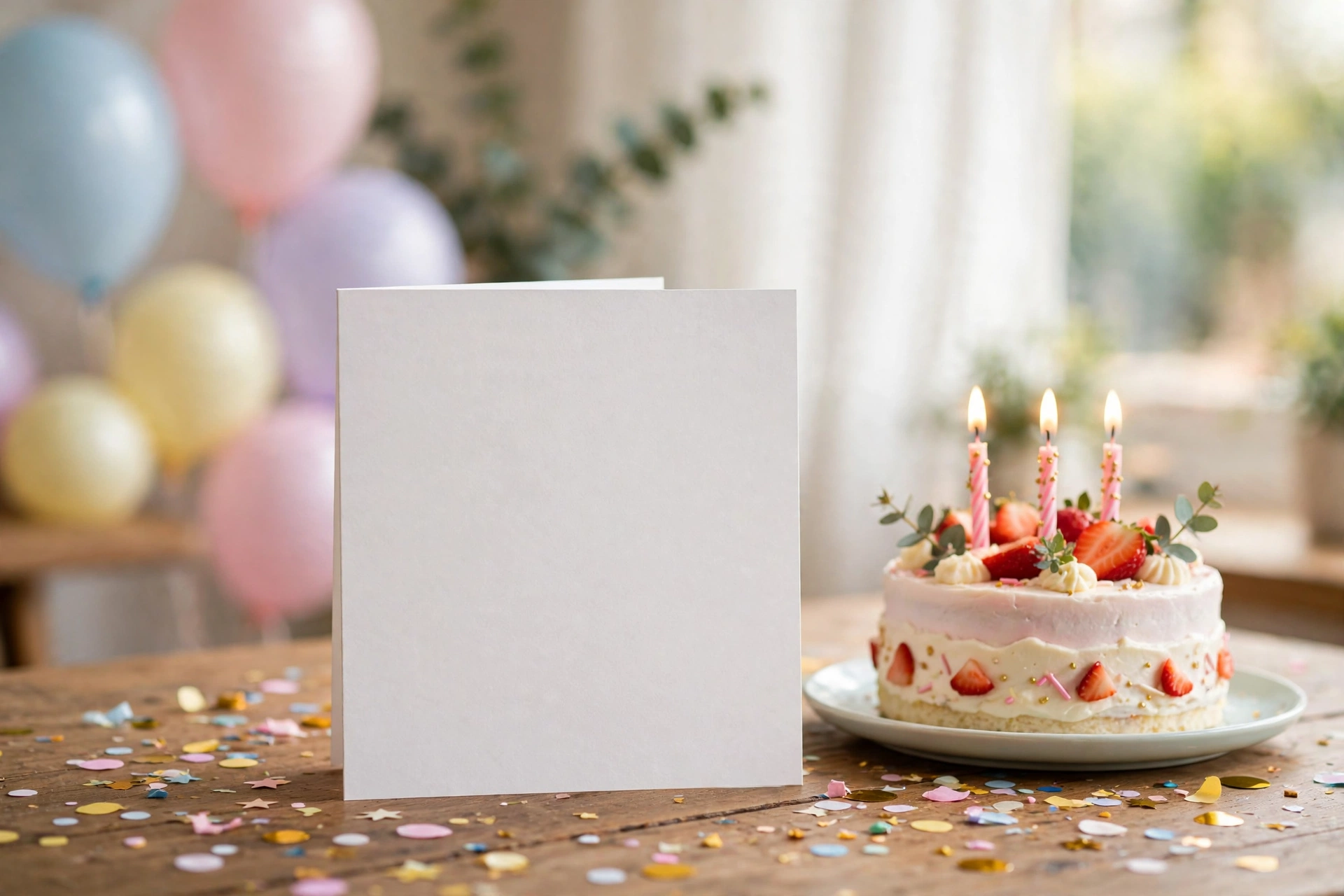
Once the words are ready, you have two easy routes. Make a personalised card with their name on it in the card maker — useful when the card is the gift, or when you are posting it and want it to look considered. Or print a card from the printable bundles all-occasion set, which also gives you matching gift tags, so the card and the tag on the parcel say the same thing in the same style. If the birthday is a children's party, the free printable birthday games guide covers the games side of the same day, so the card is not the only thing you have planned.
What to do next
The hardest birthday card most people write is the one for their grandmother, because "thank you for everything" feels too small and a joke feels wrong. That relationship has its own guide, with wording for kids, adults and far-away family. Your next page is What to Write in a Birthday Card for Grandma.
Messages for people you barely know
Some birthday cards are the hardest precisely because you do not know the person well: a new neighbour, a distant relative you see once a year, a friend of a friend who invited you to the party, a new colleague whose birthday the office is celebrating. The method still works, but the detail has to come from what you do know, not from a shared history you do not have. "Happy birthday. You make a very good first impression, and the new street is lucky to have you." That is warm, specific, and does not pretend to a closeness that is not there yet.
For a distant relative, use the family connection as the detail. "Happy birthday, Uncle John. It is always good to see you at Christmas, and I hope this year brings you plenty of time with the grandchildren." For a new colleague, use the work you have actually shared. "Happy birthday. It has been good working with you on the project, and I hope the year ahead is a kind one." For a friend of a friend, a simple honest line is enough: "Happy birthday. I am glad we met, and I hope today is a good one."
The mistake to avoid is borrowing a line that sounds close when you are not. "You mean the world to me" to someone you met twice reads as strange, not kind. Short, warm and honest is the right register for a person you barely know.
Writing a birthday card when the year has been hard
A birthday in a hard year is a different kind of card. The person may be ill, grieving, out of work, or simply worn down, and the usual cheerful lines feel wrong. "Hope this is your best year yet" can land badly when someone is just trying to get through the week. The kindest thing you can write is something honest that does not demand happiness from them.
Start by naming what is true, gently. "I know this year has asked a lot of you." Then say what you actually feel, without fixing anything. "I am thinking of you, and I am glad you are here." Then close with a wish that is small enough to be real. "I hope the year ahead is gentler than this one."
A few lines you can adapt: "Happy birthday. No big words today, just this: I am here, and I am thinking of you." Or: "Another year of you, and the world is better for it, even in a hard year." Or, for someone grieving: "I know birthdays feel different now. I am thinking of you today." Do not apologise for the sadness, and do not try to cheer them out of it in a card.
Helping children write birthday cards
Children often want to write the card themselves, and the best thing an adult can do is help them find their own words rather than dictating a perfect message. Start by asking the child one question: what do you like best about this person? The answer is usually immediate and completely their own. "Grandma makes the best chips." "Uncle Sam lets me drive the tractor." That answer is the detail, and it is already a better card than anything an adult would write for them.
Then ask what they wish for the person. Children answer this plainly too: "I hope you get lots of cake." "I hope your leg gets better soon." Put the two sentences together, add a "Happy birthday" at the start, and the card is done. Let the child write it in their own handwriting, spelling mistakes and all, and let them draw a picture on the front or inside.
If the child is very young, let them dictate the message while you write it down, then let them sign their name and add a drawing. If they are older and stuck, give them the three-part method in their own language: one true thing, one kind feeling, one wish. Do not correct the card once it is written. A crossed-out word in a child's card is charming.
Signing off: closings that fit the relationship
The sign-off is the last thing the reader sees, and it sets the tone of everything above it, so it is worth choosing on purpose rather than writing "Love" on every card out of habit. For a partner, a parent or a close friend, "With all my love" or simply "Love, always" fits, because the closeness is real. For a sibling, something lighter often fits better: "Love, your favourite brother (do not argue)". For a best friend, "Love you loads" or "Here is to us" sounds like you, which is the point.
For a colleague or a neighbour, "Best wishes" or "Warmest wishes" is the right level: friendly, respectful, and not pretending to more than the relationship holds. "Kind regards" is too formal for a birthday card unless the card is going to a client or a senior manager you barely know. For a child, the sign-off can be playful: "Lots of love and a hundred hugs". For a grandparent, "With love, always" carries the weight it needs without sounding stiff.
One rule covers all of them: match the sign-off to the message above it. A heartfelt message signed "Best wishes" feels like it lost its nerve at the end, and a light, funny message signed "With all my love, forever and always" feels like it is trying too hard.
When the card comes with a gift or money
A card that comes with a gift or money needs one extra sentence, and it is easy to get it wrong. The sentence should connect the gift to the person, not to the amount. Never write the amount in the card, and never write "hope it is enough" or "sorry it is not more", because that turns a generous gift into an apology.
For money, name the purpose, not the sum. "A little towards the holiday you have been planning." "For the new bike fund." "Spend it on something silly, not something sensible." For a gift, name why you chose it. "I saw this and thought of you straight away."
If the gift is from a group, say so plainly, and sign it from everyone. "From all of us, with love." If the money is for a child, write the message to the child, even if the parents will hold the money for now: "Happy 10th birthday. This is for whatever you have been saving up for."
Try it on MerryHub
- Card maker
- Printable bundles
- What to Write in a Birthday Card for Grandma
- Free Printable Birthday Games for Kids
- Printable Daily Planner Template