Quick answer: A science word search is a printable grid of letters with science words hidden across, down, or diagonally, plus an answer key so you can check your work. This page gives you word lists for six science topics and three puzzles you can print and solve, with answers, levels by age, and a plan for class or home.
Science Word Search: Free Printable Puzzles by Topic, With Answer Keys
A science word search is a printable grid of letters with science words hidden across, down, or diagonally, plus an answer key so you can check your work. This page gives you word lists for six science topics and three puzzles you can print and solve, with answers, levels by age, and a plan for class or home.
In plain words, a science word search is a letter grid where real science terms — planet, heart, atom — are hidden for you to find, and finding them is how the vocabulary sticks. A pupil who has never seen the word ORBIT before will read it five or six times while hunting for it.
This page is built for the two people who print these puzzles most: teachers and homeschool parents. The word lists are grouped by topic so you can pick the one your class is studying this week. The three puzzles below are worked examples with real grids and answer keys. If you want the full word-search packs, our printables page carries them alongside the kids activity packs.
MerryHub is a printable-games and planner shop by ReplyPilot. Every puzzle here was made to be printed, solved with a pencil, and checked with an answer key — not stared at on a screen.
What makes a good science word search?
A good science word search starts with the words, not the grid. The words have to be the ones the pupil actually needs. A space puzzle for a class studying the solar system should hide PLANET, ORBIT, and ROCKET — the words from this week's lessons.
The second thing is the grid. A good grid hides words in more than one direction. If every word runs across, left to right, the puzzle is over in two minutes. Across and down is the starting point, and diagonals add a real challenge. Save backwards words for the older pupils who finish everything early.
The third thing is the answer key, and it is the thing most free puzzles online get wrong. Some have no key at all. Every puzzle on this page has a key that names each word, its direction, and its exact starting row and column. You can check an answer in seconds.
The fourth thing is honesty about difficulty. A puzzle that says it is easy should be easy. A puzzle that says it is hard should be hard. The levels below are honest about this. This page uses US spellings throughout, so change any word your school spells differently before you print. Younger pupils also benefit from a quick run through sight words worksheets first.
Which science words go in each topic?
Here are the word lists, grouped by topic. Each list holds twelve words, ordered from easiest to hardest. Use the whole list for a class puzzle, or pick eight or ten for a shorter one.
Space words — the solar system:
PLANET
ORBIT
ROCKET
COMET
STAR
MOON
GALAXY
NEBULA
SOLAR
MARS
METEOR
ASTRONAUT
Human body words — how the body works:
HEART
BRAIN
BONES
MUSCLE
LUNGS
NERVE
BLOOD
SPINE
SKULL
SKIN
STOMACH
SKELETON
Chemistry words — atoms and the periodic table:
ATOM
PROTON
NEUTRON
ELECTRON
OXYGEN
CARBON
HYDROGEN
HELIUM
ION
ACID
MOLECULE
ELEMENT
Earth science words — rocks and weather:
ROCK
SOIL
RIVER
OCEAN
CLOUD
RAIN
QUAKE
VOLCANO
GLACIER
MINERAL
FOSSIL
WEATHER
Plant words — how plants grow:
SEED
ROOT
STEM
LEAF
FLOWER
PETAL
POLLEN
GROWTH
GARDEN
FOREST
SPROUT
PHOTOSYNTHESIS
Animal words — habitats and food chains:
MAMMAL
BIRD
FISH
REPTILE
INSECT
HABITAT
PREDATOR
PREY
SPECIES
MIGRATION
NOCTURNAL
ECOSYSTEM
A quick note on the long words. PHOTOSYNTHESIS is sixteen letters long, so it belongs in a bigger puzzle or as a bonus word for the fastest pupil. Do not shrink the letters to force it in. Ten words that fit well beat twelve words that do not.
Can you solve the space word search?
Here is the first worked puzzle. Ten space words are hidden in a twelve-by-twelve grid, running across and down. The words to find are:
PLANET
ORBIT
ROCKET
COMET
STAR
MOON
GALAXY
NEBULA
SOLAR
MARS
Row 1: P L A N E T U R D A X I
Row 2: O H H E X D V O X R C S
Row 3: R N B A C G H C Q T N A
Row 4: B R G W U W R K N H E O
Row 5: I S C O M E T E I Z B A
Row 6: T Y Z F W N K T I E U G
Row 7: S T A R Y K D M C M L D
Row 8: L L T I Z B X O O R A D
Row 9: G A L A X Y M O C R J U
Row 10: T L S G W C B N V H Y J
Row 11: C H D M I O S O L A R U
Row 12: M A R S L F L L G V I W
How was this grid made? It was laid out by hand for this article: each word was placed first, then the empty squares were filled with random letters, and every word was checked letter by letter against the finished grid. That check was done on 10 November 2026.
The space words here are worth a moment of real science. Our solar system has 8 planets and 5 officially recognized dwarf planets, according to NASA. That page was updated on 28 October 2026, and we checked it live on 10 November 2026.
Answer key — space word search:
PLANET — across, row 1, column 1
ORBIT — down, row 2, column 1
ROCKET — down, row 1, column 8
COMET — across, row 5, column 3
STAR — across, row 7, column 1
MOON — down, row 7, column 8
GALAXY — across, row 9, column 1
NEBULA — down, row 3, column 11
SOLAR — across, row 11, column 7
MARS — across, row 12, column 1
If you found eight out of ten, that is a solid result. If you found all ten in under five minutes, you are ready for the hard level below.
Can you solve the human body word search?
The second puzzle is about the human body. Same size, same rules: ten words, across and down, in a twelve-by-twelve grid. The words to find are:
HEART
BRAIN
BONES
MUSCLE
LUNGS
NERVE
BLOOD
SPINE
SKULL
SKIN
Row 1: H E A R T V U B C T U F
Row 2: B R X H F O M O I U W R
Row 3: R H V K Y Y B N H B Z S
Row 4: A M U S C L E E K M I K
Row 5: I C G S W K G S U P M U
Row 6: N U O E I E H X R R I L
Row 7: X S N S M L H E Q P N L
Row 8: L U N G S C Y B D E E U
Row 9: B L O O D F Z V N T R C
Row 10: M M T O Q I R A V X V D
Row 11: V R Y I Y U S P I N E K
Row 12: S K I N D J N F O A X X
This puzzle works well after a lesson on the body, because the words are the ones pupils have just heard. HEART and BRAIN are the words every pupil knows. NERVE is the word most pupils have heard but never spelled.
One practical tip: say each word out loud before the hunt starts. Hearing the word and then seeing it in the grid uses two kinds of memory at once. This grid was checked the same way, word by word, on 10 November 2026.
Answer key — human body word search:
HEART — across, row 1, column 1
BRAIN — down, row 2, column 1
BONES — down, row 1, column 8
MUSCLE — across, row 4, column 2
LUNGS — across, row 8, column 1
NERVE — down, row 7, column 11
BLOOD — across, row 9, column 1
SPINE — across, row 11, column 7
SKULL — down, row 3, column 12
SKIN — across, row 12, column 1
Do not hand out the answer key with the puzzle. Print the key once, keep it yourself, and read the answers out at the end. Pupils who finish early can help a neighbor by pointing.
Can you solve the chemistry word search?
The third puzzle is chemistry, and it is the hardest of the three. The words are longer: HYDROGEN and ELECTRON are eight letters. The words to find are:
ATOM
PROTON
NEUTRON
ELECTRON
OXYGEN
CARBON
HYDROGEN
HELIUM
ION
ACID
Row 1: A T O M I Q N Y F Q D U
Row 2: P J U Q T G E E L Y F R
Row 3: R Y Q A T K U P A D L A
Row 4: O Z J H B H T S C C X C
Row 5: T E L E C T R O N P C I
Row 6: O X Y G E N O Y R Y E D
Row 7: N E V P R F N I Q T N C
Row 8: G R Y X W G W J M V U A
Row 9: H Y D R O G E N L O Q R
Row 10: O D H H C K A S R H S B
Row 11: H A C W U H E L I U M O
Row 12: I O N B H C B K C Q H N
Chemistry has a fact worth knowing before you start hunting. The periodic table runs to element 118, and the names for elements 113, 115, 117 and 118 were approved on 28 November 2016, as IUPAC records. That page's latest release is dated 4 May 2022, and we checked it live on 10 November 2026.
This grid was built and checked the same way as the other two: placed by hand and verified word by word on 10 November 2026.
Answer key — chemistry word search:
ATOM — across, row 1, column 1
PROTON — down, row 2, column 1
NEUTRON — down, row 1, column 7
ELECTRON — across, row 5, column 2
OXYGEN — across, row 6, column 1
CARBON — down, row 7, column 12
HYDROGEN — across, row 9, column 1
HELIUM — across, row 11, column 6
ION — across, row 12, column 1
ACID — down, row 3, column 12
ION and ACID are the shortest words in this puzzle, and they are the ones that hide best. A three-letter word can sit anywhere, and the eye slides right past it. If your pupils finish fast, ask them to write one sentence using each word they found.
Which level fits which age?
Not every pupil should get the same puzzle. A word search that is too easy bores a twelve-year-old. One that is too hard makes an eight-year-old give up. Pick by age, but watch the room: a two-minute finish means move up a level, and five minutes without a word means move down.
Gentle level: ages 7 to 8, or any pupil new to word searches. Words of four to six letters only, running across and down, never backwards or diagonally. Ten words in a twelve-by-twelve grid, with big letters. A gentle puzzle takes about ten minutes. For a true gentle puzzle, use only the shortest words: STAR, MOON, ROCK, SEED, LEAF, FISH, BIRD, SKIN, ION, ACID. Younger pupils often do well with a short session on name tracing worksheets first.
Middle level: ages 9 to 11, or pupils who have done word searches before. Words up to eight letters, running across, down, and diagonally, with one word running backwards. A middle puzzle takes about fifteen minutes. The human body puzzle above sits at this level: BONES and BLOOD are easy finds, NERVE and MUSCLE take longer, and SKULL is the one most pupils miss.
Hard level: ages 12 and up, or any pupil who finishes the middle level fast. Words up to ten letters or more, running in every direction. A hard puzzle takes twenty minutes or more. The chemistry puzzle above is close to hard: ELECTRON and HYDROGEN are long, and ION hides in plain sight. If the hard level still feels easy, our word searches that are hard page carries tougher puzzles — the right next step when these three start feeling too simple.
How do you run a science word search in class?
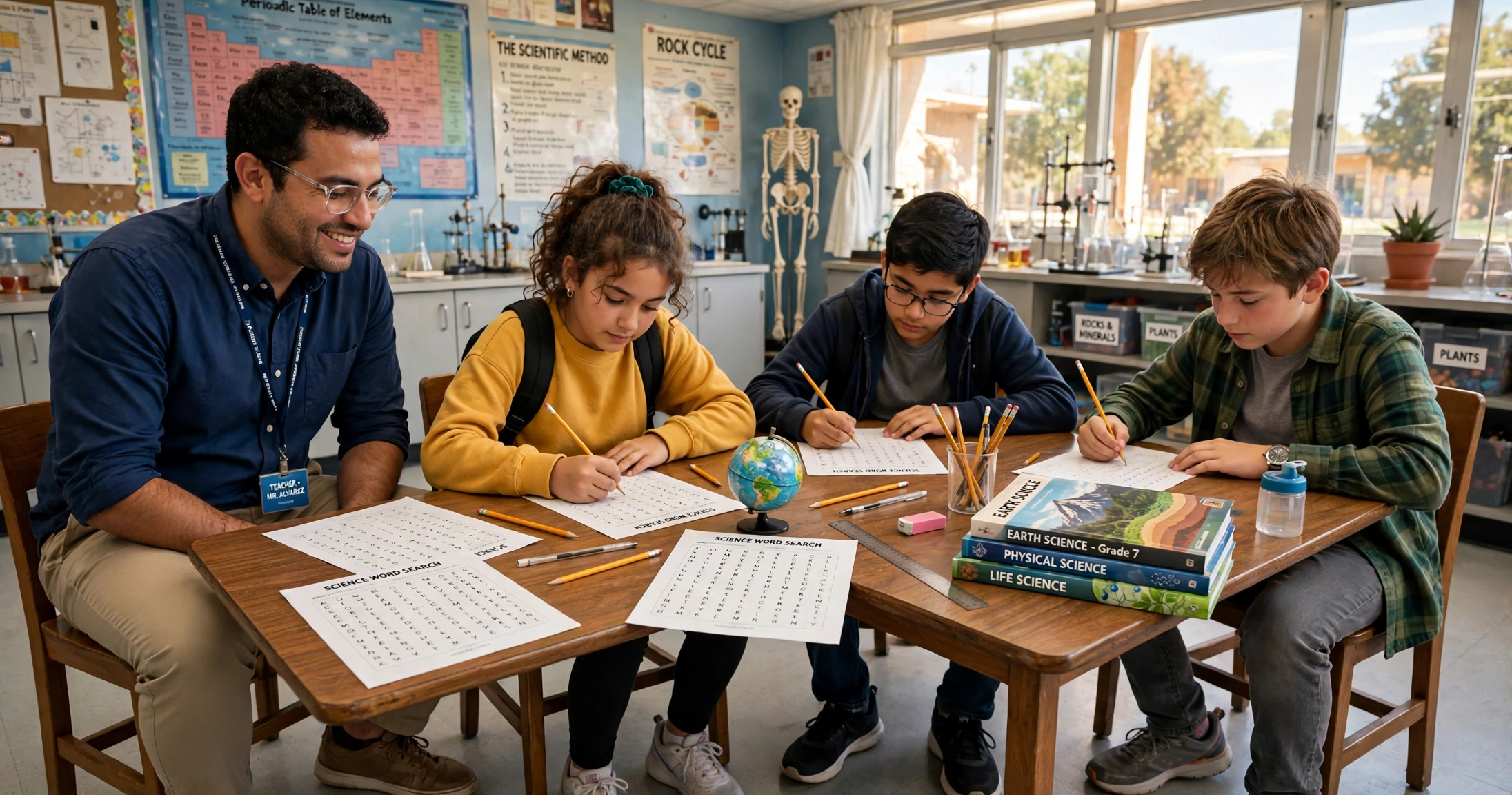
A word search in class works best as part of a lesson, not instead of one. This plan runs about thirty minutes.
First five minutes: teach the words. Write the ten words on the board. Say each one out loud. Give a one-sentence meaning for each. "An orbit is the path a planet takes around the Sun." A word search without the teaching first is just a spelling hunt. With the teaching first, it is revision.
Next fifteen minutes: the hunt. Hand out the puzzle, one copy per pupil, and a pencil each. No talking for the first five minutes, so everyone gets a fair start. After that, let pupils whisper to a neighbor if they are stuck. Walk around while they work. You will see quickly which words are easy and which ones nobody has found.
Next five minutes: check the answers. Read the answer key out loud, one word at a time, with the direction and the position. Ask pupils to mark their own sheets. When a word is read out, ask one pupil to give its meaning.
Last five minutes: use the words. Ask each pupil to pick two words they found and write one sentence with each. This is the step that proves the vocabulary landed. A pupil who can write "The Moon orbits the Earth" has learned something.
If you have a mixed class, hand out different levels at the same time. The younger pupils get the gentle version, the older ones get the hard one. For a seasonal change of pace, the same plan works with a Christmas word search printable in December, or with Thanksgiving word puzzles in November.
If your class is learning a language too, our Spanish word search printable has three puzzles by theme, with answers.
How do you use it at home for homeschool?
Homeschool is different from a classroom. There is no class to manage and no board to write on. There is one child, or two, or three, and a kitchen table. The puzzle can be slower, more talkative, and more personal. The plan below runs about twenty minutes.
First five minutes: pick the topic together. Let the child choose the topic. Space or animals? Chemistry or plants? A child who picks the topic will try harder at the puzzle. Read the words together, and ask the child what each word means before you tell them.
Next ten minutes: solve it together. Sit with the child and solve the puzzle as a team. You find one word, they find the next. Talk while you hunt. "A galaxy is a huge group of stars."
Last five minutes: make it stick. Ask the child to teach you one word. "Tell me what a proton is, as if I have never heard of it." Teaching is the best test of learning there is. If the child can explain it in their own words, the word is theirs.
A routine that works well is one puzzle a week, always on the same day, always on the topic the child is studying. For younger children, a short game of Wordle for kids makes a good warm-up before the science words arrive.
How should you print the puzzles?
A puzzle that prints badly does not get played. The fixes are small, and they are worth doing once.
Print at actual size, not "fit to page." Fit-to-page shrinks the grid, and small letters are hard to circle without covering the neighbors. If the letters look smaller than a thumbnail, the puzzle is too small.
Use plain white paper. Colored paper looks fun, but it makes the grid harder to read and it uses up your color ink.
Set the printer to black and white, or grayscale. Color ink costs more without adding anything to a word search. Do not use draft mode: it makes the letters faint, and faint letters disappear when a pupil presses hard with a pencil.
Print one copy per pupil, plus one spare. A spare copy is for the pupil who folds theirs or spills juice on it. Print the answer key once, on its own, and keep it face down until the last five minutes. For reuse, slip the page into a clear plastic sleeve and hand out dry-erase markers.
What mistakes spoil a science word search?
Most science word searches fail in the same few ways, and all of them are easy to avoid.
The first mistake is words nobody has been taught. A puzzle full of unseen words is a guessing game, not a learning activity. Teach the words first, then hand out the puzzle.
The second mistake is no answer key. Without answers, a lesson ends in an argument about whether NEUTRON has seven letters or eight. Print the key, keep it face down, and read it out at the end.
The third mistake is tiny print. If the letters are smaller than a thumbnail, the puzzle is too small. Print at actual size, and use your printer's enlarge setting once if the grid still looks cramped.
The fourth mistake is too many words in too small a grid. Twelve words in a ten-by-ten grid means the words overlap so much that finding one word gives away three others. Ten words in a twelve-by-twelve grid is the balance this page uses.
The fifth mistake is using the puzzle as busywork. A word search handed out with no teaching, no checking, and no follow-up is just a way to fill time, and pupils know it.
The sixth mistake is forgetting the fun. A puzzle should feel like a game, not like homework. Let pupils race or work in pairs. A classroom that laughs while it hunts will remember the words better than one that works in silence. For a different kind of word game, our Christmas puzzle games printable page carries crosswords, mazes, and sudoku alongside word searches.
Where should you go next?
You have three full puzzles now — space, human body, and chemistry — each with a real grid and a verified answer key, plus word lists for six topics, levels by age, a classroom plan, and a homeschool plan. The next step is the harder collection: our Hard Word Search Puzzles Printable page carries medium, hard, and expert levels with longer words, tighter grids, and answer keys. It is the right page when these three puzzles start feeling too easy.