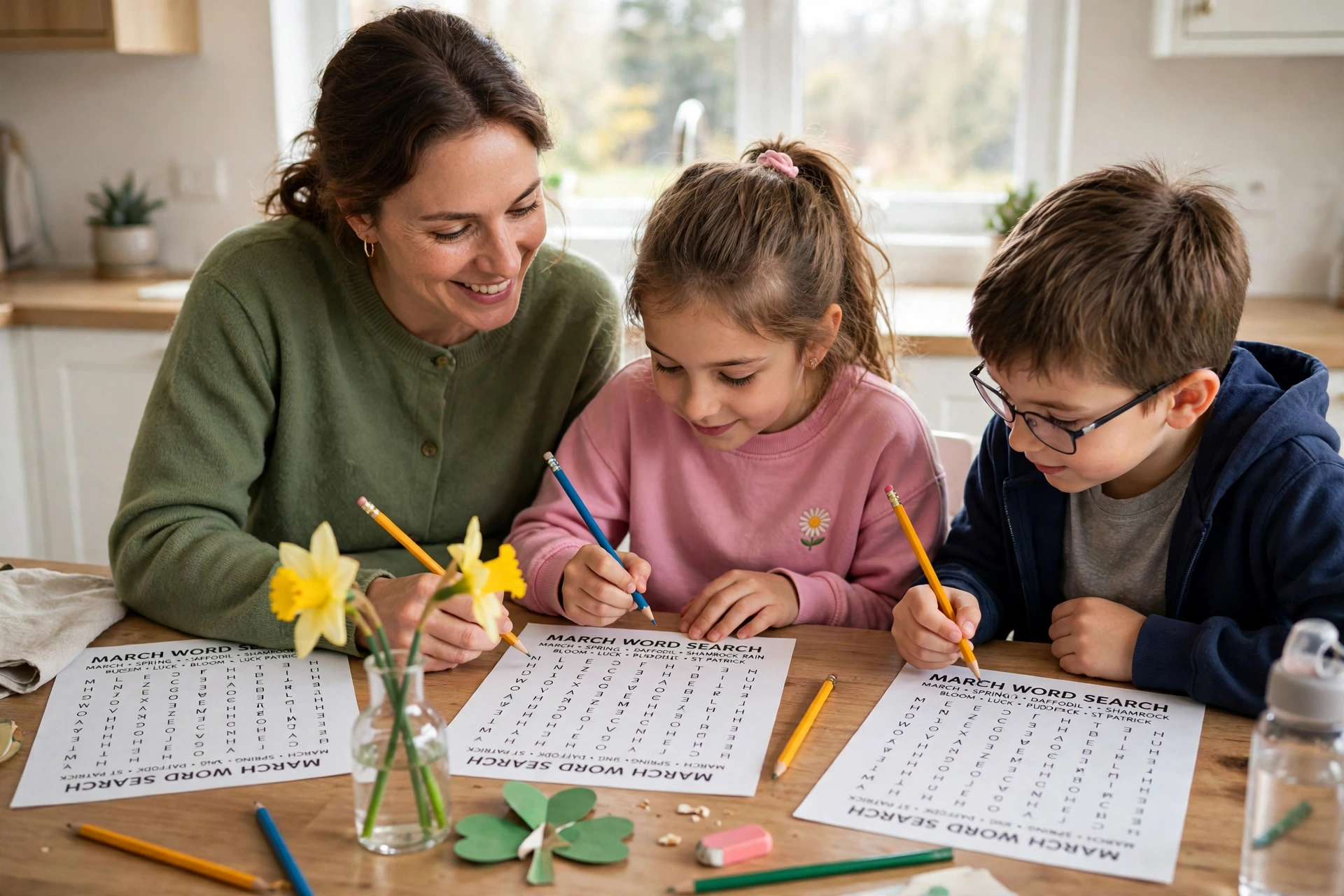
Quick answer: A march word search printable is a free 12-by-12 letter grid with March words hidden across and down, plus an answer key. This page gives you three ready puzzles — St Patrick's Day, spring, and March sports — with word lists, levels by age, a classroom plan, and printing tips, so you can print and play today.
March Word Search Printable: Free Puzzles for St Patrick's Day, Spring and Sports
A march word search printable is a free 12-by-12 letter grid with March words hidden across and down, plus an answer key. This page gives you three ready puzzles — St Patrick's Day, spring, and March sports — with word lists, levels by age, a classroom plan, and printing tips, so you can print and play today.
A march word search is a printed letter grid where real March words — shamrock, rainbow, tulip — are hidden for you to find, and finding them is how the spelling sticks. A child who has never spelled LEPRECHAUN before will read it five or six times while hunting for it.
This page is built for the two people who print these puzzles most: teachers and homeschool parents. March is a busy month for both. St Patrick's Day lands in the middle of it, spring starts near the end, and the college basketball tournament fills the weekends in between. The three puzzles below are worked examples with real grids and answer keys. If you want the full word-search packs, our printables page carries them alongside the kids activity packs.
MerryHub is a printable-games and planner shop by ReplyPilot. Every puzzle here was made to be printed, solved with a pencil, and checked with an answer key — not stared at on a screen.
What makes a good March word search?
A good March word search starts with the words, not the grid. The words have to be the ones the child actually needs. A St Patrick's Day puzzle for a class learning about Ireland should hide SHAMROCK, IRELAND, and CLOVER — the words from this week's lessons.
The second thing is the grid. A good grid hides words in more than one direction. If every word runs across, left to right, the puzzle is over in two minutes. Across and down is the starting point for younger solvers. Older children can handle a few words that cross each other, because a crossing word gives a clue: find one word and you have the first letter of another.
The third thing is the answer key. Most free puzzles online get this wrong: some have no key at all. Every puzzle here has a key naming each word, its direction, and its exact starting row and column, so you can check an answer in seconds.
The fourth thing is honesty about difficulty. A puzzle that says it is easy should be easy. A puzzle that says it is hard should be hard. The levels below are honest about this. This page uses US spellings throughout, so change any word your school spells differently before you print. Younger children also benefit from a quick run through sight words worksheets first, because the reading habit carries straight into the hunt.
Which March words go in each theme?
Here are the word lists, grouped by theme. Each list holds twelve words, ordered from easiest to hardest. Use the whole list for a class puzzle, or pick eight or ten for a shorter one.
St Patrick's Day words — Ireland, green, and luck:
SHAMROCK
LEPRECHAUN
RAINBOW
IRELAND
CLOVER
LUCKY
GREEN
GOLD
SAINT
PATRICK
PARADE
JIG
Spring words — the season turning:
BLOSSOM
FLOWER
GARDEN
RAIN
BUTTERFLY
TULIP
DAFFODIL
SPROUT
SEASON
SUNSHINE
BUD
NEST
March sports words — basketball season:
BASKETBALL
BRACKET
TOURNAMENT
HOOPS
COACH
PLAYER
SCORE
FINALS
DUNK
MADNESS
TEAM
FANS
March weather words — the month that cannot decide:
WIND
CLOUD
STORM
PUDDLE
BREEZE
THUNDER
RAINCOAT
UMBRELLA
MUDDY
CHILLY
SUNNY
SHOWER
Reading month words — March is reading month in many US schools:
READ
BOOK
STORY
AUTHOR
LIBRARY
CHAPTER
POEM
PAGES
SHELF
NOVEL
READER
FAIRYTALE
A quick note on the long words. LEPRECHAUN is ten letters long and FAIRYTALE is nine, so they belong in a twelve-by-twelve grid or bigger, never in a small one. Do not shrink the letters to force a long word in. Short words hide better anyway. GOLD is four letters, and in a full grid it is one of the last words most solvers find.
Can you solve the St Patrick's Day word search?
Here is the first worked puzzle. Ten St Patrick's Day words are hidden in a twelve-by-twelve grid, running across and down. The words to find are:
SHAMROCK
LEPRECHAUN
RAINBOW
IRELAND
CLOVER
LUCKY
GREEN
GOLD
SAINT
PATRICK
Row 1: O U X T U G R E E N F S
Row 2: T A Q P A T R I C K C A
Row 3: B B S H A M R O C K G I
Row 4: G H T A C L O V E R O N
Row 5: Y O K O S G Q H U J L T
Row 6: P A V C O U I N R C D W
Row 7: I K Y H Q J A C S Y L D
Row 8: M D L E P R E C H A U N
Row 9: J M I R E L A N D C C A
Row 10: V A G G B P M W M N K C
Row 11: S U G Y V I K C J K Y A
Row 12: N Y D R A I N B O W E H
How was this grid made? It was placed programmatically for this article: each word was set into the grid across or down, the empty squares were filled with random letters, and every word was then checked by an independent script scan of the finished grid. That check ran on 11 November 2026 and found all ten words at their claimed spots.
There is a real date behind this puzzle. St Patrick's Day is held every year on 17 March, the feast day of St Patrick, patron saint of Ireland, according to Encyclopaedia Britannica. That page was published on 25 October 2002 and updated on 22 October 2026, and we checked it live on 11 November 2026. So the puzzle lands best in the week of 17 March, when the date is on everyone's mind.
Answer key — St Patrick's Day word search:
SHAMROCK — across, row 3, column 3
LEPRECHAUN — across, row 8, column 3
RAINBOW — across, row 12, column 4
IRELAND — across, row 9, column 3
CLOVER — across, row 4, column 5
LUCKY — down, row 7, column 11
GREEN — across, row 1, column 6
GOLD — down, row 3, column 11
SAINT — down, row 1, column 12
PATRICK — across, row 2, column 4
Can you solve the spring word search?
The second puzzle is about spring. Same size, same rules: ten words, across and down, in a twelve-by-twelve grid. The words to find are:
BLOSSOM
FLOWER
GARDEN
RAIN
BUTTERFLY
TULIP
DAFFODIL
SPROUT
SEASON
SUNSHINE
Row 1: C H I S U N S H I N E B
Row 2: K T F R V X N W B S B A
Row 3: S I J N G F D S Q X L Y
Row 4: S B W K T K I F M J O Y
Row 5: U B U T T E R F L Y S S
Row 6: G A R D E N Q E I I S P
Row 7: V W R F L O W E R F O R
Row 8: N D A F F O D I L B M O
Row 9: K R I B T U L I P N I U
Row 10: Q J N Q N M V F J S L T
Row 11: M S A J S T R R Q N Y V
Row 12: Q N C C O L S E A S O N
This grid was built and checked the same way as the first one: placed by program, then verified word by word with a script scan on 11 November 2026. All ten words were found at their claimed spots.
Spring has a real start date, and it is worth knowing before you hand this puzzle out. The March equinox, the first day of spring, falls on 20 March 2026 at 10:46 am EDT, according to timeanddate. We checked that seasons table live on 11 November 2026. That makes the week of 20 March the natural home for this puzzle.
Answer key — spring word search:
BLOSSOM — down, row 2, column 11
FLOWER — across, row 7, column 4
GARDEN — across, row 6, column 1
RAIN — down, row 7, column 3
BUTTERFLY — across, row 5, column 2
TULIP — across, row 9, column 5
DAFFODIL — across, row 8, column 2
SPROUT — down, row 5, column 12
SEASON — across, row 12, column 7
SUNSHINE — across, row 1, column 4
Do not hand out the answer key with the puzzle. Print the key once, keep it yourself, and read the answers out at the end. Children who finish early can help a neighbor by pointing, which is a kinder kind of help than just giving the word away.
Can you solve the March sports word search?
The third puzzle is March sports, and it is the liveliest of the three. The words are the ones children hear on television all month: bracket, finals, madness. The words to find are:
BASKETBALL
BRACKET
TOURNAMENT
HOOPS
COACH
PLAYER
SCORE
FINALS
DUNK
MADNESS
Row 1: U T Q K V Q P O J V U C
Row 2: J N J Q P B X H C F T X
Row 3: V N I K R Y V O O I T H
Row 4: D B K J G C X O A N O L
Row 5: D U D U N K K P C A U Y
Row 6: H Q I K A L Q S H L R M
Row 7: B R A C K E T V J S N A
Row 8: B A S K E T B A L L A D
Row 9: P L A Y E R R M M F M N
Row 10: V D B L U X V R D C E E
Row 11: E C D S C O R E Z K N S
Row 12: A B N I L G G V U M T S
This grid was built and checked the same way as the other two: placed by program and verified word by word with a script scan on 11 November 2026. All ten words were found at their claimed spots.
Answer key — March sports word search:
BASKETBALL — across, row 8, column 1
BRACKET — across, row 7, column 1
TOURNAMENT — down, row 3, column 11
HOOPS — down, row 2, column 8
COACH — down, row 2, column 9
PLAYER — across, row 9, column 1
SCORE — across, row 11, column 4
FINALS — down, row 2, column 10
DUNK — across, row 5, column 3
MADNESS — down, row 6, column 12
Which level fits which age?
Not every child should get the same puzzle. A word search that is too easy bores a twelve-year-old. One that is too hard makes an eight-year-old give up. Pick by age, but watch the room: a two-minute finish means move up a level, and five minutes without a word means move down.
Gentle level, ages 7 to 8, or any child new to word searches: words of four to six letters only, running across and down, never backwards or diagonally. Ten words in a twelve-by-twelve grid, with big letters. A gentle puzzle takes about ten minutes. Use only the shortest words: GOLD, LUCKY, GREEN, RAIN, TULIP, BUD, NEST, TEAM, FANS, DUNK. Younger children often do well with a short session on name tracing worksheets first, because the pencil control carries straight into circling letters.
Middle level, ages 9 to 11, or children who have done word searches before: words up to eight letters, running across and down, with one or two words crossing. A middle puzzle takes about fifteen minutes. The St Patrick's Day puzzle above sits at this level: GREEN and GOLD are easy finds, and SAINT is the one most children miss.
Hard level, ages 12 and up, or any child who finishes the middle level fast: words up to ten letters, running in every direction, with several crossings. A hard puzzle takes twenty minutes or more. The March sports puzzle above is close to hard: BASKETBALL and TOURNAMENT are long, and MADNESS hides down the far edge. If the hard level still feels easy, here is the question that decides your next step: what does a puzzle look like when the words are longer, the grid is tighter, and nothing runs in an easy direction? Our word searches that are hard page answers it, with tougher puzzles for exactly that child.
A quick comparison, so you can pick at a glance:
Gentle level — ages 7 to 8 — words 4 to 6 letters — directions across and down — about 10 minutes
Middle level — ages 9 to 11 — words up to 8 letters — directions across and down, with crossings — about 15 minutes
Hard level — ages 12 and up — words up to 10 letters — directions across, down, and diagonal in the harder packs — about 20 minutes or more
How do you run a March word search in class?
A word search in class works best as part of a lesson, not instead of one. This plan runs about thirty minutes, and it fits a normal class period with room to spare.
First five minutes: teach the words. Write the ten words on the board. Say each one out loud. Give a one-sentence meaning for each. "A shamrock is a small green plant with three leaves, and it is a symbol of Ireland." A word search without the teaching first is just a spelling hunt. With the teaching first, it is revision.
Next fifteen minutes: the hunt. Hand out the puzzle, one copy per child, and a pencil each. No talking for the first five minutes, so everyone gets a fair start. After that, let children whisper to a neighbor if they are stuck. Walk around while they work. If half the class is stuck on the same word, give a clue: the row it starts on, or the first letter.
Next five minutes: check the answers. Read the answer key out loud, one word at a time, with the direction and the position. Ask children to mark their own sheets. When a word is read out, ask one child to give its meaning.
Last five minutes: use the words. Ask each child to pick two words they found and write one sentence with each. This is the step that proves the vocabulary landed. A child who can write "The leprechaun hid the gold at the end of the rainbow" has learned something, and has had fun doing it.
If you have a mixed class, hand out different levels at the same time, as the levels section explains. For a seasonal change of pace, the same plan works with a Christmas word search printable in December, or with a science word search when the class moves on to a science topic. For a different kind of word game to use as a warm-up, a short round of Wordle for kids works well before the March words arrive.
How does a March calendar plan work?
March is four weeks long, and each week has its own theme. A calendar plan keeps the puzzles fresh, because no theme repeats and no child gets bored of the same words.
Week one, 1 to 7 March: reading month. Use the reading month word list. This is the quiet week, the one for settling in. A short puzzle, eight words, works well here. Read a poem together first, then hand out the puzzle.
Week two, 8 to 14 March: March weather. Use the weather word list. Ask the class what the weather did this morning before you hand out the puzzle. Rain, wind, or sun, the words will match something they saw on the way to school.
Week three, 15 to 21 March: St Patrick's Day, then spring. This is the big week, and it carries two puzzles. Use the St Patrick's Day puzzle on 16 or 17 March, close to the day itself. Then use the spring puzzle on 20 or 21 March, when the equinox arrives.
Week four, 22 to 31 March: March sports. Use the sports puzzle. By now the tournament is in full swing, and the bracket talk is everywhere. Let children solve in pairs, and let them compare brackets after the hunt.
A homeschool version of the same plan is simpler: one puzzle a week, always on the same day, always on the theme of that week. A child who knows that Friday is puzzle day will ask for it.
How should you print the puzzles?
A puzzle that prints badly does not get played. The fixes are small, and they are worth doing once, before you print thirty copies.
Print at actual size, not "fit to page." Fit-to-page shrinks the grid, and small letters are hard to circle without covering the neighbors. If the letters look smaller than a thumbnail, the puzzle is too small.
Use plain white paper. Colored paper looks fun, but it makes the grid harder to read and it uses up your color ink. White paper, black letters, and a pencil are all a word search needs.
Set the printer to black and white, or grayscale. Color ink costs more without adding anything to a word search. Do not use draft mode: it makes the letters faint, and faint letters disappear when a child presses hard with a pencil.
Print one copy per child, plus one spare. A spare copy is for the child who folds theirs or spills juice on it. Print the answer key once, on its own, and keep it face down until the last five minutes. For reuse, slip the page into a clear plastic sleeve and hand out dry-erase markers. The sleeve trick works well at home too, where one printed puzzle can last all month.
What mistakes spoil a March word search?
Most March word searches fail in the same few ways, and all of them are easy to avoid once you know what to look for.
The first mistake is words nobody has been taught. A puzzle full of unseen words is a guessing game, not a learning activity. Teach the words first, then hand out the puzzle.
The second mistake is no answer key. Without answers, a lesson ends in an argument about whether LEPRECHAUN has ten letters or eleven. Print the key, keep it face down, and read it out at the end. The key on this page gives the direction and the starting row and column for every word, so there is nothing left to argue about.
The third mistake is tiny print. If the letters are smaller than a thumbnail, the puzzle is too small. Print at actual size, and use your printer's enlarge setting once if the grid still looks cramped.
The fourth mistake is too many words in too small a grid. Twelve words in a ten-by-ten grid means the words overlap so much that finding one word gives away three others. Ten words in a twelve-by-twelve grid is the balance this page uses.
The fifth mistake is using the puzzle as busywork. A word search handed out with no teaching, no checking, and no follow-up is just a way to fill time, and children know it. Teach first, hunt second, check third, use the words fourth.
The sixth mistake is forgetting the fun. A puzzle should feel like a game, not like homework. Let children race or work in pairs. A classroom that laughs while it hunts will remember the words better than one that works in silence. For a different kind of word game when the class needs a change, our Christmas puzzle games printable page carries crosswords, mazes, and sudoku alongside word searches, and our Thanksgiving word puzzles page works the same way in November.
Where should you go next?
You have three full puzzles now — St Patrick's Day, spring, and March sports — each with a real grid and a verified answer key, plus word lists for five March themes, levels by age, a classroom plan, a March calendar plan, and printing tips. The next step is the harder collection: our Hard Word Search Puzzles Printable page carries medium, hard, and expert levels with longer words, tighter grids, and answer keys. It is the right page when these three puzzles start feeling too easy, and the right place to send a child who finished the March sports puzzle in five minutes flat.